We use cookies to give you the best experience possible. By continuing to use the site, you indicate that you accept cookies. See our cookies policy here.
Better Equipped Technician Practical Essentials
A quick-reference, four-chart guide for technicians preparing a GCSE average-speed practical: what to issue, how to define the timed section, what to record and how to reset safely. For more detailed curriculum practical resources, visit our Curriculum Experiments resources.
Scope: a slow battery-powered buggy travelling along a straight, level course; a stopwatch measures the time between two fixed boundaries. This supports the distance/time and average-speed content of AQA GCSE Physics 8463, section 4.5.6.1.2, and Combined Science: Trilogy 8464, section 6.5.4.1.2. [1] [2]
P11 is a Better Equipped planning code, not “required practical 11”. The buggy method, run-in convention, station counts and repeat allocation are editorial choices requiring a local pilot. Light-gate methods are reserved for P12; acceleration down a ramp is a separate P13 topic. Walking courses and video timing are optional adaptations, not part of the base issue.
Measure A–B → time the same reference point → calculate and repeat
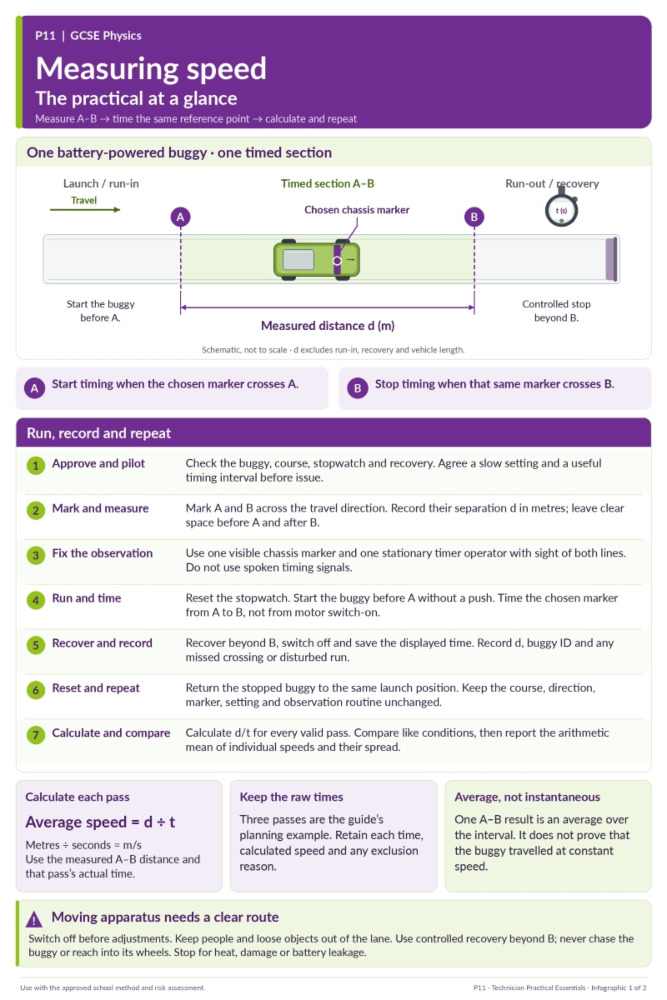
One reusable timing station · repeat passes need records, not extra vehicles
One recorded series is one buggy and one unchanged A–B condition, with all its selected repeat passes on one sheet. Series may represent group rotations or additional conditions; do not count each repeat twice. A series with one pass does not assess repeatability.
Stopwatch spares and paper spares round up separately across the class. Extra complete sets receive the same series/pass allocation. Changing passes changes the number of traversals and table rows needed, not the number of sheet sets. This preparation calculator does not calculate speed, select course length, predict lesson duration or budget batteries. Settings and ticks are not saved.
Planning issue: 10 working stations + 1 extra = 11 equipped sets. Provide 11 buggies and 11 complete course/recovery kits. Stopwatches: 11 working + 3 spare = 14. Two recorded series per set × 3 timed passes = 6 passes per set; 22 series and 66 class passes. Paper: 22 series sheets + 3 spare = 25 sheets. Reuse apparatus between passes; practice runs, battery replacements, course space and extra records are planned separately.
| Item / issue specification | Per equipped set | Class provision (11 sets) |
|---|---|---|
| 1 | 11 | |
| 1 provision | 11 provisions | |
| 1 course kit | 11 kits | |
| 1 | 11 | |
| 1 marking kit | 11 kits | |
| 1 + class spares | 14 (11 + 3 spare) |
|
| 1 complete kit | 11 kits | |
| 1 | 11 | |
| 2 records | 25 sheets (22 + 3 spare) |
Pencils, labels, cleaning materials, staff checks, battery replacements and locally assessed PPE. Additional observers need additional timers; a spare stopwatch is not an extra working station.
Count only courses that can operate safely at once. For shared stations, include every group’s recorded series and provide an accessible view and recording role. Quantity totals do not establish safe layout or staffing.
Define the boundaries · agree the crossing event · pilot the complete course
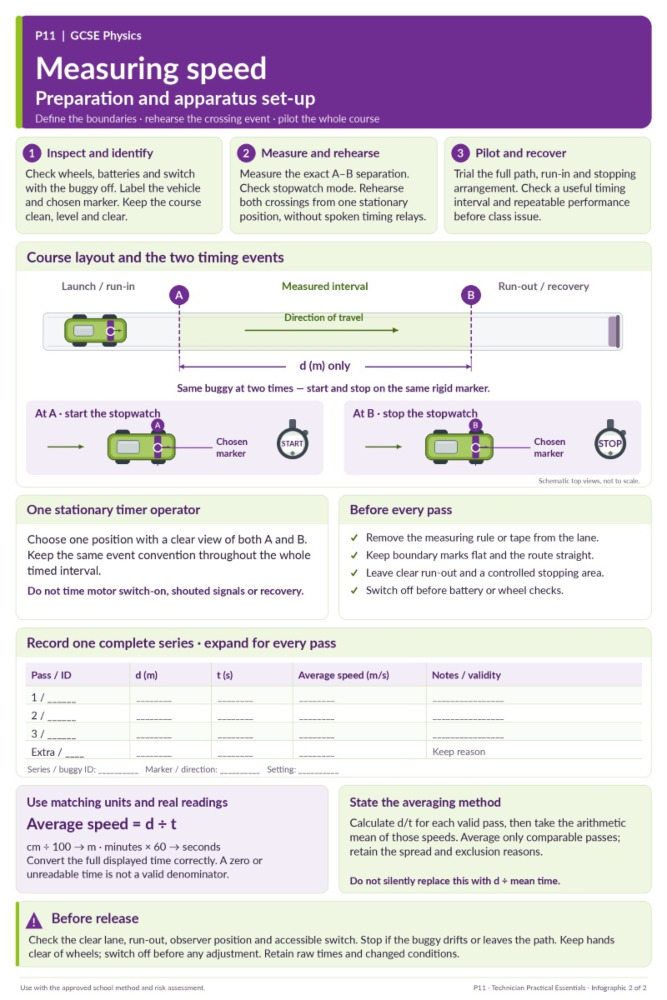
Check wheels, drive, battery compartment and switch with the buggy off. Label the vehicle and chosen marker. Keep the surface clean, level and free of loose tools or raised marks.
Mark the exact A/B line references; measure between them along travel. Check the stopwatch mode. Rehearse viewing both crossings from one stationary position, without spoken timing relays.
Trial the full path, run-in and stopping arrangement. Timing must be long enough for the method to be useful. Check repeated performance and whether a longer safe course or a different method is needed.
| Part | Required arrangement | Avoid |
|---|---|---|
| Course and boundaries | Level, straight and clear; precisely defined A/B references. | A course crossing a walkway, loose tape, or a turn within A–B. |
| Buggy reference | One rigid visible marker; unchanged for start and finish. | Front-at-A but rear-at-B, or switching reference points. |
| Timing and viewing | One timer operator sees both lines; same event convention. | Timing motor switch-on, a shouted signal or recovery. |
| Run-out and recovery | Enough space beyond B, controlled stop and accessible switch. | Reaching into wheels, bench-edge falls or stalled motors. |
| Pass / ID | d (m) | t (s) | vavg (m/s) | Notes / validity |
|---|---|---|---|---|
| 1 / ____ | ____ | ____ | ____ | ____ |
| 2 / ____ | ____ | ____ | ____ | ____ |
| 3 / ____ | ____ | ____ | ____ | ____ |
| Extra / ____ | ____ | ____ | ____ | Keep reason |
Series / buggy ID: ______ A–B distance: ______ m Marker / direction: ______
Record timer ID and display units, launch position, power setting and any changed conditions. Retain all raw readings. A zero or unreadable time is not a valid denominator.
Check the distance–time pair first · retain raw records · stop before resetting
| Problem | What to check | Technician action |
|---|---|---|
| Pass is too quick to time reliably | Course too short for the vehicle, excessive speed or unclear boundary view. | Re-pilot a slower approved buggy or a longer safe interval. Do not invent a timing correction; use an approved alternative when hand timing is unsuitable. |
| Times vary or drift across repeats | Different launches, battery condition, warm drive, wheel drag, observer reaction or changing surface. | Keep the same IDs and settings. Check equipment while off. Separate altered conditions into a new series rather than hiding the change in a mean. |
| Speed looks much too large or small | Centimetres used as metres; minutes as seconds; t/d instead of d/t; vehicle length added. | Check the original distance, time and units. Convert before dividing. Do not use a nominal motor setting as the measured speed. |
| Buggy curves, stops or touches a barrier | Poor alignment, uneven surface, debris or insufficient run-out. | Stop and inspect. The straight A–B distance does not describe a curved route. Retain the affected record with its reason and repeat after reset. |
| Start/finish event is inconsistent | Motor switch-on used as start, different chassis points, spoken signals or stopwatch mode. | Rehearse the same marker crossing each boundary. One operator times both events; reset only after saving the displayed result. |
| One reading disagrees with the others | Missed crossing, pause, stopwatch error or genuine variation. | Keep it, note any cause and repeat. Do not delete a value only because it disagrees. Report unresolved variation rather than claiming an exact speed. |
Public references checked: 19 October 2026. AQA speed and graph content [1] [2]; Oak terminology and timing discussion [3] [4]; general HSE equipment guidance [5]. Full references and adaptation notes follow the printable charts.
The buggy method, boundary convention and counts are editorial choices requiring technical review and a local pilot. No external organisation has approved this guide.
Explore buying guides, practical resources and laboratory reference information.
This Technician Practical Essentials guide brings together apparatus issue, course preparation, stopwatch timing, average-speed calculations and safe reset. It complements our Curriculum Experiments resources.
Source basis and adaptation: P10 supplies the established page styling, print approach and calculator framework. The project master list identifies P11 as Measuring Speed, a supporting practical. The science content has been checked against the public AQA and Oak sources below. The self-propelled buggy, fixed A–B interval, run-in, record layout and preparation counts are this guide’s editorial design, not a verbatim source procedure or a validated kit specification.
AQA Physics section 4.5.6.1.2 and Trilogy section 6.5.4.1.2 include taking distance/time measurements and calculating speed, including an average when motion is non-uniform. Their adjacent graph sections cover distance–time interpretation. [1] [2] P11 supports this content; it is not labelled as an additional required practical. No other examination-board mapping is asserted.
The base method has no ramp, light gate, falling mass or external pulling string. Those would change the preparation and interpretation. A school choosing another moving object must recheck the timing interval, path and recovery arrangements rather than treating the same equipment count as a complete method.
Choose one point fixed to the chassis and use it at both A and B. It travels the boundary separation along the intended straight path. Timing the front at A and the rear at B includes the vehicle’s length; using d alone would then underestimate the corresponding average speed.
Start in the run-in zone and time only A–B. This reduces the influence of switch-on handling but does not prove the motion is uniform. A constant-speed label or an unchanged motor setting is not a substitute for observations.
Mark the line centres or another explicit boundary convention, and measure using those same references. Recheck d after moving the course. A tape laid diagonally across the lane does not measure the straight travel interval; a curved or zigzag pass needs a different path measurement and is outside this base method.
vavg = d / td is the measured A–B distance in metres; t is the elapsed A–B time in seconds. The result is m/s. Both must refer to the same pass and interval. A finite interval produces an average, not an exact instantaneous reading. [1] [3]
Calculate a speed for each retained pass. For n comparable passes, report mean speed = (v₁ + v₂ + … + vn) / n, together with the minimum/maximum or another stated measure of spread. This is an arithmetic summary of repeat measurements, not a new observed traversal.
Arithmetic illustration only — not measured data or an operating prescription: d = 1.20 m and t = 6.00 s give vavg = 0.200 m/s. Equivalently, 120 cm must first become 1.20 m. The displayed digits in this example do not establish the accuracy of a pupil-timed result.
Two averages answer different questions. For equal-distance passes, d divided by mean time equals the pooled distance for those passes divided by their total timed duration. It is not generally the arithmetic mean of individual d/t values. For example, 1.00 m in 4.00 s and 1.00 m in 6.00 s give an arithmetic mean of 0.2083… m/s, while 2.00 m ÷ 10.00 s gives 0.200 m/s. These are invented numbers to demonstrate the distinction. Do not combine reset or return time with an A–B distance.
Keep unrounded values for intermediate calculations and choose final rounding appropriate to the measurements. A zero, unreadable or missed time cannot be repaired by dividing anyway. Record minutes/seconds displays unambiguously; for example, 1 minute 20 seconds is 80 seconds, not 1.20 seconds.
Starting and stopping a stopwatch both depend on identifying the crossing and responding to it. There is no universal correction to subtract from every reading, and identical start/stop delays should not be assumed. A longer safe interval reduces the fractional importance of a fixed absolute timing error, but may introduce more drift or require more space. Pilot the complete compromise; short-period timing is a recognised difficulty in related school motion work. [4]
Use the same buggy, direction, surface, A/B positions, fixed marker, launch routine and setting within a series. Record battery changes or obvious motor/wheel drift. Check with the motor off; never hold the vehicle against its drive to make the times agree.
Repeated passes include both observer variation and changes in the buggy’s motion. A second observer timing the same pass can help explore timing differences, but needs an extra timer and a clear independent viewing position. Two observers on one pass are not two independent traversals.
A changing speed does not by itself invalidate an average-speed measurement. Reject a pass only for a stated mismatch or failure, such as a missed crossing or an unmeasured curved path. Retain the original entry, explain the exclusion and take a replacement when justified. Repeating does not correct an incorrectly measured distance.
For a separately planned extension, measure several positions and their cumulative times from the same origin within each journey, using a suitable recording method. Plot distance vertically and elapsed time horizontally; a slope represents speed. [1] [2] Do not join the independent fixed-distance repeat rows into a fictitious journey graph.
A fixed camera with a known real recording timebase can help review crossings; slow-motion playback duration is not the original elapsed time. Light gates need their own setup and timing convention (P12). A walking course needs separate space, accessibility, supervision and trip-risk planning; no racing or running is included here.
The fixed example uses 10 working stations + 1 extra complete set, two recorded series per set, three timed passes per series, 20% spare stopwatches and 10% spare paper. The live calculator updates Chart 2, not the explanatory example below.
10 + 1 = 11 equipped sets.
One working stopwatch per set = 11.
20% × 11 = 2.2, rounded up to 3 spares.
11 + 3 = 14 stopwatches.
Spare timers do not create extra vehicles or courses.
11 × 2 = 22 recorded series.
22 × 3 = 66 timed passes.
One sheet per series = 22 sheets.
10% × 22 = 2.2 → 3 spare sheets.
Prepare 25 series sheets, expanding rows for every selected pass.
Extra complete sets carry the same record allocation and may serve demonstrations or pilots. Additional practice, replacement runs, battery replacements, graph sheets and optional method changes must be budgeted separately. The calculator counts a complete battery provision per buggy because cell types and quantities depend on the actual equipment. It does not specify battery lifetime, running voltage or achievable speed.
Staff must approve the course, observer positions, run-in and recovery, accessible participation, battery handling and incident arrangements. Follow the actual buggy and timer instructions and current authorised school-science safety guidance. HSE provides general principles for checking equipment, preventing battery shorts and isolating before work; it does not approve this station. [5]
No member-only CLEAPSS procedure or manufacturer instructions for the school’s actual buggy were reviewed. This guide has not been physically trialled in the school’s setting. Technical review and a complete local pilot remain separate from the public-source check; complete them before publication and classroom issue.
Public sources checked 19 October 2026. Their scope is distinguished from the editorial preparation design above.
No external source organisation has approved this guide. Source publication dates and equipment marketing labels do not validate the adapted station.
Have feedback or a useful technician tip? Please contact us.
Draft prepared: 19 October 2026 · Version: 1.0 · Technical review: pending confirmation before publication.
Build the issue around a slow, straight-running educational buggy, a suitable course and clear distance/time measurements. Check the actual vehicle, batteries, viewing position and safe recovery before ordering; course space matters as much as apparatus count.
Links open in a new tab or window. These are catalogue searches, not verified product matches or current-stock guarantees. Match battery type and quantity to the actual buggy; confirm the usable timing interval and recovery arrangement. Graph paper is optional and not included in the base issue.



 Call us:
 Email us: