Login

Better Equipped Technician Practical Essentials

Preparing a pure, dry soluble salt

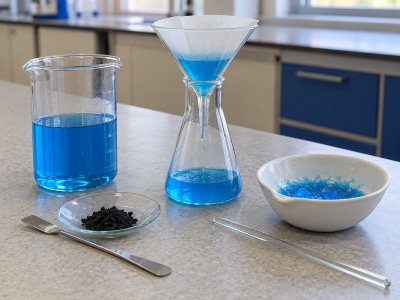
Copper(II) sulfate crystals

A quick-reference six-page guide to making a soluble salt using an acid and excess insoluble base, then filtering and crystallising. Explore our Curriculum Experiments resources for more detailed practical support.
GCSE ChemistryC01 · Making saltsTechnician referencev1.0 October 2026
gcse chemistry Preparing a pure, dry soluble salt
Print all six pages on A4 portrait (four practical charts and two infographic pages). Choose Save as PDF or your printer; use 100% scale and turn off browser headers and footers.Use your browser’s Print command: Ctrl+P (Windows) or Cmd+P (Mac).
Scope: GCSE example preparing copper(II) sulfate from dilute sulfuric acid and copper(II) oxide. Use only approved concentrations, quantities, heating and waste arrangements.
Better EquippedTechnician Practical EssentialsGCSE Chemistry · C01
01

The practical at a glance

Acid + excess insoluble base → filtration → crystallisation

Preparing a pure, dry soluble salt

Copper(II) sulfate from copper(II) oxide and dilute sulfuric acid
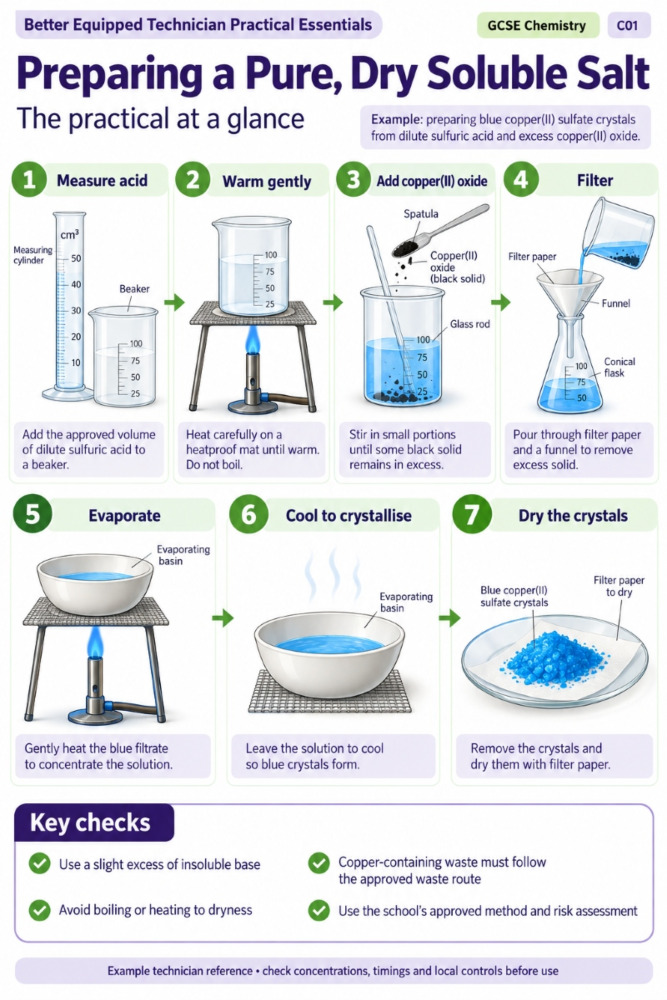
preparing a pure dry soluble salt methodology
Read the detailed step-by-step method
  1. Measure acidMeasure the approved volume of dilute sulfuric acid into a beaker.
  2. Warm gentlyWarm the acid gently using the approved heating method. Do not boil.
  3. Add oxideRemove from heat and add copper(II) oxide in small portions while stirring.
  4. Confirm excessContinue until a small amount of black oxide remains after stirring: the acid has reacted.
  5. FilterAllow to cool enough to handle safely, then filter away excess solid. Collect the blue copper(II) sulfate solution.
  6. ConcentrateGently heat the filtrate in an evaporating basin until sufficiently concentrated. Never boil dry.
  7. CrystalliseLeave to cool undisturbed. Separate crystals from mother liquor and dry carefully between filter papers.
Reaction: CuO(s) + H₂SO₄(aq) → CuSO₄(aq) + H₂O(l). The usual blue crystals are hydrated copper(II) sulfate (CuSO₄·5H₂O).
Safety: Wear appropriate eye protection. Acid, copper compounds and hot equipment present hazards. Follow the approved school method and current COSHH assessment.
Better EquippedTechnician Practical EssentialsGCSE Chemistry · C01
02

Apparatus and materials

Checklist for each group and a ten-group example

Change the number to update the apparatus totals. Chemical quantities must come from the approved method, not a guessed scale.

Fixed example: 10 groups. The interactive calculator is not active. Use the per-group column to adjust quantities manually.

Issue basis: 10 groups. Tick each item when prepared.

Item Per group 10 groups (example)
2 20
1 10
1 10
1 10
1 set 10 sets
1 10
1 10
1 set 10 sets
1 10
As needed As needed
Per pupil Per pupil
Approved quantity 10 × approved quantity
To slight excess Pilot-based allowance
Add pilot, demonstration and spares separately. Prepare, label and store chemicals according to the school’s procedures.
Better EquippedTechnician Practical EssentialsGCSE Chemistry · C01
03

Preparation and apparatus set-up

Pilot, prepare, issue and reserve cooling space
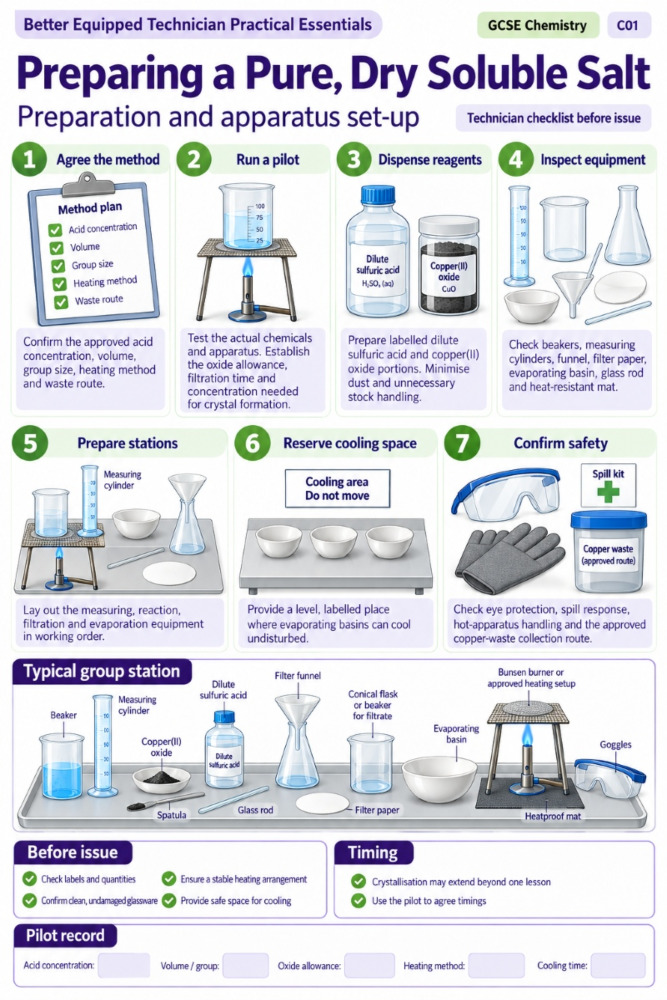
preparing a pure dry soluble salt set up
Read the detailed preparation and set-up notes
  1. Agree the methodConfirm acid concentration and volume, group size, heating equipment, timetable and waste route with the teacher.
  2. Run a pilotTest actual chemicals and apparatus. Establish the oxide allowance, filtration time and concentration required to obtain crystals.
  3. Dispense reagentsPrepare labelled dilute sulfuric acid and copper(II) oxide portions. Minimise dust and avoid uncontrolled handling of stock chemicals.
  4. Inspect equipmentCheck glassware, funnel fit, filter paper, heating apparatus, leads, heat-resistant mats and handling tools.
  5. Prepare stationsLay out measuring, reaction, filtration and evaporation equipment in working order.
  6. Reserve cooling spaceProvide a level, labelled location for evaporating basins to cool undisturbed, potentially beyond the lesson.
  7. Confirm safetyCheck eyewear, emergency arrangements, spill kit and approved copper-containing waste collection.

Before issue

Check correct labels, clean glassware, stable heating arrangement and safe cooling space.

Timing

Crystal growth may take longer than a single lesson; use the pilot to agree the timetable.

Pilot record: Acid concentration ______ · Volume/group ______ · Oxide allowance ______ · Heating method ______ · Cooling time ______
Better EquippedTechnician Practical EssentialsGCSE Chemistry · C01
04

Troubleshooting and clear-down

Common problems and safe reset

Problem Technician check / action
Black oxide does not remain More oxide may be needed; add cautiously until a small excess persists.
Black particles in filtrate Inspect filter paper and re-filter into clean glassware.
No crystals form Check concentration and cooling time; gently reconcentrate only if approved.
Crystals form a crust Heating may have been too vigorous; concentrate more gently next time.
Crystals lose their blue colour Avoid strong heating or drying that removes water of crystallisation.
Spill or exposure Stop and follow the school’s chemical spill and first-aid procedures.

Clear-down and reset

01 · CollectLabel crystal samples and mother liquor. Allow hot apparatus to cool safely.
02 · DisposeCollect copper-containing liquid and solid waste through the approved chemical waste route. Do not dispose to drains without explicit authorisation.
03 · CleanWash and dry glassware, reset heating equipment, clean benches and wash hands.
Remember: Never taste crystals or heat them strongly to dry. Check the current SDS, CLEAPSS advice and local COSHH assessment.
Example teaching sequence, not a universal validated recipe. Refer to CLEAPSS, the relevant safety data sheets and your school’s approved method.
Better EquippedTechnician Practical EssentialsGCSE Chemistry · C01

Preparing a pure, dry soluble salt · Methodology infographic

preparing a pure dry soluble salt methodology
Better EquippedTechnician Practical EssentialsGCSE Chemistry · C01

Preparing a pure, dry soluble salt · Apparatus set-up infographic

preparing a pure dry soluble salt set up

About this guide

This guide supports GCSE Chemistry technicians preparing a soluble salt from an insoluble base and an acid. It covers the practical method, apparatus, preparation, troubleshooting and clear-down.

This guide was written and reviewed by Better Equipped's technical team and further reviewed by former A Level Science Teachers. Our team includes former school laboratory technicians and supports schools, colleges and laboratories throughout the UK.

We welcome feedback: contact us.

Prepared October 2026. Confirm local technical review before publication.

Everything you need for this practical

Browse relevant equipment and chemicals. Check specifications and approved concentrations before ordering.