We use cookies to give you the best experience possible. By continuing to use the site, you indicate that you accept cookies. See our cookies policy here.
Better Equipped Technician Practical Essentials
A quick-reference, six-page guide for technicians preparing a GCSE temperature-change investigation: what to issue, how to set up the insulated cup, how to capture a temperature curve, what to check and how to clear down. For more detailed curriculum practical resources, visit our Curriculum Experiments resources.
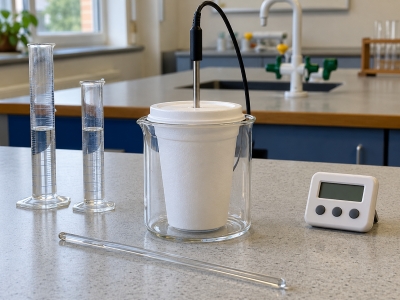
One cup per complete series · eight additions to the same mixture · fresh reagents for a repeat
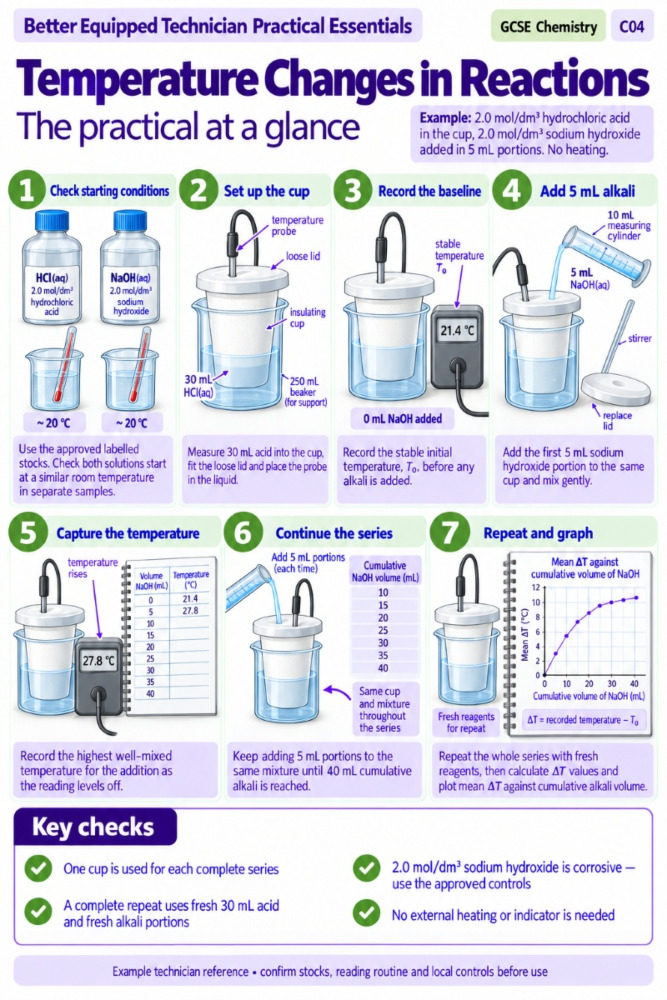
Interpretation: neutralisation is exothermic. A later temperature fall does not make it endothermic; added liquid, changing thermal mass and heat loss affect the reading. A temperature peak is not a pH test. [2] [3]
One reusable apparatus set per station · whole-series repeats · separate acid and alkali allowances
One station is one shared apparatus set; count pupils separately. Extra complete sets include equipment and a full series allowance for a pilot, demonstration or spare. One complete series uses 30 mL acid and 40 mL alkali, added in eight portions. Reagent volumes include the selected handling allowance and are rounded up to 10 mL per set before multiplying by sets. The allowance is supply stock, not extra liquid to pour into the cup. The method volumes and concentrations are fixed in this example; changing the school method requires revising the guide and calculator together. This is not a dilution recipe. Ticks and settings are not saved.
Interactive calculator not active. Fixed example: 10 stations + 1 extra set; two complete series per set; 20% allowance. Prepare 11 apparatus sets, 880 mL hydrochloric acid and 1,100 mL sodium hydroxide. Adjust locally when scripting is unavailable.
Planning issue: 10 working stations + 1 extra complete set = 11 equipped sets. Allow 2 complete series per set (22 series). Each series uses 30 mL acid and eight 5 mL alkali additions (40 mL total). With a 20% handling allowance, issue 80 mL hydrochloric acid and 100 mL sodium hydroxide per set: 880 mL acid and 1,100 mL alkali for the class. Each solution is rounded up to 10 mL per set.
| Item / issue specification | Per equipped set | Class provision |
|---|---|---|
| 1 of each | 11 of each | |
| 1 | 11 | |
| 1 | 11 | |
| 1 assembly | 11 assemblies | |
| 1 of each | 11 of each | |
| 2 | 22 | |
| 1 | 11 | |
| 1 of each | 11 of each | |
| 1 | 11 | |
| 80 mL / set | 880 mL | |
| 100 mL / set | 1,100 mL | |
| Per person | Count people separately |
Labels and recording sheets for every complete series; small vessels for checking starting temperatures; spill and first-aid arrangements, handwashing and the approved waste collection. Add any extra PPE required locally.
Reuse a cup only if suitable and approved; inspect it between series. Add replacement cups and lids separately if the chosen product is single-use. Do not multiply stands, sensors and cylinders by the eight additions.
Check stocks → equilibrate solutions → pilot the complete curve → agree the reading routine
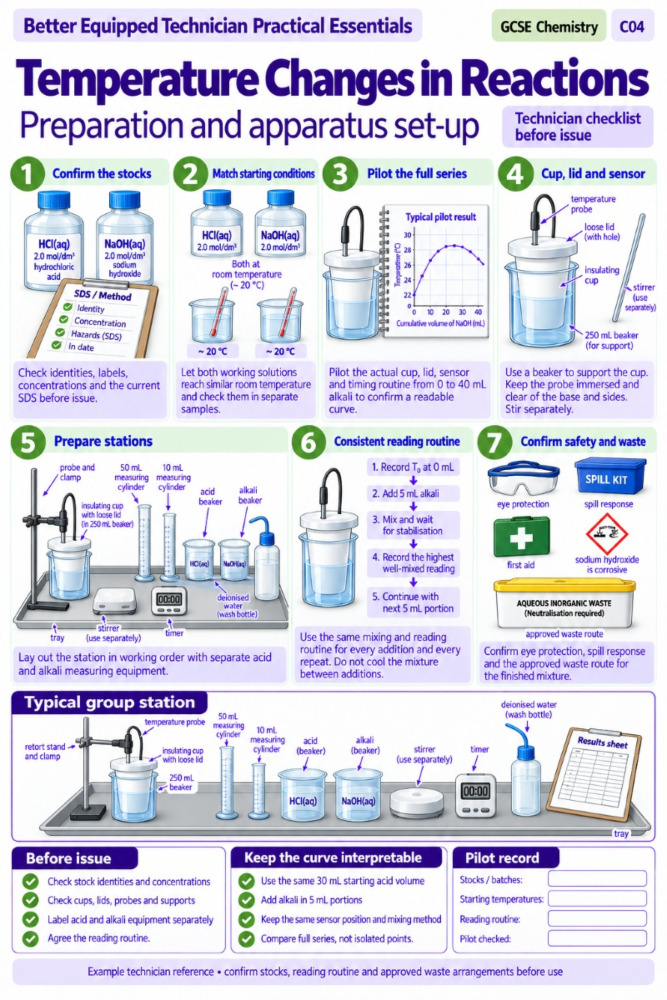
Check identities, labels, 2.0 mol/dm³ concentrations and the current SDS. Use the school’s prepared solutions. If stock preparation is needed, trained staff follow a separate approved procedure and allow solutions to cool before issue. [2] [4]
Keep working reagents together long enough to approach the same room temperature. Check separate samples and record actual values. Keep sodium hydroxide capped between uses. The acid baseline alone cannot correct a warm or cold alkali supply.
Trial the actual cup, lid, sensor and stirring arrangement from 0 to 40 mL alkali. Confirm a readable rise and turnover, sufficient cup capacity and a practical reading routine. Check sensor response and rehearse a complete repeat. [2]
Use the beaker to support the cup. Fit a loose lid with staff-prepared openings; never seal the vessel or force glass through a tight hole. Keep the sensing tip immersed from the initial 30 mL charge onwards, clear of the base and sides. Stir separately.
Agree how to mix, recognise the post-addition reading and proceed to the next portion. Account for sensor lag without prolonged waiting. Keep the routine the same across series; record actual timings and deviations. Do not cool the mixture between additions.
| Cumulative NaOH / mL | Temperature Series 1 |
Temperature Series 2 |
Mean ΔT (calculate separately) |
|---|---|---|---|
| 0 · baseline | 0.0 | ||
| 5 | |||
| 10 | |||
| 15 | |||
| 20 | |||
| 25 | |||
| 30 | |||
| 35 | |||
| 40 |
Keep the raw record: note the two starting reagent temperatures, each series’ T₀, timings and any problems. For each volume, calculate ΔT separately for Series 1 and Series 2 before taking their mean. Add columns for further complete series.
Check starting conditions, mixing and the sensor · retain raw readings · use the agreed waste route
| Problem | What to check | Technician action |
|---|---|---|
| Little or no temperature rise | Correct stock identities and strengths, measured portions, initial temperatures and sensor position. | Compare with the pilot. Stop for a suspected stock error; do not increase concentration or add an unplanned reagent to force a larger change. |
| Readings drift or jump | Sensor touching the cup, poor mixing, response lag, a loose connection or excessively long delays. | Reposition safely and check with a separate sample. Standardise mixing and reading. Record affected points; do not copy the highest earlier value. |
| No clear peak by 40 mL | Stock strengths, cumulative-volume record, missed portions, initial-temperature mismatch and timing. | Keep the data and stop at the planned limit. Ask the teacher to review the method; do not keep adding alkali to hunt for an expected peak. |
| Complete series disagree | Different starting temperatures, wet or still-warm apparatus, altered lid use or crossed cylinders. | Return clean apparatus to the starting condition. Repeat a complete series if approved; document exclusions rather than selecting only agreeable readings. |
| Cup leaks or sensor is unstable | Damaged foam, an unsuitable lid opening, excessive clamp force or insufficient support. | Stop, make the spill safe by the local procedure and replace damaged items. Do not transfer a partly completed run and label it as unchanged. |
| Splash, spill or exposure | Chemical identity and concentration; the school’s immediate-response arrangements. | Stop the activity, alert staff and follow the current SDS and school first-aid/spill procedure promptly. Do not neutralise chemicals on skin or improvise bulk neutralisation. |
Reference check: 10 October 2026. AQA curriculum and practical handbook [1] [2] [3]; manufacturer hazard information [4]. Full sources, access limits and adaptations are online. The quantity allowance, sensor-reading clarifications and mean-ΔT record are editorial choices. Pilot and approve locally. No examination-board, supplier, RSC or CLEAPSS approval is claimed.
Explore buying guides, practical resources and laboratory reference information.
This Technician Practical Essentials guide brings together apparatus issue, reagent planning, temperature measurement, cumulative-volume records and clear-down for a GCSE neutralisation investigation. It complements our Curriculum Experiments resources.
Source basis and adaptation: AQA provides the curriculum context and the worked cumulative-addition method: 30 mL hydrochloric acid, 5 mL sodium hydroxide additions to 40 mL in total, and a complete repeat. The handbook’s technical notes specify 2 mol/dm³ solutions. [1] [2] The separate stirrer, sensor-support detail, matched-starting-temperature checks, calculator allowance and mean-ΔT record are editorial preparation choices, not a verbatim or laboratory-validated protocol. Check the actual apparatus and local assessment before use.
AQA Chemistry required practical 4 concerns variables affecting temperature change in reacting solutions. The full specification mentions several reaction types; this guide develops neutralisation only. C04 does not claim that one method covers every option, examination board or local teaching plan. [1] [3]
C02 uses a burette and indicator to find a colour-change endpoint. C04 measures a temperature curve while known alkali portions accumulate in one cup. No indicator, colour endpoint or burette is required for this worked version. Do not use C02’s 0.10 mol/dm³ stock assumptions in C04.
Use an insulating cup supported in a stable beaker, with a loose lid and safely prepared holes. Check chemical and temperature compatibility and that the sensor works in the initial 30 mL volume. Leave headroom above the final 70 mL mixture. Follow probe immersion and clamp instructions; a lid is not a reason to seal the vessel.
Adding warmer or colder liquid changes the measured temperature independently of the reaction. Check representative separate working samples; do not dip a shared sensor directly into both stock bottles. After a complete series, clean and dry the equipment and allow it to return to the starting condition before the next baseline.
The handbook asks for a maximum temperature after mixing and for a curve extending beyond the hottest region. [2] With real sensors, distinguish the new mixed reading from the previous reading left on the display. Mix gently, keep the sensor immersed, allow it to respond and record the post-addition temperature under one agreed routine. On the descending part of the curve, the new mixed value can be lower than the preceding value.
Do not use a running maximum that can only rise: that would erase the descending side. Equally, do not wait for the solution to return to room temperature at each volume. Pilot how to recognise the reading with the actual sensor and record timings. A separately planned data-logging version can preserve the full time trace, but the teacher must specify how temperatures at each addition are selected.
The eight successive additions share the same reaction mixture and are not independent repeats. Two complete series each start with fresh acid and a new baseline. Use the same nominal stock concentrations, cup and lid arrangement, portion sizes, stirring and reading convention across repeats.
With equal acid and alkali concentrations, a 1:1 equation places the stoichiometric volume near the acid volume. That is a prediction, not permission to change the data. Heat exchange, response time and 5 mL spacing affect the measured maximum. A fitted intersection is an estimate, not an exact pH-7 measurement.
Keep each series’ initial acid temperature and all later temperatures. The handbook records repeated temperatures; this guide additionally calculates ΔT separately for each series before taking a mean at each volume. This helps keep baselines explicit, but it does not remove the need for comparable starting conditions. Label the vertical axis “Mean temperature change / °C” and the horizontal axis “Cumulative sodium hydroxide added / mL”.
After the reacting acid is used up, added alkali does not release the same neutralisation energy. Added liquid also changes the total mass being warmed, and energy is exchanged with the cup and surroundings throughout. A falling measured temperature is therefore not evidence that the same reaction has become endothermic. [2] [3] A pH measurement or safe-disposal decision would require its own appropriate procedure.
The equipment count is working stations plus extra complete sets. Every complete series consumes 30 mL acid and 40 mL alkali. For each reagent, the calculator multiplies its per-series volume by the number of series, adds the chosen percentage allowance, rounds up to the next 10 mL per equipped set, then multiplies by all sets. Each extra set receives the full selected series allowance.
Replacement single-use cups, additional recording materials, pupil numbers and extra PPE are not inferred. Changing the concentration, acid volume, increment size or final alkali volume changes the method; it requires revising the record sheet, stock labels, pilot and calculator together. Do not treat the input maximums as approval to run a class of that size.
Do not describe the 2.0 mol/dm³ sodium hydroxide as low-hazard because it is a classroom reagent: the manufacturer hazard information carries the corrosive classification and H314. [4] Obtain and use the exact supplier SDS for both working stocks. No concentrated-stock preparation or dilution recipe is provided here. Confirm who prepares solutions, who authorises issue and how splashes and spills will be managed.
Agree the waste route before the lesson. Finished cups, first rinsings and unused stock can have different compositions; keep them identified and do not assume neutralisation is complete. This guide does not authorise bulk waste neutralisation or disposal to drains.
Displacement reactions, dissolving salts and other exothermic or endothermic examples need their own approved recipe, hazards, quantities and waste plan. They are not reagent substitutions into this calculator. The broader temperature-change topic is covered by the specification, but these extensions are outside this worked C04 method. [3]
Reference check: 10 October 2026. The following sources distinguish the published basis from the guide’s original technician-planning choices.
No member-only CLEAPSS guidance or school-specific risk assessment was consulted. Use current employer/school guidance, the exact chemical SDS and apparatus instructions. No examination-board, RSC, supplier or CLEAPSS endorsement is implied. The activity has not been laboratory-tested as part of producing this guide.
Have feedback or a useful technician tip? Please contact us.
Draft prepared: October 2026 · Version: 1.0 · Technical review: pending confirmation before publication.
Build the issue around a supported insulating cup, clear temperature measurement and separately labelled acid and alkali vessels. Check materials, measuring ranges, cup capacity and the school’s approved stock concentrations before selecting products. This is not a pre-approved kit.
Chemical searches may include different concentrations or solid reagents. They are not instructions to prepare stock, or confirmation that a product is suitable. Select the exact approved working solution and obtain its SDS. Check lids and replacement-cup requirements separately.
Links open in a new tab or window. Catalogue search links do not guarantee a matching product. Individual specifications, pack sizes and availability were not checked during preparation.



 Call us:
 Email us: