We use cookies to give you the best experience possible. By continuing to use the site, you indicate that you accept cookies. See our cookies policy here.
Better Equipped Technician Practical Essentials
A quick-reference, six-page guide for technicians preparing a GCSE temperature–rate investigation: what to issue, how to condition the reagents, which temperatures to record and how to manage the residues. For more detailed curriculum practical resources, visit our Curriculum Experiments resources.
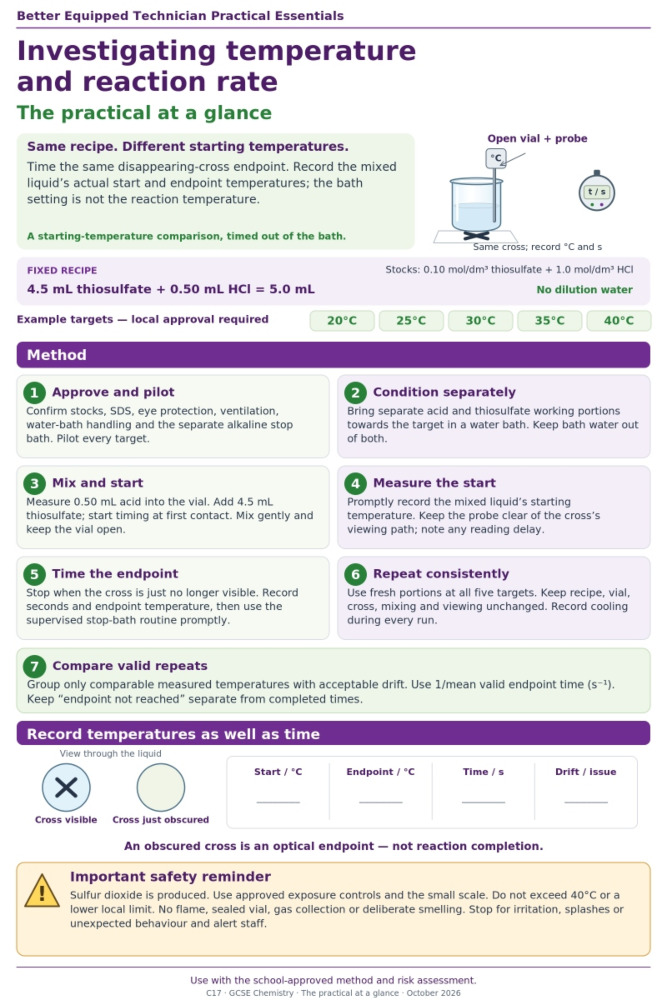
Same recipe · different starting temperatures · one consistent visual endpoint
Five temperature points per series · reusable equipment counted once per equipped set
One complete series contains five separate reactions: one at each selected temperature. Every run uses 4.5 mL thiosulfate stock and 0.50 mL HCl. Three complete series give three runs at each temperature. Extra sets receive the same series allowance. Clean and reuse equipment between runs; do not start five vials together.
Apply the handling allowance to each reaction-liquid budget per set, then round each stock up to 1 mL before multiplying by sets. These are draw-off budgets, not prescribed conditioning-vessel fills. Add extra working volume for reliable temperature measurement where needed. Thermal pilots, bath water, cleaning, stop-bath replenishment and indicator are not calculated. Settings and ticks are not saved.
Interactive calculator not active. Fixed example: 10 stations + 1 extra set, three complete five-temperature series and 25% handling allowance. Provide 935 mL thiosulfate and 110 mL HCl for planned draw-off; add any extra conditioning fills. Adjust the fixed figures manually if scripting is unavailable.
Planning issue: 10 working stations + 1 extra = 11 sets; 3 complete five-temperature series per set = 15 reaction runs per set, 165 runs in all. At 25% handling allowance, provide 85 mL thiosulfate and 10 mL HCl per set: 935 mL and 110 mL respectively for the class. Prepare 11 reaction vials, 22 conditioning vessels and 11 water-bath stations. Stop-bath carbonate starter: 110 mL in all. Extra working fills, thermal pilots, replenishment and indicator are additional.
| Item / issue specification | Per equipped set | Class provision (11 sets) |
|---|---|---|
| 1 of each | 11 of each | |
| 2 | 22 | |
| 1 small + 1 large 2 containers |
11 of each syringe 22 containers |
|
| 1 station | 11 stations | |
| 1 kit (2 sensors) | 11 kits; 22 sensors | |
| 1 kit | 11 kits | |
| 85 mL | 935 mL | |
| 10 mL | 110 mL | |
| 1 | 11 | |
| 10 mL starter | 110 mL starter + replenishment |
|
| Locally specified | Count separately | |
| Per person / room | Count people and controls separately |
Check the lowest remaining volume still permits reliable withdrawal and temperature checks. Do not enlarge a reaction dose to use surplus. Water-bath water, rinses and thermal-pilot portions are separate.
The displayed carbonate amount does not establish neutralising capacity or safe fill level. Staff must provide replenishment and monitoring before release. Keep unused stocks and other waste out.
Condition separately · measure the mixed liquid · distinguish target from observation
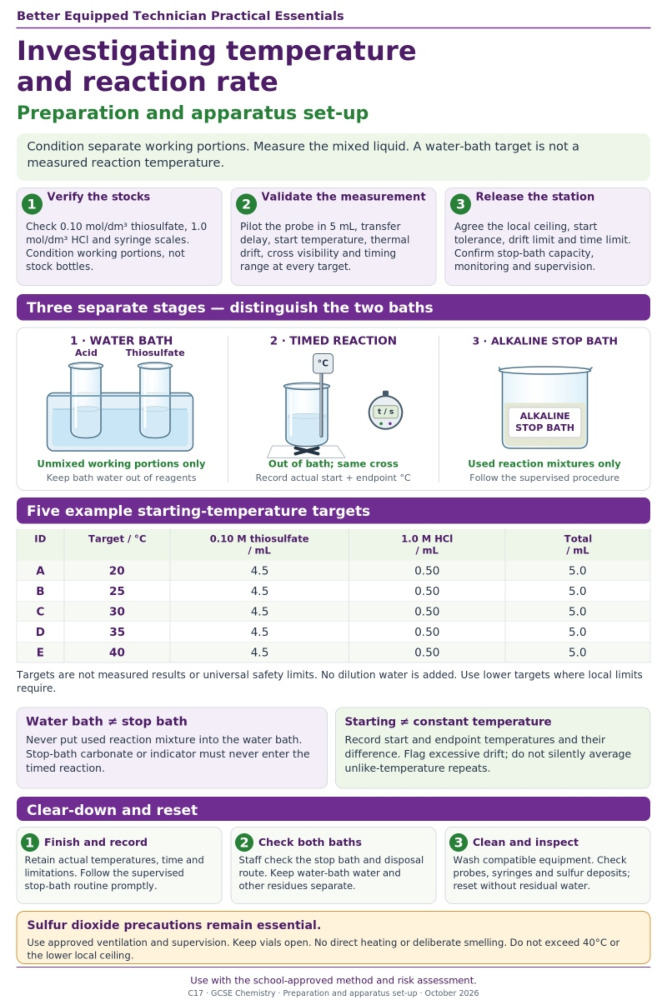
Check both stocks, syringe scales and two distinct bath labels. Use the approved mild water bath and a pilot-verified equilibration routine. Condition working portions only, not stock bottles; keep bath water out.
Pilot all five targets. Check probe response and immersion in 5 mL, transfer delay, starting temperature and drift to the endpoint. Confirm a readable cross, safe viewing position and a usable timing range.
Record the local temperature ceiling, start tolerance, drift limit and time limit. Have stop-bath capacity and supervision ready. Work one reaction at a time; clean, rinse and reset before repeating.
| ID | Target / °C | 0.10 M thiosulfate / mL | 1.0 M HCl / mL | Total / mL |
|---|---|---|---|---|
| A | 20 | 4.5 | 0.50 | 5.0 |
| B | 25 | 4.5 | 0.50 | 5.0 |
| C | 30 | 4.5 | 0.50 | 5.0 |
| D | 35 | 4.5 | 0.50 | 5.0 |
| E | 40 | 4.5 | 0.50 | 5.0 |
The water bath conditions the unmixed reagents. The separate alkaline stop bath treats used reaction mixtures. Never pour a timed mixture into the water bath or add stop-bath carbonate/indicator to a reaction vial.
This version is timed out of the bath. Record actual start and endpoint temperatures and their difference. If drift is excessive, re-pilot; do not claim an isothermal rate or silently average unlike-temperature repeats.
| ID / repeat | Start / °C | Endpoint / °C | Time / s | Drift / endpoint / issue |
|---|---|---|---|---|
| ________ | _______ | _______ | _______ | |
| ________ | _______ | _______ | _______ |
Check temperature, optics and timing first · retain raw records · manage exposure promptly
| Problem | What to check | Technician action |
|---|---|---|
| Bath target and liquid temperature differ | Equilibration time, sensor immersion, withdrawn portions cooling and transfer delay. | Use measured mixed-liquid temperatures. Re-pilot the conditioning sequence; do not enter the bath setting as a measured reaction temperature. |
| Temperature drifts during a run | Out-of-bath cooling, sensor response, inconsistent vial handling or long reaction time. | Record start and endpoint values. Flag excessive drift; compare only suitable repeats. Revise the whole method with staff rather than warming one active vial. |
| Warmest run is too quick to time | Addition speed, delayed timer/probe readings, chosen upper target and stock identity. | Retain the failed run. Reduce the temperature range only through a revised, approved pilot; do not change concentration for just one point. |
| Cross is unclear before the reaction | Probe in the sightline, condensation, bath-water droplets, dirty glass or sulfur residue. | Correct the viewing arrangement before adding reactants. Keep the sensor position and optical geometry unchanged across all runs. |
| No endpoint by the agreed limit | Lowest temperature, stock/dose error, reaction geometry or observation conditions. | Record “not reached by … s” and treat through the stop bath. Do not count the limit as an endpoint time, add acid or heat to force a result. |
| Irritation, spill or stop-bath limit reached | Exposure controls, hot/wet handling, bath condition and untreated mixtures accumulating. | Stop new runs and alert staff. Move away from exposure where necessary; follow the local incident procedure. Restart only after controls are restored. |
Reference check: 13 October 2026. AQA temperature–rate content [1] [2]; Worley/Allan microscale method and temperature extension [3]; HSE assessment principles [4]. Full references and access limits are online below.
The 20–40°C series, conditioning and temperature-recording routine, allowances and calculator are editorial adaptations. No classroom trial, technical sign-off or source-organisation endorsement is claimed.
Explore buying guides, practical resources and laboratory reference information.
This Technician Practical Essentials guide brings together reagent conditioning, small-volume dispensing, temperature checks, timing records and clear-down for a temperature–rate investigation. It complements our Curriculum Experiments resources.
Better Equipped’s technical team draws on experience supplying practical science equipment to schools, colleges and laboratories, including experience as school laboratory technicians. This draft is prepared for technical review before publication; it does not claim that a review or classroom trial has already taken place.
Source basis and adaptation: the previous guides supply the page layout, print styling and interactive-control pattern. The fixed 5 mL recipe and the idea of using water to change temperature follow Activity 1 and its optional extension in Bob Worley and Adrian Allan’s Quick quantitative chemistry – the microscale way. [3] The temperature targets, out-of-bath workflow, measurement checks and preparation arithmetic below are additional editorial decisions, not a verbatim or validated source protocol.
AQA includes temperature and collision theory in Chemistry 4.6.1.2–4.6.1.3 and Trilogy 5.6.1.2–5.6.1.3. [1] [2] Their named rate practicals investigate concentration using gas-volume and colour/turbidity methods. C17 is a supporting temperature investigation, not a replacement for those requirements.
C16 changes starting thiosulfate concentration. C17 holds the 4.5 mL thiosulfate / 0.50 mL acid recipe fixed and changes starting temperature. Do not combine both changes in one comparison or reuse the C16 dilution table.
The published temperature extension sets a below-60°C condition to reduce sulfur dioxide exposure. [3] This draft instead proposes 20, 25, 30, 35 and 40°C starting targets, with no temperatures above 40°C within its scope. That narrower range is an editorial restriction, not a declaration that every room, learner or reagent issue is safe at 40°C. A lower local ceiling takes precedence.
A target on a worksheet and the displayed bath temperature are not measurements of the reacting liquid. Condition the two reagents separately using the validated local routine; then record the mixed liquid’s actual start temperature. A cold syringe or delay can change it. Record the delay rather than describing a late reading as the exact temperature at first contact.
The probe must measure reliably in a 5 mL charge without touching the glass bottom or blocking the view. Check chemical compatibility, minimum immersion, response time and readable resolution against the manufacturer’s instructions. Pilot its location with the actual vial; a standard large immersion thermometer may not suit the geometry. Rinse and reset probes to avoid cross-contaminating working supplies.
In this version, the reacting vial is timed on its cross outside the conditioning bath. Its temperature may change, especially in slower runs. Record start and endpoint values and an agreed tolerance; a start/end pair still does not prove constant temperature throughout. If drift prevents a useful comparison, redesign and pilot a temperature-controlled optical arrangement separately rather than silently altering one run.
Condition labelled working portions in supported vessels. Keep the mouths clear of bath water and use separate dispensing tools. Use only a mild, staff-controlled water bath; no direct flame or uncontrolled kettle-water issue. The recipe is measured with syringes, not by beaker graduations. Do not return warmed or used portions to the master stock.
One equipped set in the calculator includes a bath station, two conditioning vessels and a two-sensor measurement kit. Shared thermostatic baths may be booked differently, but queueing and transfer delays must be piloted. Also plan spill handling, stop-bath monitoring and supervision; reducing the number of baths on a booking sheet is not by itself a workable shared-station method.
The intended reaction forms sulfur, which obscures the cross, and sulfur dioxide, which must be considered in the exposure assessment. [3]Na₂S₂O₃(aq) + 2HCl(aq) → 2NaCl(aq) + S(s) + SO₂(g) + H₂O(l)The disappearance of a cross is a chosen optical threshold. It neither shows that the reaction is complete nor measures a gas volume.
For the fixed recipe, the calculated initial thiosulfate concentration is 0.10 × 4.5/5.0 = 0.090 mol/dm³, and initial HCl concentration is 1.0 × 0.50/5.0 = 0.10 mol/dm³. Both calculations include the acid in the 5.0 mL final volume. Concentrations subsequently change as reaction proceeds.
Temperature affects particle motion and the likelihood of collisions with sufficient energy. [1] It is not necessary to claim that rate doubles for every 10°C increase. This apparatus does not establish a reaction order or a reliable activation energy, especially when the temperature drifts.
Keep a record for every fresh reaction: target ID, repeat number, actual start and endpoint temperatures, time, timing delay and any method variation. Use the same observer, cross, liquid depth, illumination and probe position wherever practical. Record a failed measurement and its reason rather than deleting a point to improve a trend.
Chosen analysis convention: average the valid endpoint times only within an agreed comparable-temperature group; then calculate 1/(mean time), in s⁻¹. This is a relative-rate index. Mean reciprocal time and reciprocal mean time are not generally equal. Keep the convention unchanged and retain temperature variation alongside it.
For arithmetic illustration only, three valid times of 38, 40 and 42 s have mean 40 s, giving 1/40 = 0.025 s⁻¹. These are invented calculation examples, not predicted results. “Cross still visible at 180 s” is not a completed 180 s endpoint, and a failed timing is not a zero-rate measurement. Plot against measured starting temperatures, not substituted bath targets; do not average materially different temperatures into one supposedly controlled condition.
Contains only the water used to condition supported working-supply vessels. Keep chemical openings above its water level. Do not dump reaction residues into it or treat it as chemically clean after a suspected spill. Electrical controls and wet equipment must be handled by the approved procedure.
The source begins with 10 mL of 0.5 mol/dm³ sodium carbonate in a 250 mL beaker, using phenolphthalein to monitor alkalinity. [3] Staff approve the indicator formulation and dose, capacity checks, replenishment and disposal. Sodium carbonate and the indicator belong in this separate treatment bath, never in the timed reaction.
The calculator includes only the starter carbonate volume. More repeats do not automatically increase that display, and neither a large beaker nor a coloured indicator guarantees unlimited neutralising capacity. Provide a separate replenishment supply and a staff response to the agreed condition and fill limits. Do not copy a generic drain-disposal instruction into the school procedure.
Assess the substances produced during the work, the duration and frequency of exposure, the people present and cleaning activities as well as the stock-bottle labels. [4] If suitable exposure control and supervision cannot be provided, do not run this adaptation; select a separately approved activity. The stop bath supplements, rather than replaces, prevention and control of exposure.
Static example — independent of the interactive settings above: 10 stations + one extra set, three complete five-temperature series per set, and 25% handling allowance. This gives 11 × 3 × 5 = 165 reaction runs. Every extra set has the same run provision; additional thermal pilots are separate.
One series uses 5 × 4.5 = 22.5 mL thiosulfate and 5 × 0.50 = 2.5 mL HCl. For three series and 25% allowance: 22.5 × 3 × 1.25 = 84.375 mL, rounded to 85 mL per set; 2.5 × 3 × 1.25 = 9.375 mL, rounded to 10 mL per set. Multiply by 11: 935 mL thiosulfate and 110 mL HCl.
Issue 11 reaction vials/holders, 22 conditioning vessels, 11 small and 11 large syringes, 11 water-bath stations and 11 two-sensor kits. Clean and reuse these across the runs. The stop-bath starter is 10 mL × 11 = 110 mL carbonate solution, with replenishment and indicator additional.
Budget boundary: calculate the minimum practical conditioning-vessel fill locally, including any residual volume needed for reliable sensor immersion or withdrawal. Add it where it exceeds the displayed draw-off budget. No water is added to the timed recipe; bath water, rinsing, probe cleaning, extra pilots and unplanned repeats remain separate. These figures neither authorise scale-up nor calculate stock-preparation masses, thermal tolerance, exposure limits or stop-bath capacity.
Checked 13 October 2026. Source content and this guide’s editorial planning choices are distinguished above.
The public AQA, Science in School and HSE text was consulted. No specific supplier SDS or member-only CLEAPSS procedure was accessed. Trained staff must consult their current authorised guidance, verify the actual stocks and equipment, and approve and pilot the complete activity before use. No examination-board, author or safety-body endorsement is claimed.
Have feedback or a useful technician tip? Please contact us.
Draft prepared: 13 October 2026 · Version: 1.0 · Technical review: pending confirmation before publication.
Build the issue around consistent reaction vials, reliable small-volume dispensing, suitable temperature measurement and separate conditioning and stop-bath provision. Confirm the school method, probe specifications, actual reagent concentrations and SDS before ordering.
Links open in a new tab or window. These are catalogue searches, not verified product matches or a pre-approved kit. Confirm stock concentrations, vessel geometry, probe immersion requirements and bath suitability. Syringes are used without needles. Stock and stop-bath preparation are separate trained-staff procedures.



 Call us:
 Email us: