We use cookies to give you the best experience possible. By continuing to use the site, you indicate that you accept cookies. See our cookies policy here.
Better Equipped Technician Practical Essentials
A quick-reference, six-page guide for technicians preparing a GCSE acid–alkali investigation: what to issue, how to follow the indicator changes, what to check and how to clear down. For more detailed curriculum practical resources, visit our Curriculum Experiments resources.
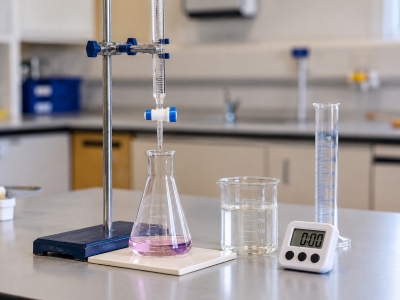
Add alkali gradually · mix before reading · record the actual colour changes
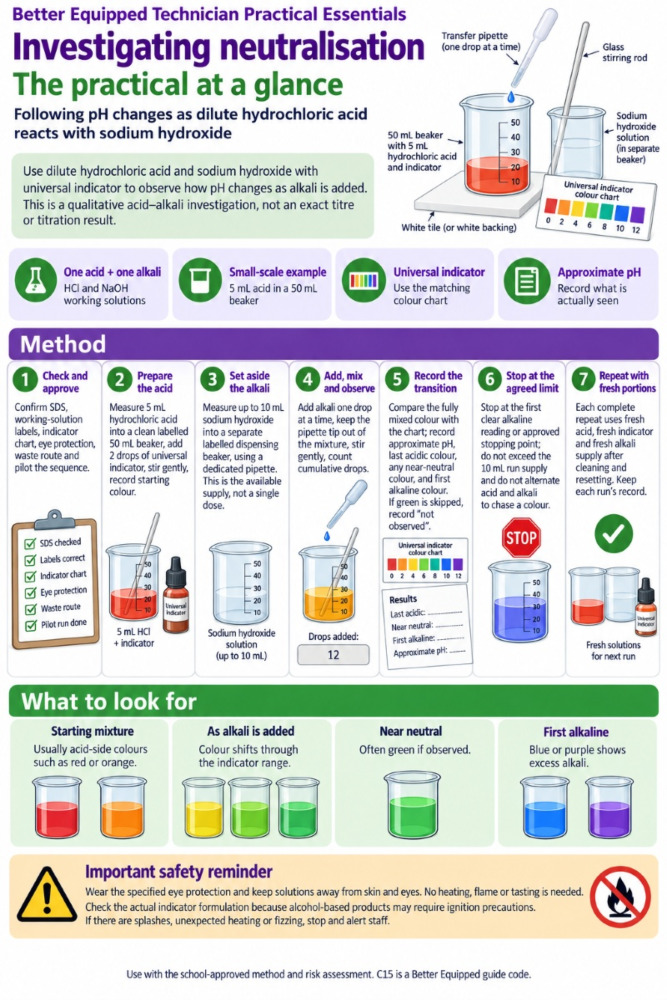
Meaning of the result: indicator colour estimates pH; it does not prove an exact neutralisation volume or identify a pure product. [1] Record what was seen, not a predetermined rainbow.
One reusable station · fresh acid, alkali supply and indicator for each complete run
One set is one station. Each complete run uses 5 mL acid, up to 10 mL alkali supply and two indicator drops. Reuse the beakers, cylinders and tools between runs. An extra complete set includes the same number of runs as a working set.
Apply the handling allowance to acid and alkali only. Round each liquid up to 1 mL per set before multiplying by sets. Indicator totals count drops actually dosed; bottle working fills, dead volume and indicator losses must be added locally. No drop-to-mL conversion is assumed. The calculator does not establish safe concentrations, an endpoint or a permitted reaction volume. Settings and ticks are not saved.
Interactive calculator not active. Fixed example: 10 stations + 1 extra set, two runs per set and 25% acid/alkali allowance. Prepare 11 reaction beakers + 11 alkali vessels, 143 mL acid and 275 mL alkali. Indicator dose totals 44 drops; add practical bottle working fills. Adjust manually if scripting is unavailable.
Planning issue: 10 working stations + 1 extra = 11 sets; 2 complete fresh runs per set = 22 runs. Reuse 11 reaction beakers and 11 alkali vessels. At 25% acid/alkali allowance, issue 13 mL acid and 25 mL alkali per set: 143 mL acid and 275 mL alkali for the class. Indicator dosing: 4 drops per set, 44 drops in all; bottle working fills and losses are additional.
| Item / issue specification | Per equipped set | Class provision (11 sets) |
|---|---|---|
| 1 | 11 | |
| 1 | 11 | |
| 2 | 22 | |
| 1 of each | 11 of each | |
| 1 station kit | 11 kits | |
| 3 | 33 | |
| 1 of each | 11 of each | |
| 13 mL | 143 mL | |
| 25 mL | 275 mL | |
| 4 drops dosed | 44 drops dosed | |
| Per person | Count people separately |
Book approved stock preparation, additional pilot portions, labels, spill/first-aid provision and identified waste containers. Stock preparation is a separate trained-staff procedure.
The 10 mL alkali budget allows for stopping after the transition. Do not pour it all in. Indicator working fills are additional to the displayed dose count; no standard drop volume is assumed.
Verify stocks and indicator · pilot dropwise additions · keep the two beakers distinct
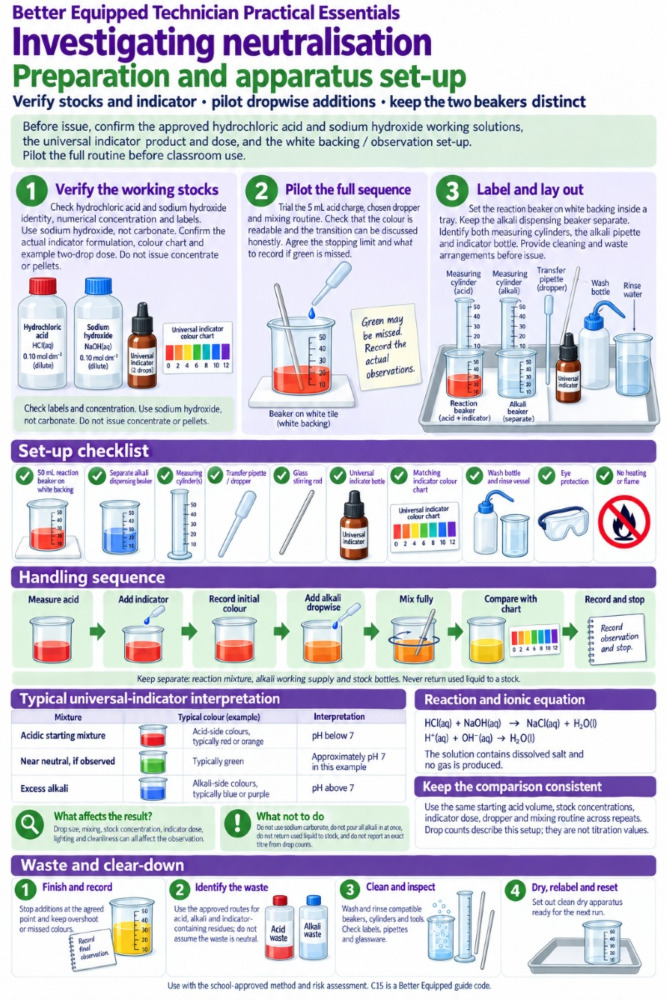
Check HCl and NaOH identity, numerical concentration and labels. Use sodium hydroxide, not carbonate. Confirm the actual indicator formulation, colour chart and example two-drop dose; do not issue concentrate or pellets.
Trial the 5 mL acid charge, chosen dropper and mixing routine. Check that the colour is readable and the transition can be discussed honestly. Agree the stopping limit and what to record when green is missed.
Set the reaction beaker on white backing inside a tray. Keep the alkali dispensing beaker separate. Identify both cylinders, the alkali pipette and indicator bottle. Provide cleaning and waste arrangements before issue.
| Observation stage | Possible mixed colour | What it suggests |
|---|---|---|
| Acidic starting mixture | Acid-side colours, typically red/orange | pH below 7; record the actual chart estimate. |
| Near neutral, if observed | Typically green | Approximately pH 7 in this room-temperature example; not an exact endpoint measurement. |
| Excess alkali | Alkali-side colours, typically blue/purple | pH above 7; the mixture is now alkaline. |
A green stage may be brief or missed. Colour words remain essential when printing in black and white; this table is not a calibrated pH colour chart.
HCl(aq) + NaOH(aq) → NaCl(aq) + H₂O(l)H⁺(aq) + OH⁻(aq) → H₂O(l)The solution contains dissolved salt, not just water. No gas is a product of this acid–hydroxide reaction. [1]
Retain the same starting acid volume, stock concentrations, indicator dose, dropper and mixing routine across repeats. A drop count describes this setup; do not convert it to mL without calibration or report a titration result.
| Stage | Total alkali drops | Actual mixed colour | Approx. pH / uncertainty |
|---|---|---|---|
| Starting mixture | 0 | ||
| Nearest neutral seen | ________ | Or “not observed” | |
| First alkaline seen | ________ | Or stopping limit reached |
Check identity, mixing and dose first · keep overshoots · do not assume waste is neutral
| Problem | What to check | Technician action |
|---|---|---|
| Green is skipped | Drop size, mixing and a rapid transition near neutral. | Keep the last acidic and first alkaline readings. Record “near-neutral colour not observed”. Repeat as approved; do not alter the record or chase green with repeated acid additions. |
| Purple streaks appear, then disappear | A local alkali-rich region before the beaker is fully mixed. | Stir gently and read only the uniform colour. Do not count a streak at the pipette tip as the whole solution’s pH. |
| Colour is too dark or unclear | Excess indicator, wrong indicator, dirty vessel or poor lighting. | Use the specified small dose, clean glassware and matching chart on white backing. Do not add more indicator merely to make a result look stronger. |
| Starting colour is unexpected | Bottle identity, numerical concentration, indicator chart and contaminated equipment. | Withhold suspect working portions. Staff check against verified supplies and the pilot; do not strengthen the reagent or relabel it by colour alone. |
| Repeats need different drop counts | Different droppers, partial drops, changing stock concentrations or acid starting volume. | Keep each run separate and record the method variation. Drop counts are not accurate titres; repeat only after checking the issue and technique. |
| Fizzing or unusual heating occurs | Wrong reagent, contamination, an incorrect concentration or an unexpected addition. | Stop and alert staff. Do not add further chemicals or perform a gas test. Preserve the labels and follow the local incident procedure. |
Reference check: 13 October 2026. AQA neutralisation and pH content [1] [2]; ACS indicator and dropwise-observation teaching [3] [4]; HSE assessment principles [5]. Full references and limits appear below the printable area.
The 0.10 mol/dm³ stocks, 5 mL acid charge, 10 mL alkali supply, two-drop indicator dose and calculator are editorial choices, not a laboratory-validated protocol. Obtain local technical/safety approval before use.
Explore buying guides, practical resources and laboratory reference information.
This Technician Practical Essentials guide brings together apparatus issue, reagent planning, indicator checks, observation records and clear-down for a small-scale neutralisation investigation. It complements our Curriculum Experiments resources.
Better Equipped’s technical team draws on experience supplying practical science equipment to schools, colleges and laboratories, including experience as school laboratory technicians. This draft is prepared for technical review before publication; it does not claim that a review or classroom trial has already taken place.
Source basis: the previous guides supply the page format and interactive-control approach. AQA supplies the curriculum framework; ACS teaching resources support the interpretation of indicator colours and stepwise additions. C15’s hydrochloric acid/sodium hydroxide pairing, concentrations, volumes, beaker arrangement and calculator are editorial selections. The ACS activities use different reagents; this page does not reproduce their recipe or transfer their disposal instructions.
AQA Chemistry sections 4.4.2.2 and 4.4.2.4 address neutralisation products and the pH scale. The corresponding Trilogy sections are 5.4.2.2 and 5.4.2.4. [1] [2] This is a supporting practical, not an assertion that C15 fulfils a required-practical assessment.
C02 covers acid–alkali titration; C04 covers temperature measurements. C13 and C14 investigate metal–acid and carbonate–acid reactions. This example uses a dissolved hydroxide and an indicator; it needs no metal, carbonate, gas delivery tube, heater or salt-crystallisation stage.
The worked example specifies 0.10 mol/dm³ HCl and 0.10 mol/dm³ NaOH. Confirm the actual approved labels and preparation records; “dilute” alone is not a complete concentration specification. Trained staff prepare stocks separately. Substituting an acid, alkali or concentration requires a fresh method and quantity review.
Use the chosen manufacturer’s matching chart and check that the small example dose of two drops is readable in the pilot. Do not replace universal indicator with methyl orange or phenolphthalein while retaining this colour interpretation. A different approved dose needs a matching change to both the method and calculator constants.
View the fully mixed liquid against white backing. A drop can take the observation from an acid-side colour directly to an alkali-side colour. [3] Record that transition and its uncertainty; never fill in a green observation solely because it was expected. A demonstration or supplied result must be labelled as such.
Use written colour descriptions and approximate pH values, not colour alone. Where colour discrimination is difficult, plan an appropriate observation partner or a separately approved pH-probe method. A probe requires its own calibration, handling, storage and apparatus provision; none is included in the default calculator.
Static worked example — independent of the interactive settings above: 10 working stations + 1 extra set, two complete runs per set and 25% handling allowance for acid and alkali. One extra set has the same run provision as a working station. Additional trials or unplanned repeats must be added separately.
Acid: 5 mL × 2 runs = 10 mL per set. Add 25% → 12.5 mL; round up to 13 mL. For 11 sets: 143 mL HCl.
Alkali supply: 10 mL × 2 = 20 mL per set. Add 25% → 25 mL. For 11 sets: 275 mL NaOH. Keep the two supplies separate.
Indicator: 2 drops × 2 runs × 11 sets = 44 drops actually dosed. This is not a bottle-fill volume; staff add practical working fills and losses.
Provide 11 reaction beakers, 11 alkali vessels, 22 measuring cylinders and 11 alkali pipettes. Reuse these after the approved reset.
Rounding: acid and alkali are each rounded up to the next whole mL for every set before the class total is calculated. The same percentage is not applied to indicator drops. The indicator requirement remains a dose count because drop size and bottle dead volume are not specified.
Supply is not the amount that must react: the alkali budget is deliberately larger than the starting acid volume. For ideal, equally concentrated HCl and NaOH, their 1:1 reaction means equal volumes would supply equal reacting amounts. That calculation does not establish an observed endpoint with an uncalibrated dropper and indicator. Stop at the agreed observation rather than emptying the available alkali.
Check the current SDS for each actual working solution and indicator, including any solvent in the indicator. Plan exposure controls, appropriate eye protection, spill response, cleaning and waste arrangements for the activity. [5] No universal hazard classification is assigned to all “dilute” solutions or all indicator formulations here.
The final beaker can still contain excess acid or alkali as well as dissolved salt and indicator. A near-neutral colour is not a disposal authorisation. Follow the school’s approved route; do not apply this small-scale teaching activity to bulk neutralisation, spill treatment or preparing food-grade salt. Do not transfer the ACS activities’ reagent-specific disposal advice to this different mixture.
Checked 13 October 2026. These sources support the stated principles, not every practical choice or quantity in C15.
The publicly accessible AQA, ACS and HSE pages were consulted. No member-only CLEAPSS material or specific supplier SDS was reviewed for this draft. Before classroom issue, trained staff must check current school/CLEAPSS guidance where applicable, the actual SDS and equipment instructions, then approve the local pilot. No examination-board, ACS or safety-body endorsement is claimed.
Have feedback or a useful technician tip? Please contact us.
Draft prepared: 13 October 2026 · Version: 1.0 · Technical review: pending confirmation before publication.
Build the issue around small beakers, separate dispensing tools, the correct working solutions and a matching indicator chart. Confirm the approved method, concentration, product specifications and practical bottle fills before ordering.
Links open in a new tab or window. These are catalogue searches, not verified product matches or a pre-approved kit. Confirm current availability and actual specifications. Do not substitute concentrates, solid hydroxide or a different indicator without a separate preparation/method review.



 Call us:
 Email us: