We use cookies to give you the best experience possible. By continuing to use the site, you indicate that you accept cookies. See our cookies policy here.
Better Equipped Technician Practical Essentials
A quick-reference, six-page guide for technicians preparing a GCSE rates investigation: what to issue, how to check the gas-collection apparatus, how to organise fresh runs at different concentrations and how to clear down. For more detailed curriculum practical resources, visit our Curriculum Experiments resources.
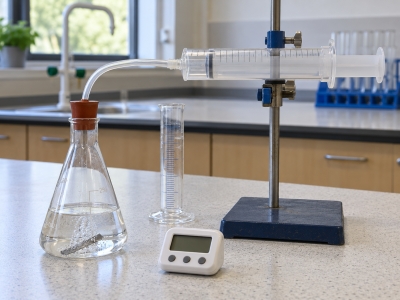
Change concentration only · matched magnesium · continuous gas-volume readings
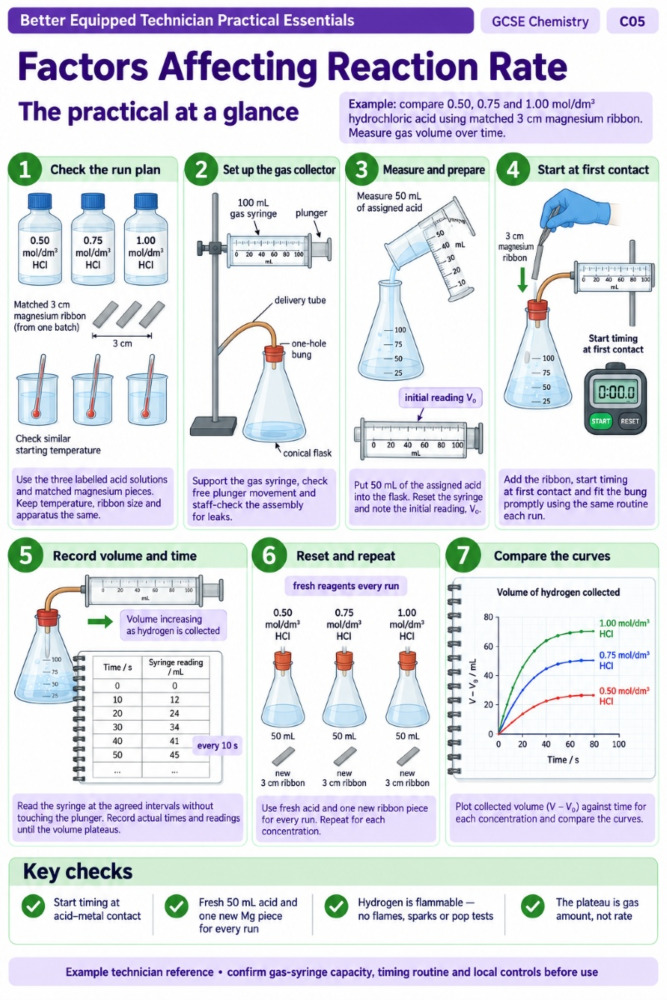
Curriculum boundary: this is the gas-volume method only. AQA also requires a separately planned colour/turbidity investigation. [1] [2]
One reusable set per station · fresh reagents for every concentration and repeat
One set is one shared apparatus station. Extra complete sets include the same run plan. Each run uses 50 mL of one acid concentration and one matched 3 cm magnesium piece. Acid is rounded up to 10 mL per concentration, per set; spare magnesium pieces are rounded up once for the class. Add ribbon cutting/cleaning losses separately. Allowances are supply stock, not extra reactants for a run. The three concentrations and method volumes are fixed; revise the guide and calculator together if the school method changes. This is not a stock-dilution recipe or a pressure-safety calculation. Settings and ticks are not saved.
Interactive calculator not active. Fixed example: 10 stations + 1 extra set; three runs of each concentration; 20% acid allowance and 20% spare magnesium. Prepare 11 sets, 1,980 mL of EACH acid concentration and 119 matched 3 cm ribbon pieces. Adjust locally when scripting is unavailable.
Planning issue: 10 stations + 1 extra set = 11 equipped sets. Three concentrations × 3 runs each = 9 runs per set (99 runs overall). With 20% acid allowance, prepare 180 mL of EACH concentration per set: 1,980 mL of EACH for the class. With 20% class magnesium spares, issue 119 matched 3 cm pieces (99 experimental + 20 spare): at least 357 cm of usable ribbon before cutting losses.
| Item / issue specification | Per equipped set | Class provision |
|---|---|---|
| 1 | 11 | |
| 1 | 11 | |
| 1 assembly | 11 assemblies | |
| 1 assembly | 11 assemblies | |
| 1 | 11 | |
| 3 | 33 | |
| 1 of each | 11 of each | |
| 1 of each | 11 of each | |
| 180 mL / set | 1,980 mL | |
| 180 mL / set | 1,980 mL | |
| 180 mL / set | 1,980 mL | |
| 9 + class spares | 119 pieces (99 + 20 spare) | |
| Per person | Count people separately |
Suitable balance and weighing boats for the batch check; ruler, scissors and approved ribbon-preparation materials. Small temperature-check vessels, labels, record sheets, spare dry tubing, handwashing, spill/first-aid provision and agreed waste routes.
The 3 cm length is a pilot example, not a guaranteed mass. Change a ribbon dimension only after reviewing gas yield and rewriting the matched-run plan. The calculator does not book the colour/turbidity method or other-factor extensions.
Verify stocks → match ribbon → pilot gas capacity → rehearse timing → release stations
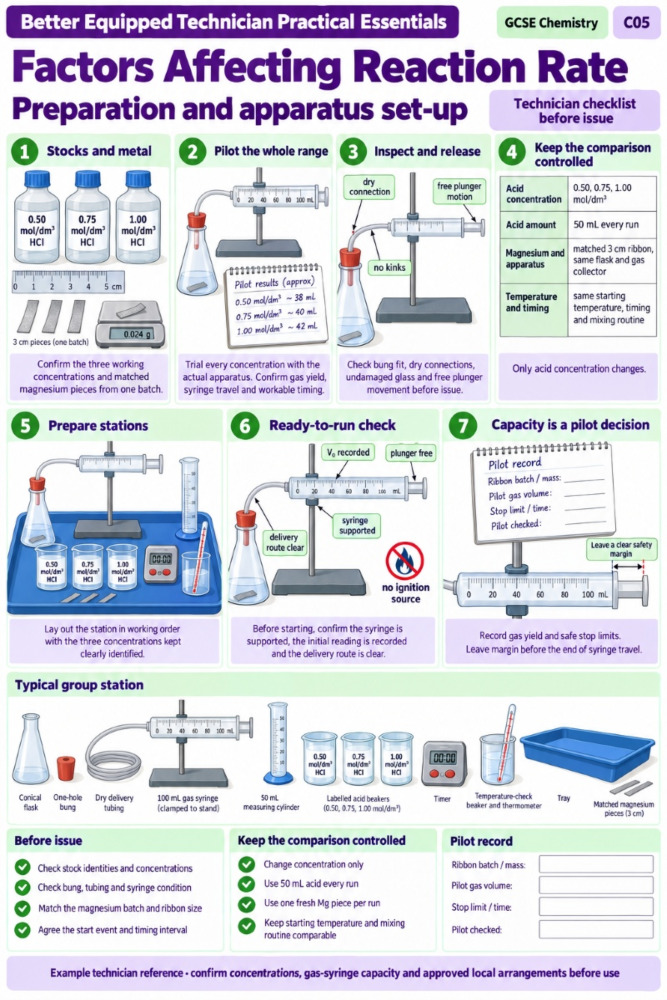
Confirm the three working concentrations and batch labels. Staff prepare solutions by the school’s procedure. Use one ribbon batch; check representative pieces by mass as well as length. Apply the same approved surface preparation to all pieces.
Trial every concentration with the actual flask, tubing, syringe and ribbon. Confirm acid remains in excess, gas yield leaves ample syringe travel, and timing is workable. RSC’s 3 cm example gives about 40 mL gas; this is not a batch guarantee. [3]
Check the bung fit, dry connections, undamaged glass and free plunger motion. Fix the barrel, not the plunger. Rehearse starting at acid–metal contact and record the interval, mixing routine and stopping rule before pupil issue.
| Factor | Plan for every run |
|---|---|
| Acid concentration | 0.50, 0.75 and 1.00 mol/dm³; this is the independent variable. |
| Acid amount measured | 50 mL of the assigned solution. Equal volume, not equal acid moles. |
| Magnesium and apparatus | Matched 3 cm ribbon pieces; same flask geometry, tubing and collection method. |
| Temperature and timing | Similar measured starting temperature; same mixing, start event and reading interval. |
Syringe supported; V₀ recorded; plunger free; delivery route clear; flask and bung compatible; acid and ribbon identified. No liquid in the gas line and no ignition source. Do not test a suspected blockage with a reacting mixture.
Record the actual ribbon mass, final gas volume and safe stop limit. Leave margin before the end of syringe travel. Do not push or pull a stuck plunger during a run; stop, stand clear and alert the teacher for the approved response.
| Elapsed time / s | Syringe reading / mL | Collected volume V − V₀ / mL | Observations / timing deviations |
|---|---|---|---|
| 0 · contact | 0 by definition | Note any start delay. | |
| 10 | |||
| 20 | |||
| Continue… | To the piloted endpoint. |
Check gas collection and timing first · keep raw readings · do not force the apparatus
| Problem | What to check | Technician action |
|---|---|---|
| Gas bubbles, syringe barely moves | Leak, kink, blocked line or a sticking plunger. | Stop and alert staff. Do not force the plunger or open a suspected pressurised joint. Repair/test empty apparatus under the approved procedure; repeat the run with fresh reagents. |
| Reaction is over before readings | Concentration, ribbon size/condition, warm stock or start delay. | Compare with the pilot. Do not silently change the ribbon or acid. Agree and document a revised method, then apply it to every condition. |
| Final volumes differ widely | Ribbon masses, leaks, unfinished runs, gas loss and unequal gas temperature. | Keep the observations. Confirm acid excess and matched portions; compare completed runs under similar conditions before interpreting the plateau. |
| Repeat curves disagree | Starting temperature, timing, mixing, wet flask or crossed labels. | Check the record and technique. Obtain an additional approved run where needed; do not keep only the result nearest the expected curve. |
| Liquid enters the delivery line | Flask headroom, vigorous handling or inlet below the liquid. | Stop and make the apparatus safe. Staff clean/dry or replace affected parts as specified. Do not push liquid through the gas syringe. |
| Plunger nears its travel limit | Oversized ribbon or inadequate pilot/capacity check. | Alert the teacher before the limit is reached and follow the agreed stop response. Never hold the plunger in place or disconnect pressurised apparatus casually. |
Reference check: 10 October 2026. AQA curriculum [1] [2] [4] [6]; RSC gas collection and companion-method resources [3] [5]. Full references and access limits are online. The three-concentration plan, allowances and detailed checking/recording routines are editorial adaptations requiring a local pilot and approval. No examination-board, RSC or CLEAPSS endorsement is claimed.
Explore buying guides, practical resources and laboratory reference information.
This Technician Practical Essentials guide supports preparation for a GCSE investigation of factors affecting reaction rate, using acid concentration and gas collection as its worked example. It covers the class issue, pilot checks, reproducible starts, fresh-run quantities, interpretation and clear-down. It complements our Curriculum Experiments resources.
Source basis and adaptation: AQA supplies the curriculum and rate-measurement context. RSC describes magnesium with hydrochloric acid and permits gas-syringe collection as an alternative to collection over water. [1] [2] [3] [6] The three concentrations, three-repeat example, 100 mL syringe selection, calculator allowances and detailed checking/recording routines here are editorial preparation choices, not a verbatim or laboratory-validated protocol. Pilot the actual apparatus and stock; approve the method locally before issue.
AQA Chemistry practical 5 and Trilogy practical 11 require both gas-volume and colour/turbidity methods, with a hypothesis. [1] [2] This sheet provides the gas-volume route only. Do not describe it as the whole requirement or assume that another board uses the same numbering. The other-factor notes below are planning prompts, not extra issued experiments.
Each station is one reusable flask/syringe arrangement used for all three concentrations. The teacher decides grouping and shares the hands-on tasks. An extra complete set includes the full run allowance; book it only where needed. PPE is counted by people, not by apparatus sets. The default nine-run plan may need more than one lesson; agree time and class pooling in advance. The calculator assumes every set performs all three concentrations.
The calculation below is a screening example, not an expected result or a safety certificate. Measure representative pieces from the actual batch; length alone does not establish mass. Using an illustrative magnesium mass of 0.040 g, relative atomic mass 24.3 and about 24 dm³ per mole of gas at room temperature and pressure: [3] [4]
n(Mg) = 0.040 ÷ 24.3 ≈ 0.00165 mol. The equation requires twice that amount of HCl: about 0.00329 mol. The weakest example charge contains 0.50 × 0.050 = 0.025 mol HCl, so acid is in excess for this illustrative piece. Recheck after any change to ribbon mass, concentration or volume.
V(H₂) ≈ 0.00165 × 24 × 1,000 ≈ 40 mL. This is below a nominal 100 mL syringe’s capacity, but the actual usable travel, starting reading, temperature and collection behaviour still need checking. Set a local stop limit with ample margin; never depend on the end-stop to contain excess gas.
RSC’s approximate ribbon mass and gas-yield values are batch-dependent. Its published numerical statement about the multiple of acid excess is not used here; the check above is calculated from the balanced equation and the guide’s own lowest acid concentration. This avoids treating a quoted ratio as a universal property of a 3 cm strip.
The acid total shown is for each of the three prepared solutions, not one total to divide between them. For the default 11 sets and three runs per concentration, each set uses 150 mL at each concentration before allowance. With 20% handling stock, this becomes 180 mL of each per set, or 1,980 mL of each for the class. The combined issue is 5,940 mL across three differently labelled stocks; it is not a 5,940 mL dilution instruction.
Magnesium is counted once per run: 11 × 3 concentrations × 3 runs = 99 pieces. The class-level 20% spare allowance is rounded up to 20 pieces, giving 119 matched pieces. At 3 cm each that is at least 357 cm of usable ribbon before cutting or surface-preparation losses. Do not put the spare pieces into experimental flasks. The supply allowance does not predict the number of valid results.
Issue correctly labelled working solutions at 0.50, 0.75 and 1.00 mol/dm³. Any staff dilution follows a separate school procedure and the actual stock information. Confirm concentration and temperature after preparation. The calculator does not infer a concentrated-acid recipe or authorise pupil stock preparation.
Drain and dry the flask adequately so leftover water does not change the next concentration. Keep the gas line dry and follow the syringe’s cleaning instructions. A brief delay between first contact and sealing is a limitation of this simple setup. A different closed-start device needs its own approved method and must not create a blocked pressure system.
Compare repeated curves using a stated method. For an average rate over the same time interval, calculate ΔV ÷ Δt; a tangent gives the local gradient of a curve. These are different measures. AQA includes rate calculations and graph interpretation, with a quantitative tangent-gradient requirement at Higher Tier. [6]
If collected volume increases from 8 mL at 20 s to 20 mL at 40 s, the interval mean is (20 − 8) ÷ (40 − 20) = 0.60 mL/s. These invented numbers demonstrate arithmetic only. They are not an initial rate, a required result or a predicted class dataset.
Many time points from one flask describe one run. A repeat needs fresh acid and magnesium after a full reset. At a chosen elapsed time, average comparable valid volumes from independent runs; show variability and explain exclusions. Do not turn a missed point into zero or shift the clock to make curves agree.
With the same limiting magnesium amount and excess acid, compare how quickly a similar total gas amount is reached under comparable conditions. This does not require identical measured plateaux: gas loss, leaks, mass differences and temperature can affect collection. The reaction itself can warm the flask; matching starting temperature does not make a run perfectly isothermal. Record such limitations rather than claiming that every other variable remained exactly constant. [3]
| Factor | What a separate plan must settle |
|---|---|
| Temperature | Choose an approved reaction and temperature-control arrangement; account for thermal expansion in gas collection. Do not add a flame or improvised heater to this hydrogen-producing setup. |
| Surface area | Keep solid mass and chemical identity fixed while defining the particle-size change. Shortening a ribbon changes its amount as well as its area; magnesium powder is not a direct substitute. |
| Catalyst | Choose a separately approved reaction and suitable catalyst, then define how its amount and form will be controlled. Do not add an unspecified catalyst to the magnesium experiment. |
| Pressure | Treat gas-pressure effects through a suitable taught example or separately engineered apparatus. Never obstruct the gas syringe or seal its outlet to investigate pressure. |
These are editorial planning cautions, not additional protocols. AQA lists concentration, temperature, surface area, gas pressure and catalysts as rate factors. [6] Use a separate method, issue list, pilot and risk assessment for each chosen investigation.
A commonly used companion is sodium thiosulfate with hydrochloric acid, timing a fixed cloudiness endpoint such as a disappearing cross. RSC provides a 14–16 practical resource with technician notes. The reaction can release sulfur dioxide: plan the approved scale, ventilation, viewing arrangement, stopping/collection arrangements and waste treatment before issue. [5]
Keep the liquid depth, total volume, cross, viewing conditions and endpoint judgement consistent. A reciprocal-time value, 1/t, is an endpoint-based relative measure; it is not a gas volume per second. This signpost intentionally gives no reagent recipe and is excluded from the C05 calculator. Obtain the complete current school-approved instructions rather than adapting the hydrogen-collection apparatus.
Checked 10 October 2026. References support the chemistry and curriculum. None replaces the school/employer’s risk assessment or the actual supplier SDS and equipment instructions.
The AQA practical handbook PDF could not be retrieved during this build and was not used as the method source. No member-only CLEAPSS guidance or school-specific risk assessment was accessed. No examination-board, supplier, RSC or CLEAPSS approval is claimed.
Have feedback or a useful technician tip? Please contact us.
Draft prepared: October 2026 · Version: 1.0 · Technical review: pending confirmation before publication.
Build the issue around matched magnesium pieces, three labelled dilute acid solutions and reliable gas collection. Confirm syringe capacity, compatible connections and the school’s method before ordering. This is not a pre-approved kit.
Choose ribbon, not magnesium powder. The required acid concentrations must match the method; a catalogue result is not authority to substitute a stronger stock. Apparatus listings may need separate bungs, tubing or supports.
Links open in a new tab or window. These are labelled catalogue searches, not verified individual product recommendations. Search results, availability, pack sizes and specifications were not confirmed during this build; check them before ordering.



 Call us:
 Email us: