We use cookies to give you the best experience possible. By continuing to use the site, you indicate that you accept cookies. See our cookies policy here.
Better Equipped Technician Practical Essentials
A quick-reference, six-page guide for technicians preparing a GCSE energy-change practical: what to issue, how to check starting temperatures, which readings to record and how to clear down. For more detailed curriculum practical resources, visit our Curriculum Experiments resources.
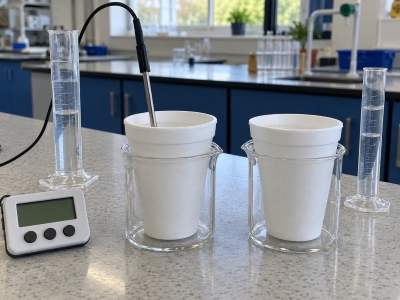
Check the baseline → mix → follow the trace → keep the signed change
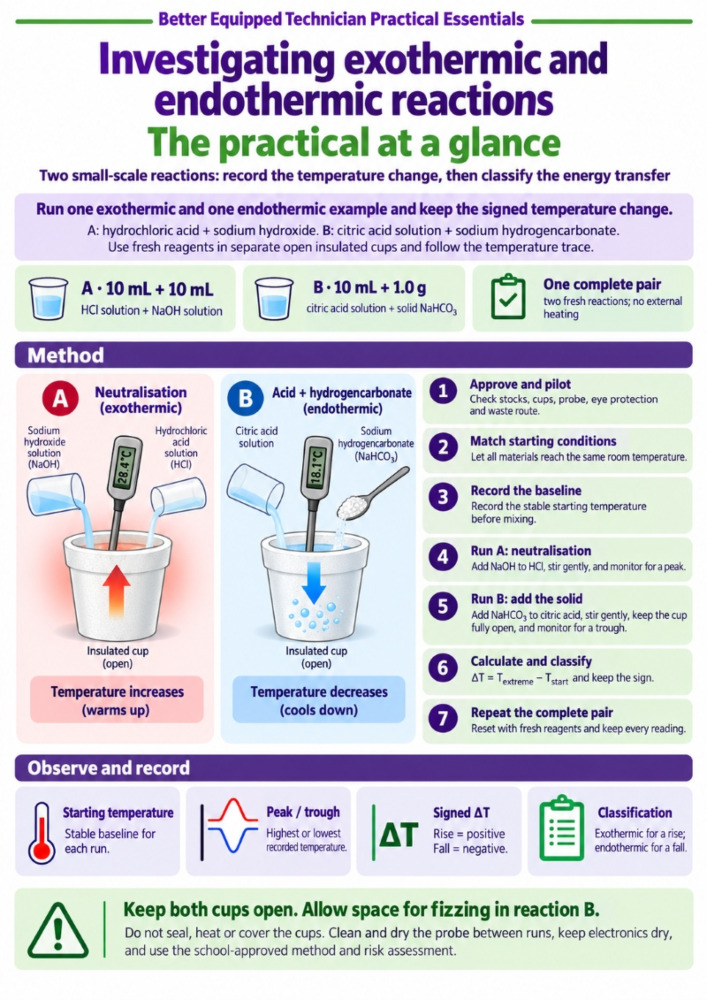
Measurement boundary: compare the direction of change, not which reaction has the larger energy change. A and B have different compositions and heat capacities; this is not a calibrated calorimeter.
One A+B pair per repeat · fresh reagents · reuse two clean reaction cups
One pair means one A reaction + one B reaction. Each pair uses 10 mL of EACH liquid stock (HCl, NaOH and citric acid) and one 1.0 g NaHCO₃ portion. Two cups/supports are reused between complete pairs, only when clean, intact and suitable for reuse. Extra sets receive the same repeat allocation.
Round the supply of each separate liquid up to whole mL per set before multiplying. Round spare solid portions up once across the class. Spares replace lost portions; they do not include extra liquid for additional B runs. Cup replacements, probe-check liquids, cleaning water, stock preparation, handling losses and additional pilots are not calculated. Settings and ticks are not saved.
Interactive calculator not active. Fixed example: 10 stations + 1 extra set, two pairs per set, 25% liquid allowance and 20% spare portions. Provide 275 mL of EACH liquid stock and 27 × 1.0 g NaHCO₃ portions. Book 22 cups/supports, 11 probes and 33 measuring cylinders. Adjust manually when scripting is unavailable.
Planning issue: 10 working stations + 1 extra = 11 sets; 2 complete A+B pairs per set = 22 pairs and 44 reactions. With 25% liquid allowance, provide 25 mL of EACH stock per set: 275 mL of EACH for the class. At 20% spares, prepare 22 + 5 = 27 sodium hydrogencarbonate portions of 1.0 g (27 g total). Reuse 22 cups/supports, 11 probes and 33 dedicated measuring cylinders; add cleaning, replacement cups and extra pilot work separately.
| Item / issue specification | Per equipped set | Class provision (11 sets) |
|---|---|---|
| 2 of each | 22 of each | |
| 1 | 11 | |
| 1 | 11 | |
| 1 | 11 | |
| 3 | 33 | |
| 2 | 22 | |
| 25 mL | 275 mL | |
| 25 mL | 275 mL | |
| 25 mL | 275 mL | |
| 2 portions + class spares |
27 portions (22 + 5 spare) 27 g total |
|
| 1 issue kit | 11 kits | |
| Per person | Count people separately |
Add a balance, dry scoops, portion holders, probe supports, replacement cups, spill/first-aid provision and identified waste vessels. Stock preparation is a separate trained-staff procedure.
The per-set liquid supply includes repeat and handling allowances. Each run still uses the fixed quantities on Chart 1. No indicator, heater, gas syringe or stop bath is required by this example.
Verify stocks → match starting conditions → position the sensor → pilot both traces
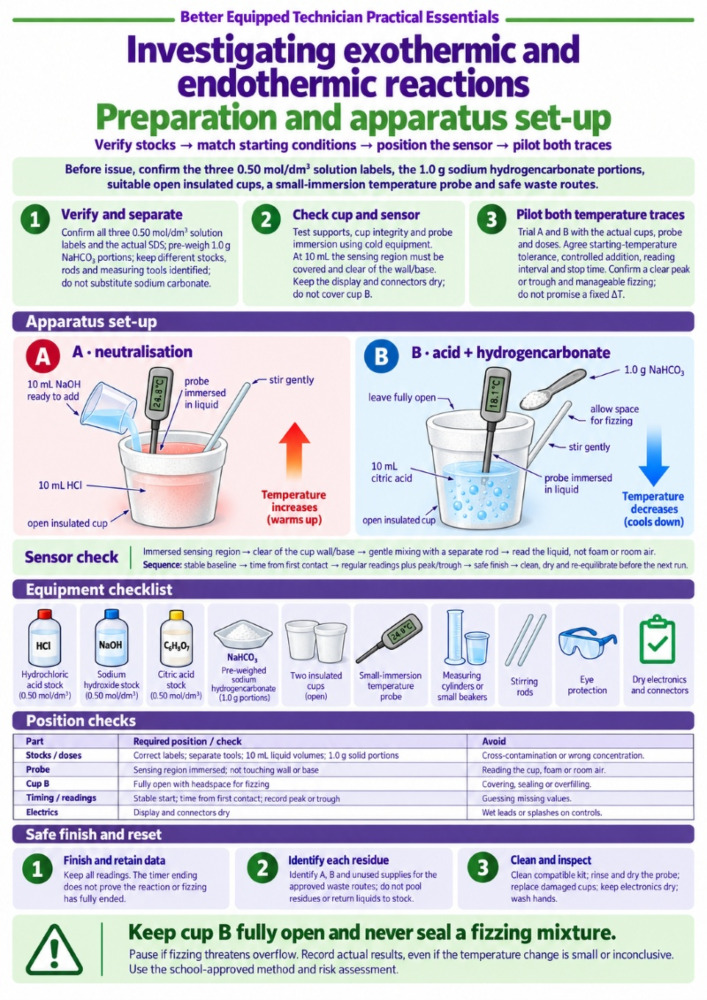
Confirm all three 0.50 mol/dm³ solution labels and the actual SDS. Pre-weigh 1.0 g NaHCO₃ portions. Keep different stocks, rods and measuring tools identified; do not substitute sodium carbonate.
Test supports, cup integrity and probe immersion using cold equipment. At 10 mL the sensing region must be covered, not touching a wall/base. Keep the display and electrical connectors dry; do not cover cup B.
Trial A and B with the actual cups, probe and doses. Agree starting-temperature tolerance, controlled addition, reading interval and stop time. Confirm a discernible peak/trough and manageable fizzing; do not promise a fixed ΔT.
| ID | Charge / addition | Expected observation, not a supplied result |
|---|---|---|
| A | 10 mL 0.50 mol/dm³ HCl + 10 mL 0.50 mol/dm³ NaOH; matched initial temperatures. | Temperature rises during neutralisation; no gas expected. [3] |
| B | 10 mL 0.50 mol/dm³ citric acid + 1.0 g solid sodium hydrogencarbonate. | Temperature falls and the mixture fizzes. Gas production does not mean exothermic. [5] |
For A, record both liquid temperatures before mixing; if they differ beyond the agreed tolerance, wait and recheck. Do not average unequal starts to conceal the mismatch. For B, record the citric acid baseline; keep the solid at the same room conditions.
Pilot an example schedule of every 10 s for up to 3 min, while watching for an earlier extreme. A short peak may be missed between readings. Record any added points and their times; use a faster approved probe/logger where needed rather than inventing a maximum.
| Run / repeat | Tstart / °C | Peak or trough / °C | Signed ΔT / °C | Classification / evidence / limitation |
|---|---|---|---|---|
| A / ____ | ________ | ________ | ________ | |
| B / ____ | ________ | ________ | ________ |
Check starting conditions and probe response · retain raw readings · keep residues identified
| Problem | What to check | Technician action |
|---|---|---|
| Little or no resolved temperature change | Wrong concentration, heat loss, excessive cup mass, shallow probe immersion or a slow sensor. | Record “change not resolved”. Staff review the complete pilot; do not use stronger solutions or larger portions to force a result. |
| A starts with unequal liquid temperatures | Recent stock preparation, different storage or an uncooled/undried probe. | Pause and allow equilibration. Record both starts; do not treat simple warm/cold mixing as reaction evidence. |
| Peak or trough seems to be missing | Reading interval, delayed timing, slow addition or sensor lag. | Keep the actual trace and the limitation. Repeat using the approved schedule; never substitute an expected temperature. |
| B fizzes strongly or threatens overflow | Cup headspace, incorrect dose, too-rapid addition, contaminated tools or wrong solid. | Stop additions and alert staff. Keep the vessel open; do not put on a lid, move a splashing cup or add water to “calm” it. |
| Temperature drifts back towards room level | Heat exchange after the initial peak/trough or the hand warming the cup. | Record the return as part of the trace. It is not evidence that the reaction has changed from exothermic to endothermic, or vice versa. |
| Repeats disagree or ΔT has the wrong sign | Data transcription, starting conditions, cross-contamination, residual rinse water or changed technique. | Retain each raw result. Recalculate extreme minus start and check the issue; do not erase a negative sign or discard a run just to match the prediction. |
Reference check: 14 October 2026. AQA curriculum [1] [2]; RSC neutralisation context [3]; Vernier / AACT temperature investigations [4] [5]; HSE assessment [6]; ACS energy-change explanation [7]. Full references and access limits appear below the printable area.
The stated concentrations, charges, apparatus and calculator are editorial choices, not a laboratory-validated protocol. Technical and safety review plus a local pilot are required; no source organisation has approved this guide.
Explore buying guides, practical resources and laboratory reference information.
This Technician Practical Essentials guide brings together reagent issue, small-volume temperature measurement, baseline checks, repeat planning and safe clear-down. It is intended as a technician quick reference alongside the school’s approved method and our Curriculum Experiments resources.
Source basis and adaptation: the established guide series supplies the four-chart page structure, print approach and calculator pattern. AQA provides the curriculum scope; RSC identifies acid–alkali neutralisation as an accessible exothermic example; Vernier and AACT describe citric acid with sodium hydrogencarbonate as a contrasting temperature investigation. [1] [3] [4] [5] The exact pairing of these examples, 0.50 mol/dm³ stocks, 10 mL charges, 1.0 g solid dose, open-cup issue and preparation budgets are C22 editorial selections, not a verbatim or independently validated recipe from those sources.
This is classification practice. AQA Chemistry required practical 4 and Trilogy required practical activity 10 investigate variables affecting temperature changes. The corresponding wider practical work must be planned separately; C22’s two contrasting examples alone are not a claim of full coverage. [1] [2]
A is one neutralisation; B is one acid–hydrogencarbonate reaction. Repeating the pair means new reactants for both, not an additional reading from a used mixture. Run sequentially with the shared probe, cleaning and resetting it between different liquids.
Ten millilitres is shallow in some insulated cups. Check the manufacturer’s minimum sensor immersion and ensure the sensing region stays in the liquid, clear of walls, base and foam. A wider cup can increase heat loss and reduce depth. Changing geometry may require re-piloting and a new issue plan, not simply adding more liquid.
Use the same room-temperature conditions for all reagents and apparatus. For A, check the two actual liquid temperatures before mixing. Specify an acceptable difference in relation to the expected signal and instrument uncertainty; do not claim one universal tolerance. Measure each run’s own starting temperature rather than reusing the room reading.
Give the solution a gentle, repeatable stir using a separate rod. Do not warm the cup with the hand, press the sensor against its base or remove the probe during the trace. Clean and dry the probe without leaving rinse water that changes the next charge. A digital display’s decimal places do not establish its accuracy, immersion requirement or response speed; check the actual instrument instructions.
Reading plan: every 10 seconds for up to three minutes is a planning example, not a guaranteed way to capture the extreme. Observe continuously and record any peak or trough with its actual time. If the local pilot is faster than manual reading allows, revise the approved measurement arrangement. Keep “no resolved change” or “extreme not captured” distinct from a completed measurement. AACT provides an example of repeated temperature readings; its quantities and schedule differ from C22. [5]
HCl(aq) + NaOH(aq) → NaCl(aq) + H₂O(l)The intended observation is a temperature rise, not a colour change or gas test. Match the two starting solutions before mixing. Do not add universal indicator merely because the reagents resemble the C15 neutralisation investigation.
The reacting mixture is expected to cool and produce carbon dioxide. [4] [5] This example starts with a solid, so dissolution, reaction and heat exchange contribute to the observed trace. Citric acid is not interchangeable with hydrochloric acid, and sodium hydrogencarbonate is not sodium carbonate.
The comparison records the net temperature response of each procedure. Different quantities of reacting material, solution masses, gas losses and cup heat capacities prevent a fair comparison of molar energy changes from the heights of the traces alone. B may retain acid after the stated addition; neither expected temperature change establishes a final pH or a disposal route.
A start of 21.0 °C and peak of 24.2 °C gives ΔT = +3.2 °C.
A start of 21.0 °C and trough of 17.6 °C gives ΔT = −3.4 °C.
These are invented arithmetic examples, not expected or measured C22 results. Keep the sign and record realistic precision.
After a peak or trough, heat exchange can pull the mixture back towards the room temperature. Do not use that later drift to reclassify the original process. Examine the complete trace and retain any unresolved result instead of choosing a convenient late reading.
At the teaching level, exothermic processes transfer energy out and endothermic processes take energy in. Bond breaking requires energy; bond formation releases it. The overall balance determines the reaction’s energy change. A temperature trace alone does not identify individual bonds or quantify those contributions. [7]
Fixed example: 10 working stations + 1 extra complete set; two A+B pairs per set; 25% liquid handling allowance; 20% spare solid portions. The interactive controls update Chart 2 only; this worked example deliberately remains fixed.
11 sets × 2 pairs = 22 pairs / 44 reactions.
For EACH stock: 10 mL × 2 pairs × 1.25 = 25 mL per set.
25 mL × 11 = 275 mL HCl, 275 mL NaOH and 275 mL citric acid.
Keep all three stocks separate. Working bottle fill and losses beyond the allowance require local planning.
22 B runs need 22 × 1.0 g portions.
22 × 20% = 4.4, rounded up to 5 spares.
Prepare 27 portions / 27 g NaHCO₃, plus any preparation losses.
2 cups/supports × 11 sets = 22 of each; 1 probe × 11 = 11 probes; 3 cylinders × 11 = 33 cylinders.
Rounding and limits: liquid quantities are rounded up separately per stock, per equipped set, before multiplying. Solid spares are rounded up once across the class. A spare solid portion is not an additional complete experiment: extra B runs also need citric acid. Reusable cups are counted once per station only on the assumption that they remain suitable for cleaning and reuse; add replacement cups or single-use provision locally.
Local approval must cover the actual solutions, weighed solid, open-cup gas release, handling, spills and cleaning. Keep the work at the approved scale and issue prepared solutions, not concentrate or sodium hydroxide pellets. Check substance identity and labels rather than treating familiar ingredients as edible. Follow the school’s eye-protection and handwashing requirements. [5] [6]
Staff decide how each spent mixture, first rinsing and unused working supply is retained or disposed of. Do not infer a neutral pH or drain permission from the word “neutralisation”. Do not pool reacting residues, add them back to fresh stock or seal a mixture still releasing gas. No external heating, cold-pack bag, balloon, flame test or chemical recovery is included in this guide.
Checked 14 October 2026. Source content and this guide’s editorial preparation choices are distinguished above.
Public AQA, Vernier, AACT, ACS and HSE pages and indexed RSC text were consulted. No supplier-specific SDS or member-only CLEAPSS procedure was reviewed. Before classroom use, trained staff must check current authorised guidance, the actual product SDS and equipment instructions, then approve and pilot the complete activity. No source organisation has approved this guide.
Have feedback or a useful technician tip? Please contact us.
Draft prepared: 14 October 2026 · Version: 1.0 · Technical review: pending confirmation before publication.
Build the issue around supported insulated cups, a suitable small-immersion temperature probe, dedicated measuring tools and verified working solutions. Confirm the local method, sensor response, cup compatibility and chemical concentrations before ordering. This is not a pre-approved kit.
Links open in a new tab or window. These catalogue searches are not verified product matches or availability checks. Confirm product specifications, sensor immersion and cup suitability. Do not substitute sodium carbonate or issue concentrated reagents. Stock preparation is a separate staff procedure.



 Call us:
 Email us: