We use cookies to give you the best experience possible. By continuing to use the site, you indicate that you accept cookies. See our cookies policy here.
Better Equipped Technician Practical Essentials
A quick-reference, six-page guide for technicians preparing a GCSE separation practical: what to issue, how to keep the residue and filtrate distinct, when to stop heating and how to retain both solids. For more detailed curriculum practical resources, visit our Curriculum Experiments resources.
Dissolve → filter → keep the sand → evaporate the filtrate → dry and identify
The complete text guide is available below. The corresponding infographic is reserved for page 5 of the six-page print pack.
Count fresh portions per batch; reserve drying vessels; reuse the working station
One complete batch uses one mixed portion (4 g sand + 1 g NaCl), 25 mL extraction water plus up to 5 mL total for filter wetting and transfers, and one filtration paper. A batch retains one basin/loose cover, one sand-residue dish and two sample pots. Mixing, filtering and heating equipment is reused sequentially. Extra sets include the same batch allocation.
Round process water up to whole mL per set before multiplying. Round spare dry portions and papers separately across the class. Solids are calculated from the complete portion count. Spares are replacements, not extra full batches: additional runs also need water and retained vessels. Bath water, cleaning water, portion holders, preparation losses, pilot work and drying times are not calculated. Settings and ticks are not saved.
Interactive calculator not active. Fixed example: 10 stations + 1 extra set, two batches per set, 25% process-water allowance and 10% spare portions/papers. Provide 825 mL water, 25 mixed portions (100 g sand + 25 g salt) and 25 papers. Reserve 22 basins/covers, 22 residue dishes and 44 sample pots; reuse 11 working stations. Adjust manually when scripting is unavailable.
Planning issue: 10 working stations + 1 extra = 11 sets; 2 complete batches per set = 22 batches. With 25% water allowance, provide 75 mL process water per set: 825 mL for the class. At 10% spares: 25 mixed portions (100 g sand + 25 g NaCl) and 25 filtration papers, each 22 + 3 spare. Reserve 22 basins/covers, 22 residue dishes and 44 sample pots. Reuse 11 heating/filtration kits sequentially; drying time and extra pilot work are not calculated.
| Item / issue specification | Per equipped set | Class provision (11 sets) |
|---|---|---|
| 1 | 11 | |
| 1 | 11 | |
| 1 filtration kit | 11 kits | |
| 1 of each | 11 of each | |
| 2 of each | 22 of each | |
| 2 dishes 4 pots |
22 dishes 44 pots |
|
| 1 booked position + handling kit |
11 positions / kits | |
| 2 papers + class spares |
25 papers (22 + 3 spare) |
|
| 2 portions + class spares |
25 portions 100 g sand + 25 g NaCl |
|
| 75 mL | 825 mL | |
| 1 issue kit | 11 kits | |
| Per person | Count people separately |
Reserve supervised bath positions and labelled drying places. Shared equipment needs a timetable; the calculator does not determine electrical load, bath capacity or elapsed time.
Add a balance, scoops, portion holders, spare clean tools, spill/first-aid provision and approved waste arrangements. No weighing of hot or wet recovered samples is planned.
Verify the mixture → fit the filter → pilot evaporation → retain both fractions
The complete text guide is available below. The corresponding infographic is reserved for page 6 of the six-page print pack.
Verify clean, washed coarse sand and sodium chloride. Staff make separate 4 g + 1 g portions; do not rely on an uneven bulk scoop. Match sand and paper so the residue is retained without an impractically slow filter.
Fit and wet the paper; test support and receiver clearance. Keep liquid below the paper edge. Check basin support, bath water level, electrical separation and the handling route using cold apparatus first.
Test dissolution, the full 5 mL transfer budget, filtrate clarity, gentle concentration and an off-heat finish. Agree the small-volume heating stop and next check. Book one basin and residue dish per batch.
| Stage | Required position / check | Avoid |
|---|---|---|
| Filter and paper | Paper supported and seated; no tears; liquid kept below the paper rim. | Overfilling, poking the paper or pouring around its edge. |
| Receiver and filtrate | Stable labelled beaker; funnel tip clear of rising liquid; no visible sand. | Treating a clear filtrate as pure water or discarding it. |
| Transfer water | At most 5 mL combined for wetting and transfers in this example. | Unmeasured repeated rinsing that greatly extends evaporation. |
| Heating and stop | Stable basin on the approved bath; stop external heat with liquid remaining. | Heating wet paper, waiting for spitting or heating a dry crust. |
| Drying and retention | Sand paper on its own dish; salt in its own basin; labels and a named next check. | Recombining the fractions or tightly sealing hot/wet samples. |
| Batch / mixture | Filter residue | Filtrate clarity | Salt / drying / issue |
|---|---|---|---|
| ________ | ________ | ________ | |
| ________ | ________ | ________ |
Keep the filtrate · prevent bypass and overheating · account for both solids
| Problem | What to check | Technician action |
|---|---|---|
| Filtration is slow or stops | Overfilled paper, fine sand, poor paper fit or an unsuitable grade. | Pause additions and let the liquid drain. Do not pierce, squeeze or scrape the paper; staff review the filter and retain the batch. |
| Filtrate contains visible sand | Torn paper, flow over its rim, or pouring around the paper. | Keep the liquid labelled. Re-filter as approved through fresh suitable paper before evaporation; do not call a cloudy sample successfully separated. |
| Little salt is recovered | Incomplete dissolution, discarded filtrate, transfer losses or insufficient evaporation time. | Check the material record and labels. Retain the actual outcome; do not add extra salt to make the sample look successful. |
| Wet sand appears to contain salt | Salt solution left with the sand, undissolved salt or inadequate planned washing. | Record the limitation. Additional measured washing is a method change and adds liquid to evaporate; do not claim a purity result. |
| Salt remains wet / drying is unfinished | Excess transfer water, early removal from heat or insufficient off-heat time. | Keep the batch labelled for the next check. Do not restart aggressive heating, taste the residue or report a wet mass as dry salt. |
| Spitting, a dry crust or bath trouble | Over-concentration, excess heat, low bath level, unstable support or wet electrical parts. | Stop heating if safe, stand clear and alert staff. Do not add water to a hot basin, touch wet controls or scrape hot salt. |
Reference check: 14 October 2026. AQA separation principles [1] [2]; RSC separation activity and terminology [3] [4] [7]; HSE assessment and electrical safety [5] [6]. Full sources and access limits are below the print area.
The scale, transfer budget, electric-bath method, off-heat finish and calculator are editorial adaptations, not a laboratory-validated protocol. Local technical and safety approval is required; no source organisation has endorsed this guide.
Filtration and evaporation
Infographic space reserved. The artwork has not yet been added to this guide.
The complete practical instructions are provided on pages 1–4.
Filtration and evaporation
Infographic space reserved. The artwork has not yet been added to this guide.
The complete practical instructions are provided on pages 1–4.
Explore buying guides, practical resources and laboratory reference information.
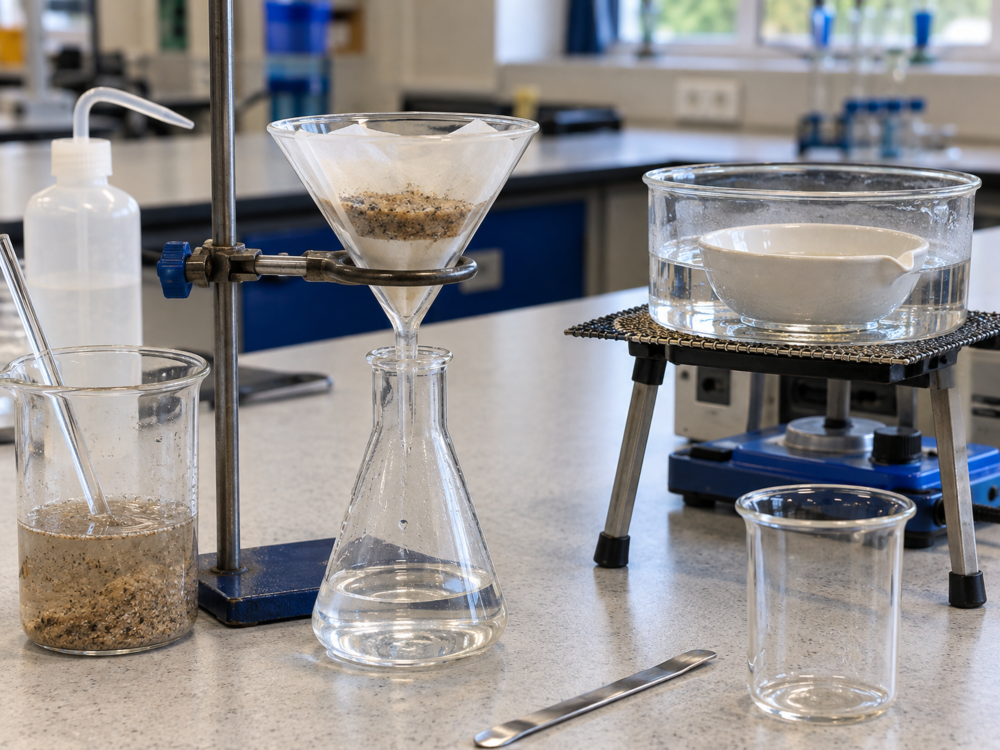
This Technician Practical Essentials guide brings together a known sand–salt issue, selective dissolution, gravity filtration, controlled evaporation and separate retention of both solid fractions. It complements our Curriculum Experiments resources.
Source basis and adaptation: the page structure, print approach and interactive controls follow C20. AQA provides the curriculum context; RSC describes separating sand and salt by dissolving, filtering and evaporating. [1] [2] [3] C21’s 4 g sand + 1 g NaCl, 25 mL extraction water, 5 mL combined wetting/transfer budget, electric water bath, off-heat finish and retained-vessel allocation are editorial choices. The RSC activity uses about 50 mL water and a burner-based evaporation routine; this page is not a verbatim reproduction of that method.
AQA Chemistry 4.1.1.2 and Trilogy 5.1.1.2 cover physical separation of mixtures and the selection of suitable techniques. [1] [2] C21 is a supporting practical, not an examination-board practical identifier or a complete salt-synthesis procedure.
A complete batch begins with a fresh mixed portion and finishes with sand separated from recovered salt. Re-filtering the same liquid or checking a drying basin again is not a new batch. Two batches need separate retained vessels even when the working apparatus is reused.
Use verified sodium chloride and clean, washed coarse sand of a grade compatible with the paper. Staff pre-weigh the two components for each mixed portion. Dry particles of different sizes can segregate in a bulk container; a scoop is not a dependable measured composition. Avoid creating dust; do not grind sand or use an unknown building, beach or soil sample.
The paper must seat inside the funnel and retain the chosen sand without an impractical delay. Pilot the actual funnel, paper and grain size together. Keep all pours below the paper rim. A tear or overflow allows solids into the receiver; an extra clean filter is a correction to record, not evidence that the first filter worked.
The 30 mL process-water budget is 25 mL for dissolution + up to 5 mL total for paper wetting and transfers/rinsing. Allocate these before starting. The 5 mL is not an additional 5 mL for every rinse. Bath filling and cleaning water are separate. The volume of filtrate recovered need not equal 30 mL because some solution remains with the sand, paper and vessels.
Some salt solution can remain in the sand residue. The demonstration is sufficient to discuss the two fractions, but it is not a validated quantitative extraction. A larger or repeated wash must be specified and budgeted separately, and will extend evaporation. Additional washing or mass-recovery comparisons need their own teaching plan.
Confirm a heat-rated basin, compatible non-floating support, working water level, accessible heat control and suitable handling tools. Separate wet filtration from electrical controls. Inspection and testing depend on the equipment and conditions; an old label alone is not a pre-use check. [6] Do not add improvised heating accessories or assume the calculator has booked enough bath positions.
This adaptation removes external heat at a piloted small-volume stage while liquid remains. The sample then finishes evaporating in its protected holding place. A loose dust cover should leave an evaporation gap and must not seal a hot vessel. Staff need to trial how long this takes; the guide promises neither a fixed heating time nor a dry sample within one lesson.
Residue is the material retained by the filter; filtrate is the liquid that passes through. [4] For the stated mixture, dissolved sodium chloride travels with the water through ordinary filter paper while the sand grains remain. The filtrate may be clear and colourless without being pure water.
Evaporation removes solvent; dissolved material remains and can form a solid deposit as water leaves. These are physical separation processes, not a reaction that makes sodium chloride. [1] [7] In this guide, water is not condensed and collected. C19 covers solvent recovery by distillation, while C20 concentrates a prepared copper(II) sulfate solution and recovers a crystal crop on cooling.
Keep the two uses of “residue” unambiguous: “filter residue” means the retained sand; “evaporation residue” means the salt left in the basin. Label by material and stage, not simply “residue”. Do not discard the filtrate after successfully collecting sand, because it carries the salt needed for the next step.
Visible separation is not a measured purity or recovery result. A wet salt sample includes water; a sand sample may include adhering salt solution. Any quantitative extension needs recorded starting component masses, a defined drying endpoint, tare measurements and transfer-loss controls. No balance-reading or recovery percentage is inferred from the calculator.
Fixed example: 10 working stations + 1 extra complete set, two batches per set, 25% process-water allowance and 10% spare dry portions/papers. The interactive calculator updates Chart 2; this explanation remains a fixed example.
11 sets × 2 batches = 22 planned batches.
Water: 30 mL × 2 × 1.25 = 75 mL per set; 75 × 11 = 825 mL.
Dry portions: 22 + ceil(22 × 0.10) = 25 portions.
25 × 4 g = 100 g sand; 25 × 1 g = 25 g NaCl.
22 papers + 3 rounded spares = 25 papers.
One basin, loose cover and sand-residue dish per batch = 22 of each.
Two sample pots per batch = 44 pots.
Mixing, filtering, measuring and heating/handling provision = 11 reusable sets.
Rounding and replacements: water is rounded up to whole millilitres per set, then multiplied. Spare papers and dry portions are rounded up independently across the class; their totals happen to be equal because one of each is used per batch. The solid masses are preparation totals for the complete portion count, not a dose to place in one beaker.
Spare portions do not automatically create new complete batches. To run extra batches rather than replace a lost portion, increase the batch count or add complete sets so water and retained vessels are included. Further pilot work, pre-weighing holders, packaging losses, shared-bath scheduling, bath/cleaning water and extra re-filtration beyond the paper allowance require local additions.
Keep the heating stop, hot-vessel transfer and drying check under staff control. A sample can be left off heat in a designated labelled area, but the electric bath must not be left heating unattended. If a bath leaks or wet electrical parts are suspected, stand clear, stop heating only if safe and alert staff. [6] No pupil should improvise an electrical repair or judge vessel temperature by touch.
Retain samples only as the teacher directs. Remove sand and used paper before washing vessels; use the school’s approved routes for solids, salt solution and rinsings. Do not taste the liquid or recovered salt. No drain-disposal, food-grade or take-home approval is implied, and this waste plan must not be copied to unknown or substituted chemicals.
Checked 14 October 2026. Public source principles and this guide’s planning adaptations are distinguished above.
The AQA and HSE pages and publicly indexed RSC text were consulted. Direct access to the RSC pages was restricted during preparation. No member-only CLEAPSS procedure, actual sand/salt product SDS or specific water-bath instructions were reviewed. Trained staff must check the current authorised guidance and actual equipment/materials, then approve and pilot the complete activity. No source organisation has approved this guide.
Have feedback or a useful technician tip? Please contact us.
Draft prepared: 14 October 2026 · Version: 1.0 · Technical review: pending confirmation before publication.
Build the issue around a known sand–salt mixture, well-matched gravity filters, supported water-bath evaporation and separate drying vessels. Confirm the locally approved materials, paper grade, basin support and heating arrangements before ordering. This is not a pre-approved kit.
Links open in a new tab or window. These are catalogue searches, not verified product matches or availability claims. Check material grade, paper retention, vessel sizes, heater compatibility and suitable handling tools. Allow separately for preparation holders, cleaning supplies and shared equipment.



 Call us:
 Email us: