We use cookies to give you the best experience possible. By continuing to use the site, you indicate that you accept cookies. See our cookies policy here.
Better Equipped Technician Practical Essentials
A quick-reference, six-page guide for technicians preparing GCSE flame tests: what to issue, how to organise samples and burners, how to check for contamination, what to record and how to clear down. For more detailed curriculum practical resources, visit our Curriculum Experiments resources.
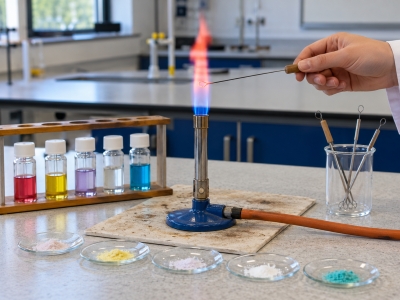
Known references first · separate sample loops · small working portions · no alcohol or sprays
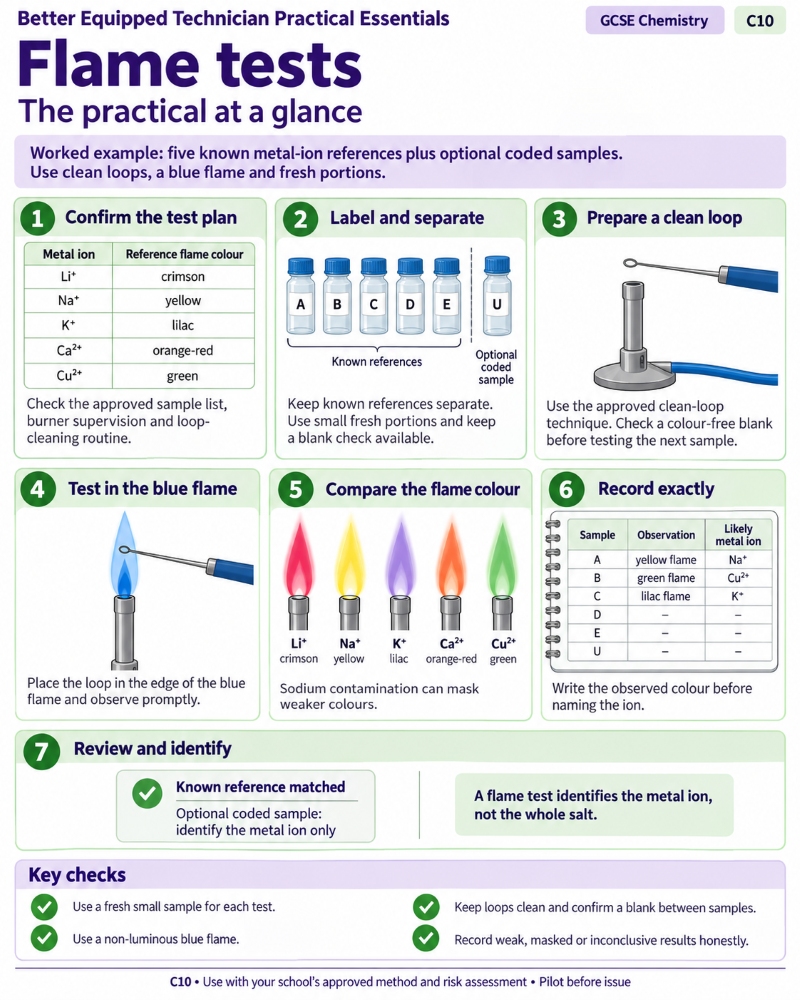
Sample sets and burner positions counted separately · reusable loops · fresh working portions
Each set receives all five references and the selected coded samples. Every set has the same codes; calculate different allocations as separate batches. One round is one presentation of EACH sample, not one burner or one new apparatus set. Budget 2 mL working solution per code per round and 2 mL blank water per round, add the percentage, then round up to 1 mL per code per set. This is a supply allowance, not the amount to burn. Only a tiny loop-held sample enters the flame. Loops, vessels and droppers are reused after approved reset. Extra sets receive the same run plan; burner numbers are independent. Stock strengths, cleaning reagents, staffing and gas-service capacity are not calculated. Settings and ticks are not saved.
Interactive calculator not active. Fixed example: 10 working sets + 1 extra; five references + one coded sample; two tests each; 25% allowance. Prepare 77 loops, 77 small vessels and 55 mL of EACH of the six sample solutions, plus 55 mL blank water. Book two shared burners. Cleaning provision and washing water are additional. Adjust locally when scripting is unavailable.
Planning issue: 10 working sets + 1 extra = 11 sets; five references + 1 coded sample/set. Two tests per code = 132 sample presentations, plus blanks. Prepare 7 loops and 7 vessels/set (77 of each). At 25% allowance: 5 mL of EACH reference and EACH coded sample/set (55 mL of EACH/class); keep supplies separate. Blank water: 55 mL/class, washing water extra. Book 2 shared burner positions. Volumes round up to 1 mL per code per set.
| Item / issue specification | Per sample set | Class provision |
|---|---|---|
| 7 | 77 loops | |
| 7 | 77 vessels | |
| 1 kit | 11 kits | |
| 7 | 77 droppers | |
| 1 of each | 11 of each | |
| 5 mL | 55 mL | |
| 5 mL | 55 mL | |
| 5 mL | 55 mL | |
| 5 mL | 55 mL | |
| 5 mL | 55 mL | |
| 5 mL / code | 55 mL / code | |
| 5 mL | 55 mL | |
| Shared, not per set | 2 kits | |
| Per person | Count people separately |
Staff loop-cleaning materials, extra blanks/controls, replacement loops, labels, records, spill/first-aid and waste provision. No concentrated-acid cleaning stock is included in pupil issue.
Confirm solution strengths, working-vessel depth and the amount needed to wet a loop. The 2 mL budget and 25% allowance are editorial examples, not validated test doses or guaranteed supply needs.
Confirm the sample bank → pilot all colours → check blanks → separate hot and wet areas
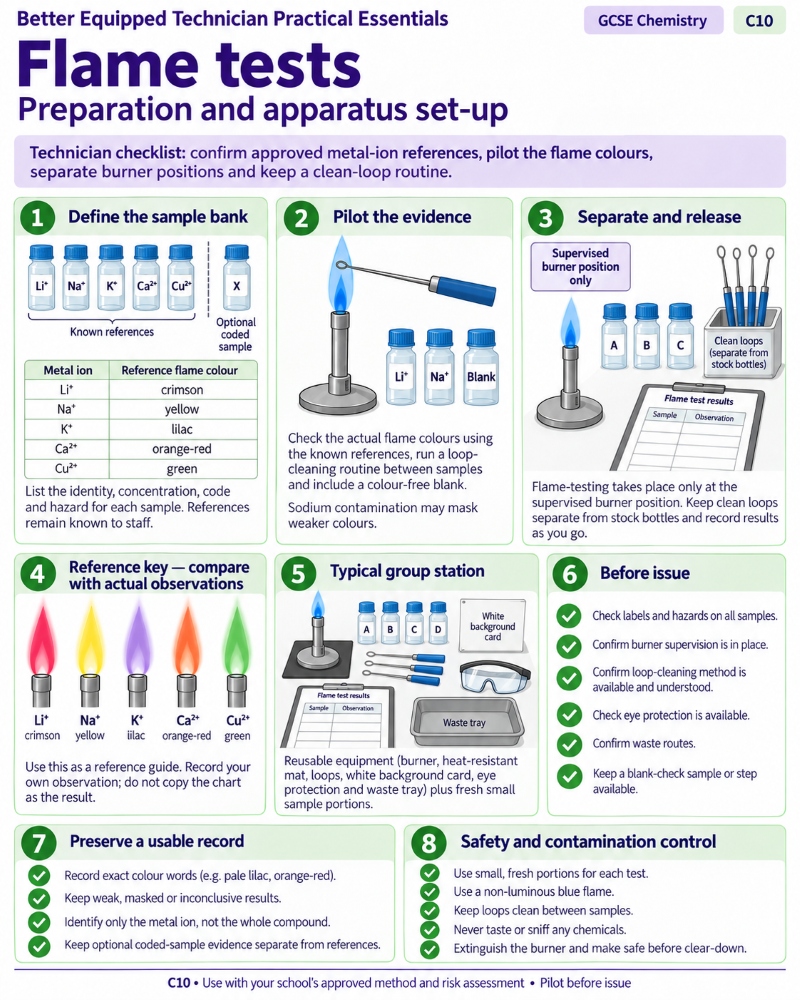
Record the salt, concentration, batch, code and SDS for every bottle. Use aqueous references and single-salt unknowns from the same bank. A code does not replace hazard labelling. Keep the identity key with staff.
Use the actual solutions, loops and burner. Check all five references, a clean carrier and water blank, including weak potassium and the difference between lithium and calcium. Approve the loading, viewing and cleaning routine. [3] [4]
Check burner condition and compatible gas tubing by the school’s procedure. Provide stable sample racks, labelled loop rests and a clear work area. Keep stock and washing areas away from heat; agree supervision and stopping rules.
| Cation / sample | AQA colour term | Technician check |
|---|---|---|
| Lithium · Li⁺ | Crimson | Compare with the calcium reference; do not record both simply as “red”. |
| Sodium · Na⁺ | Yellow | Keep sodium-dedicated equipment separate; check contamination if everything looks yellow. |
| Potassium · K⁺ | Lilac | A weak colour needs a successful known control, not a guessed negative result. |
| Calcium · Ca²⁺ | Orange-red | Match the actual reference under the same viewing conditions. |
| Copper(II) · Cu²⁺ | Green | A blue-green appearance may be seen with the chosen stock. Record it honestly; AQA uses “green”. [4] |
A bare-loop check tests the carrier. A deionised-water blank tests water and handling. A known salt checks that the method produces its expected colour. A clean dedicated loop is still checked before use; dedication alone is not proof of cleanliness.
Only the loop enters the test flame. Keep hands on the holder and labels away from heat. Let the loop cool before contact with liquid, fingers or storage. Return it to its labelled rest, not across sample vessels; do not touch the wire to test its temperature.
| Sample / repeat | Loop / blank check | Actual colour / changes | Cation inference / limitation |
|---|---|---|---|
| Reference ____ / ____ | |||
| Code ____ / ____ |
Check the carrier, stock and blank first · preserve observations · do not improvise larger flames
| Problem | What to check | Technician action |
|---|---|---|
| Every sample looks yellow | Sodium contamination, fingers on wire, shared droppers or the burner’s own yellow flame. | Check a clean loop, blank and known reference. Replace contaminated portions. Do not relabel all samples as sodium. [3] |
| Little or no sample colour | Correct stock, loop loading, viewing position, flame setting and the known control. | Repeat using the approved routine. Keep an inconclusive result; do not add stronger solution or change the test carrier without agreement. |
| Colour persists on the blank | Old deposits, a crossed loop, contaminated water or an unsuitable carrier. | Withdraw the loop and replace the blank. Staff use the approved cleaning procedure; no improvised strong-acid treatment. |
| Lithium and calcium confused | Different sample amounts, very brief colour, viewing conditions or crossed labels. | Compare fresh known controls and record the distinct words. Do not overwrite the first observation to fit the key. |
| Mixed colours / conflicting repeats | Carrier carry-over, shared vessels, coded sample outside the bank or unexpected mixed stock. | Retain both observations. Check identity and blanks; restart with verified separate portions. Do not resolve a conflict by guessing a new salt. |
| Burner problem, spill or damaged holder | Unstable flame, suspect gas connection, hot wire, loose handle or spilt liquid near heat. | Stop and alert staff. Make the area safe using the school’s procedure; isolate faulty equipment. Never investigate a suspected gas leak with a flame. |
Reference check: 12 October 2026. AQA curriculum [1] [2]; RSC wire-loop, contamination and method resources [3] [4] [6]; CLEAPSS public resource listing [5]. Full source notes and access limits are online. The dedicated-loop layout, coded-sample plan, supply budgets and calculator are editorial choices requiring a local pilot and approval. No external endorsement or completed technical review is claimed.
Explore buying guides, practical resources and laboratory reference information.
This Technician Practical Essentials guide supports preparation for a GCSE flame-test investigation. It brings together sample issue, burner organisation, contamination checks, reference observations, repeat records and clear-down. It complements our Curriculum Experiments resources.
Source basis and adaptation: AQA defines the five-ion curriculum and the wider ion-identification requirement. [1] [2] RSC describes wire-loop presentation in a blue flame, cleaning and contamination. [3] [4] [6] This C10 layout uses school-prepared aqueous chlorides, dedicated handled loops, optional coded single-salt samples and a separate count of shared burners. Those arrangements and the 2 mL supply budget are editorial preparation choices, not a verbatim published protocol or a laboratory-validated recipe.
C10 isolates the flame-test skill for additional practice and comparison. C07 covers a wider chemical-test menu. A flame result supports a metal-ion identification; identifying both ions in a whole salt needs the relevant further tests. This standalone guide does not complete AQA required practical 7. [2]
The printed reference key uses AQA terminology. RSC descriptions include some different everyday colour words and a blue/green appearance for copper. Keep the actual observation as recorded, then relate it to the selected specification and known reference. Do not change a pupil’s raw colour word merely to match a diagram. [1] [4]
The sample bank is lithium chloride, sodium chloride, potassium chloride, calcium chloride and copper(II) chloride in water. Use the school’s validated working solutions and record each actual concentration and formulation. This guide deliberately sets no universal stock strength: the published sources use different carriers and preparation approaches. A successful local pilot, the exact SDS and the employer’s assessment determine what is issued. Selecting a different salt, solvent or concentration requires reviewing the method, hazards and observations together.
Keep large stock bottles in the preparation area. Small labelled aliquots reduce stock contamination; use a dedicated dropper and carrier for each sample. Unknowns must be staff-known single salts drawn from the same five-reference bank. Preserve required hazard information and keep a staff key; use recorded or demonstrated evidence where coding is inappropriate.
The issue allows one loop per sample plus one spare/blank loop per set. Check every loop; keeping it dedicated does not remove deposits or surface contamination. Staff must approve cleaning and cooling before reissue. The public CLEAPSS PP037 listing describes a nichrome-wire method that avoids concentrated hydrochloric acid, but its member-only instructions were not consulted. Read the full current procedure through school access. [5]
This worked layout supplies pre-checked loops and sends a failed blank back to staff for cleaning or replacement. Cleaning-acid identity, strength and quantity therefore remain separate from sample issue. RSC outlines acid cleaning in general, but does not make any acid concentration automatically suitable for every school arrangement. Do not treat omission from the calculator as omission from the risk assessment. [3]
One round means one test of every issued sample code. Blank checks, cooling, repeat observations and travel between work areas add time. A second burner provides another position only when the gas service, space and supervision are approved; it does not double reagent demand. Pilot the actual class rotation instead of inferring staffing or lesson length from the calculator.
With 10 working sets and one extra, prepare 11 sets. Five references plus one coded sample gives six codes. Two rounds require 11 × 6 × 2 = 132 sample presentations. Each solution budget is 2 × 2 × 1.25 = 5 mL per set, giving 55 mL of each reference and 55 mL of the coded sample. These supplies remain separate. Each set has seven loops and seven vessels, giving 77 of each.
The formula is: mL per code per set = round UP [2 × rounds × (1 + allowance/100)] to the next whole mL. Multiply by the number of sets, not burners. Apply the same calculation to blank water. With zero coded samples, the coded-sample requirement becomes zero and each set retains five reference positions plus one blank/spare. Additional codes are separate supplies, never a mixed stock.
No stock dilution, acid-cleaning recipe, fuel demand, gas-installation capacity or supervision ratio is calculated. Washing water, exceptional replacement loops, staff-only extra checks and any demonstration material need separate provision. The 2 mL working-portion allowance is much larger than the tiny film carried into the flame and must never be poured into it.
Use actual known references to establish the appearance under the classroom conditions. Keep an observer’s raw colour description distinct from their ion inference. For a learner who cannot discriminate the colours reliably, provide an agreed partner observation or reviewed evidence without pretending it was personally observed. Photographs depend on exposure, white balance and screen reproduction.
A spectroscope, a different ion bank or a soaked-splint method changes the preparation and interpretation. This guide does not authorise alcohol flames, aerosol delivery or a “rainbow flame” demonstration. Do not combine elements from different published methods without a fresh local review.
Checked 12 October 2026. The template supplies the visual and print structure; the chemistry below is based on the named public references. Source wording and method differences are identified rather than silently merged.
Check current school/employer guidance, the actual chemical SDS and burner/loop manufacturer instructions before use. No member-only CLEAPSS document, supplier SDS for a selected stock batch, or local laboratory pilot was completed during this drafting task.
Have feedback or a useful technician tip? Please contact us.
Draft prepared: October 2026 · Version: 1.0 · Technical review: pending confirmation before publication.
Build the issue around handled flame-test wires, small labelled sample vessels and properly equipped burner positions. Choose every item and chemical strength to the school’s approved method; this is not a pre-approved kit.
Catalogue results may include solids, different hydrates, concentrations or pack sizes. A search result is not the working solution specified by your school. Stock preparation and hazard checking are trained-staff tasks.
Links open in a new tab or window. Search links use the existing Better Equipped catalogue-search format; individual results, stock availability and current product specifications were not verified. Check the exact item before ordering.



 Call us:
 Email us: