We use cookies to give you the best experience possible. By continuing to use the site, you indicate that you accept cookies. See our cookies policy here.
 Skip to the practical guide
Better Equipped Technician Practical Essentials
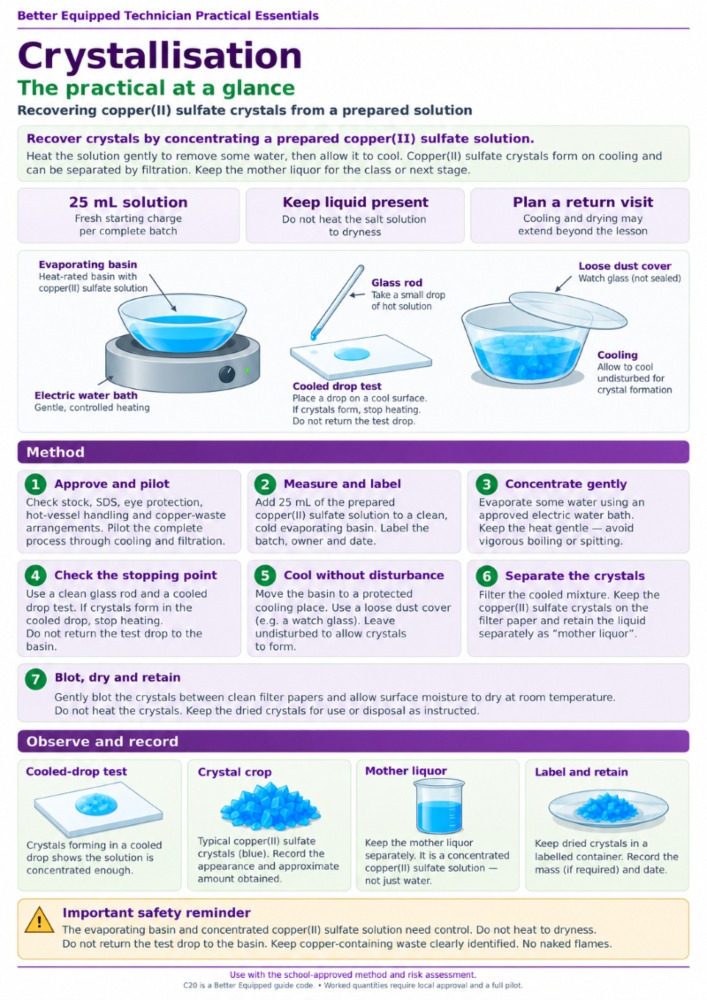
A quick-reference, six-page guide for technicians preparing a GCSE crystallisation practical: what to issue, when to stop concentrating, how to organise cooling and how to recover the crystals. For more detailed curriculum practical resources, visit our Curriculum Experiments resources.
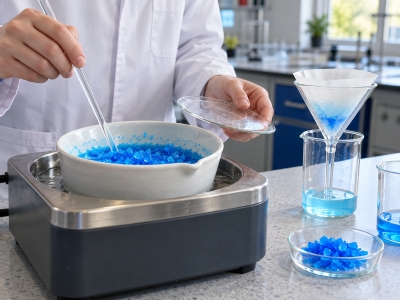
Concentrate → stop with liquid remaining → cool → filter → blot and air-dry
Reserve cooling vessels per batch · reuse heating and filtration equipment sequentially
One complete batch starts with 25 mL fresh stock and ends with a separately labelled crystal crop. Each batch gets its own basin, loose cover and sample container so cooling crops do not block the next batch. Heating/handling and filtration equipment is reused sequentially. Extra sets include the same batch allocation.
Round solution supply up to whole mL per set before multiplying. Budget one filtration paper and two blotting sheets per batch; round spares up separately for each type across the class. The calculator does not choose concentration, predict crystal yield, schedule bath positions or estimate cooling time. Working bottle fills, further pilot work, bath/cleaning water and additional drying sheets may be needed. Settings and ticks are not saved.
Planning issue: 10 working stations + 1 extra = 11 sets; 2 complete batches per set = 22 batches. At 25% solution allowance, provide 63 mL stock per set: 693 mL for the class. Reserve 22 basins, 22 loose covers and 22 sample containers, one of each per batch. Reuse 11 heating and filtering stations sequentially. At 10% paper spares: 25 filtration papers (22 + 3) and 49 blotting sheets (44 + 5). Cooling time, bath capacity and extra pilot work are not calculated.
| Item / issue specification | Per equipped set | Class provision (11 sets) |
|---|---|---|
| 2 | 22 | |
| 2 | 22 | |
| 1 booked position | 11 positions | |
| 1 handling kit | 11 kits | |
| 1 of each | 11 of each | |
| 1 filtration kit | 11 kits | |
| 2 papers + class spares |
25 papers (22 + 3 spare) |
|
| 4 sheets + class spares |
49 sheets (44 + 5 spare) |
|
| 2 | 22 | |
| 1 issue kit | 11 kits | |
| 63 mL | 693 mL | |
| Per person | Count people separately |
Book labelled cooling/storage places for every batch, plus a supervised heating schedule. A shared water bath must have enough compatible positions and a safe load.
Add stock preparation, pilot portions, spill/first-aid provision, copper-bearing liquid and solid waste, and extra blotting sheets where needed. Do not use the allowance as an extra dose.
Verify stock → check bath and basin → pilot the stop test → reserve cooling space
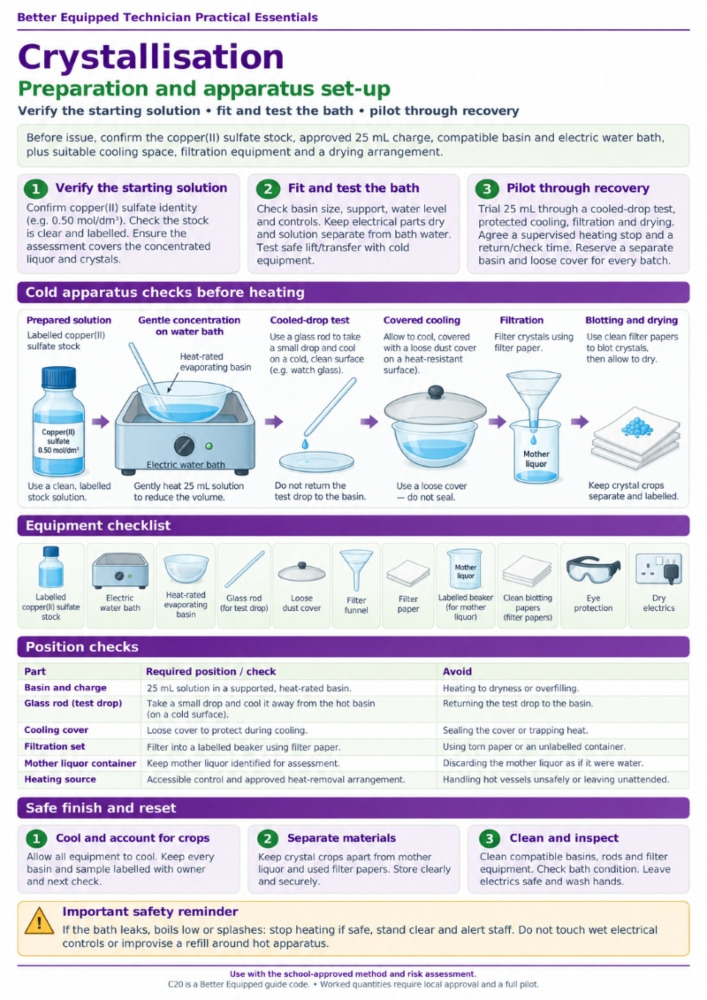
Confirm copper(II) sulfate identity, 0.50 mol/dm³ example concentration and a clear, labelled stock. The assessment must also cover concentrated liquor and crystals. Withhold unidentified, cloudy or contaminated material.
Check basin size, support, water level and controls against the actual bath instructions. Keep electrical parts dry and solution separate from bath water. Test the safe lift/transfer using cold equipment first.
Trial 25 mL through the cooled-drop test, protected cooling, filtration and drying. Agree a supervised heating stop and a return/check time. Reserve a separate basin and loose cover for every batch.
| Stage | Required check | Avoid |
|---|---|---|
| Before heating | 25 mL clear stock in a stable, compatible basin; bath and handling plan ready. | Overfilling, a floating basin or wet electrical controls. |
| Stopping test | A small test drop crystallises as it cools; liquid remains in the basin. [3] | Boiling to dryness or judging saturation from colour alone. |
| Cooling / holding | Basin labelled, loosely covered and undisturbed in a staff-controlled area. | A hot sealed vessel, unprotected windowsill or unlabelled crop. |
| Filtration | Cooled crystals retained on suitable paper; mother liquor collected and identified. | Filtering the starting solution and expecting dissolved salt to stay on the paper. |
| Drying / storage | Remove surface moisture gently; retain the hydrated crystal form. [7] | Heater-drying the crop or packaging a hot, wet sample. |
Evaporation removes some solvent; crystallisation recovers solid from solution. [1] The remaining mother liquor still contains dissolved copper salt. A crystal crop is not evidence of complete recovery or a measured purity.
The intended crop is hydrated copper(II) sulfate. Blotting removes adhering liquid; strong heating can remove water of crystallisation. [7] Do not transfer C19’s anti-bumping granules into this issue; they would contaminate the crop.
| Batch / stock | Stop-test result | Cooling / check time | Crystals / mother liquor / issue |
|---|---|---|---|
| ________ | ________ | ________ | |
| ________ | ________ | ________ |
Check concentration, cooling and handling · preserve the crystal crop · identify all copper residues
| Problem | What to check | Technician action |
|---|---|---|
| No crystals at the planned check | Too little concentration, insufficient cooling/time, a changed stock or a different basin. | Record “no crystals yet”. Keep the batch identified; staff review the pilot. Do not keep heating towards dryness or add unapproved seed material. |
| A crust forms during heating | Excess evaporation, a dry edge, uneven heating or failure to use the agreed stop test. | Stop heat input if safe and alert staff. Do not scrape a hot dry crust or add water to a hot basin. Review only after safe cooling. |
| Many tiny crystals / uneven crop | Cooling history, disturbance, concentration and surface contamination. | Record the actual appearance. For a repeat, restore the approved cooling and handling routine; do not report all small crystals as a failed reaction. |
| Crystals disappear during handling | Liquid added during transfer or an unplanned warm-water wash. | Do not add more wash water. Retain the labelled liquid and alert staff; any recovery is a separate supervised step, not an unrecorded repeat. |
| Crystals remain wet or stick to paper | Insufficient draining, too much mother liquor or saturated blotting sheets. | Allow drainage, use suitable clean tools and replace blotting sheets as needed. Air-dry as approved; do not use a flame, hotplate or oven to hurry the crop. |
| Bath leaks, boils low or splashes | Water level, support, electrical separation and excessive heating. | Stop heating if safe, stand clear and alert staff. Do not touch wet electrical controls or improvise a refill around hot apparatus. |
Reference check: 14 October 2026. AQA separation/salt content [1] [2] [8]; RSC techniques and hydration [3] [4] [7]; HSE assessment guidance [5] and public CLEAPSS teaching information [6]. Full references and access limits are below the print area.
The stock, scale, bath arrangement, batch allocation and calculator are editorial choices, not a laboratory-validated protocol. Local technical and safety approval is required; no source organisation has endorsed this guide.
Explore buying guides, practical resources and laboratory reference information.
This Technician Practical Essentials guide brings together stock issue, controlled concentration, labelled cooling space, crystal recovery and copper-waste planning. It complements our Curriculum Experiments resources.
Source basis and adaptation: the page layout and interactive-control pattern follow C19. AQA supplies the curriculum context; RSC describes crystallisation and related separation techniques. [1] [2] [3] [4] The 25 mL of 0.50 mol/dm³ prepared copper(II) sulfate, 50–100 mL basin, electric water-bath heating, separate cooling-vessel allocation and paper budgets are this guide’s planning choices. They are not a verbatim examination-board method or a substitute for an approved school procedure.
AQA identifies crystallisation as a separation process and describes crystallising soluble salts. [1] [2] [8] C20 starts with an already prepared solution. It does not include the acid/insoluble-base reaction and therefore does not by itself complete AQA’s full soluble-salt preparation practical.
A batch includes concentration, cooling, crystal collection and surface drying. Repeatedly inspecting one basin is not a new batch. Two batches may occupy two cooling places even when they use the same heater at different times.
Use a verified copper(II) sulfate solution and record its numerical concentration, batch and preparation history. Do not issue a salt mixture or substitute copper chloride. Concentration increases during evaporation, so assess both the starting and concentrated forms as well as the crystals. [6] Stock preparation is a separate trained-staff task; check hydrate identity before calculating a solid-to-solution recipe.
Specify the compatible bath, basin support, water level, heat control and handling tools together. The basin must not float or tip, and bath water must not enter the sample. A shared heater is not permission to add more vessels than the equipment or supervision can support. No fixed bath setting is prescribed here.
The small cooled-drop check is used in the cited RSC salt-preparation method. [3] Here it is a pilot-approved operational check while liquid remains in the basin, not a requirement to evaporate an exact percentage or obtain a fixed colour. Stop earlier for low liquid, splashing or any other concern; do not wait for the basin to become dry.
Reserve a labelled, staff-controlled holding area before starting. Use loose dust covers off the heat, record the next check and protect crops from interference. Cooling/drying may extend into a later lesson. An unchanged basin needs continued identification and review, not an unattended heater.
Separate solute recovery from solvent recovery. Crystallisation recovers solid from solution; C19 instead collects condensed solvent. These are different objectives. [1] Filtration after cooling separates the crystal crop from the liquid still surrounding it. That mother liquor retains dissolved material, so collecting crystals does not prove that all the original salt has been recovered.
Surface moisture and water of crystallisation are different. The intended copper(II) sulfate crop is hydrated. Gentle blotting removes adhering liquid; heating a hydrated salt can remove water from its crystal structure. [7] This is why the example does not include oven drying, heating to constant mass or a dehydration experiment. Colour and crystal appearance alone do not establish the crop’s purity or exact hydration.
No yield calculation is built in. Crystal size, number, wet mass and the appearance of a dry edge are not measures of percentage recovery. A quantitative extension would need a defined starting amount, hydrate basis, drying criterion, mass measurements and treatment of the mother liquor and transfer losses. These are outside the present issue.
Fixed example: 10 working stations + 1 extra set, two complete batches per set, 25% solution allowance and 10% paper spares. The calculator updates Chart 2; this worked example remains fixed.
11 sets × 2 batches = 22 batches.
25 mL × 2 × 1.25 = 62.5 mL; round up to 63 mL per set.
63 × 11 = 693 mL stock.
Reserve 22 basins, 22 loose covers and 22 sample containers. Reuse 11 heating/filtration stations sequentially.
Filtration: 22 × 1 = 22 papers; 10% = 2.2, rounded up to 3 spares → 25 papers.
Blotting: 22 × 2 = 44 sheets; 10% = 4.4, rounded up to 5 spares → 49 sheets.
The two paper types are rounded independently; add more drying sheets if needed.
Why cooling vessels scale with batches: an earlier crop may still be cooling when the next batch is concentrated. Reserving a basin and cover per batch avoids having to pour hot concentrated solution into improvised containers or discard one crop to free equipment. Once every crop is recovered, the basins can be cleaned and reused for a later class.
Supply is not a process setting. The allowance covers issue and handling, not extra solution added to a basin. It does not choose the evaporation endpoint or guarantee a usable crystal mass. Each extra set includes the selected batch allowance. Additional pilot work, working bottle fills, bath/cleaning water, reserve glassware, electrical loading, staffing and cooling/storage capacity must be planned separately.
Assess splashes, hot water, steam, basin stability, transfer and electrical isolation alongside the substance hazards. HSE’s guidance calls for identifying exposure routes and planning controls, storage and disposal. [5] The public CLEAPSS sheet is teaching material, not the member-only safety-management guidance needed to approve this practical. [6] Trained staff must check current authorised guidance and the actual product SDS.
Keep crystal crops, copper-bearing mother liquor, contaminated papers and first rinsings identified. The example does not authorise drain disposal, take-home crystal kits, bulk neutralisation or reuse of mother liquor as fresh stock. Any crystal washing, seeding, slow-growth comparison, different salt or solvent requires a revised method and supply plan. Recovered samples remain laboratory chemicals, not decorations or food.
Checked 14 October 2026. The source principles are distinguished from the guide’s worked preparation choices above.
The AQA and HSE pages, the public CLEAPSS Student Safety Sheet and publicly indexed RSC passages were consulted. Direct RSC page access was restricted during preparation; no linked video, member-only method, product-specific SDS or instructions for the school’s actual bath were reviewed. Before classroom issue, approve and pilot the complete activity against those local sources. No source organisation has approved this guide.
Have feedback or a useful technician tip? Please contact us.
Draft prepared: 14 October 2026 · Version: 1.0 · Technical review: pending confirmation before publication.
Build the issue around compatible basins and bath supports, secure cooling space and a complete filtration and drying station. Confirm the locally approved concentration, product SDS and equipment specifications before ordering. This is not a pre-approved kit.
Links open in a new tab or window. These catalogue searches do not guarantee a matching item, stock concentration or current availability. Check bath/basin compatibility, paper sizes, hydrate identity and chemical specifications. Stock preparation is a separate staff procedure.



 Call us:
 Email us: