We use cookies to give you the best experience possible. By continuing to use the site, you indicate that you accept cookies. See our cookies policy here.
Better Equipped Technician Practical Essentials
A quick-reference, six-page guide for technicians preparing a GCSE water investigation: what to issue, how to compare water samples, how to set up distillation, what to record and how to clear down. For more detailed curriculum practical resources, visit our Curriculum Experiments resources.
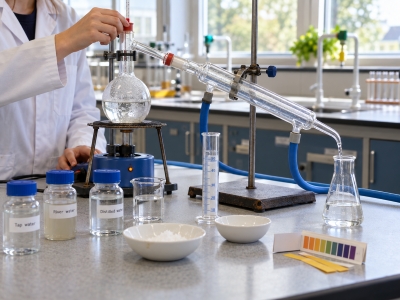
Three starting samples · separate pH portions · dry residues · compare C with collected D
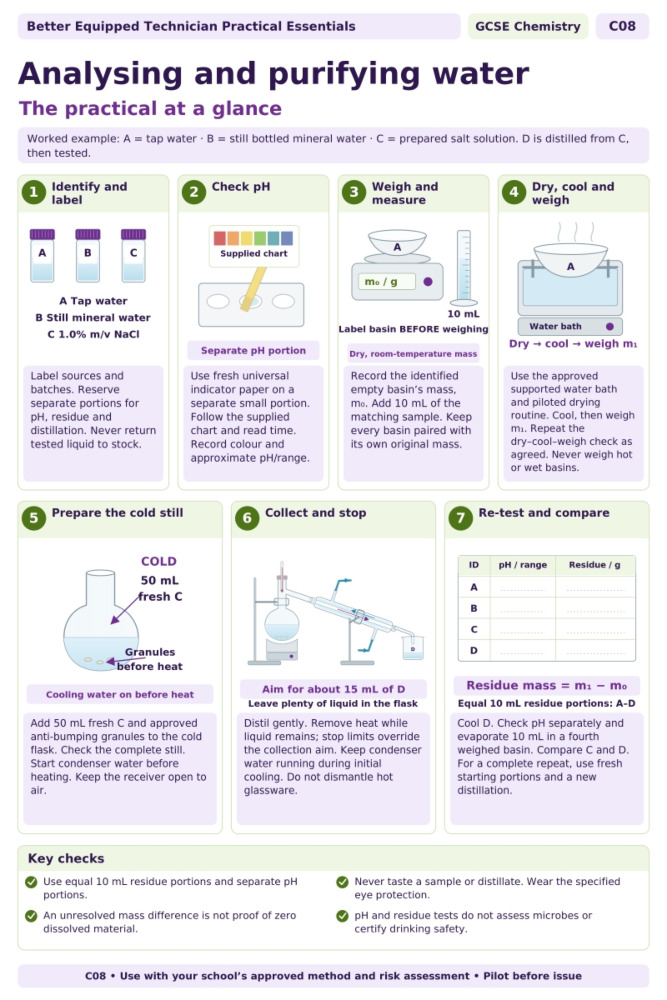
Analysis sets and shared stills are counted separately · fresh water portions for every complete round
One complete round means pH and 10 mL residue checks on A, B, C and the distillate D, with one new 50 mL distillation of C. Budget 15 mL EACH of A and B per round; C needs 65 mL (15 mL for analysis + 50 mL still feed). The 15 mL analysis allowance covers the 10 mL residue portion and separate pH sampling/transfer, not a 15 mL evaporation dose. Liquids round up to 10 mL per sample per analysis set after the allowance. Paper rounds up once for the class.
Extra analysis sets include a full run allowance. Shared distillation stations are a separate class-level equipment count and are reused in sequence; changing their number does not change sample demand. The batch count is a minimum, not a lesson-time estimate. D is produced, not pre-issued. Add blanks, bath/cooling/rinse water, staff time and any extra pilot runs separately. This is a supply calculator, not a validated method or heating-capacity assessment. Settings and ticks are not saved.
Interactive calculator not active. Fixed example: 10 analysis stations + 1 extra set, one complete round per set, 2 shared stills and 20% allowance. Prepare 44 basins, 53 pH strips, 220 mL EACH of A and B, and 880 mL of C. Eleven distillations need at least six sequential batches. Adjust locally when scripting is unavailable.
Planning issue: 10 analysis stations + 1 extra = 11 sets. One complete round per set gives 11 distillations and 44 residue/pH comparisons. Issue 20 mL EACH of A and B and 80 mL of C per set: 220 mL EACH of A and B, plus 880 mL of C for the class. Prepare 44 basins and 53 pH strips. The 2 shared distillation stations need at least 6 sequential batches, including cooling and reset. D is collected during the practical, not supplied as stock.
| Item / issue specification | Issue basis | Class provision |
|---|---|---|
| 4 of each / analysis set | 44 of each | |
| 4 / analysis set | 44 | |
| 4 strips / round | 53 strips; 11 charts | |
| 1 of each / analysis set | 11 of each | |
| 20 mL / analysis set | 220 mL | |
| 20 mL / analysis set | 220 mL | |
| 80 mL / analysis set | 880 mL | |
| 1 matched kit / still | 2 kits | |
| 1 assembly / still | 2 assemblies | |
| 2 support positions / still | 4 positions | |
| 1 of each / still | 2 of each | |
| Per person | Count people separately |
Balances: suitable capacity and resolution, piloted for the residue. Book supported evaporation water baths, heaters, heat-resistant surfaces, drying/cooling space and service capacity; these are not multiplied automatically.
Deionised-water blank; rinse water and wash bottles; labels and records; sink supply/drainage for the condenser, spare granules, spill/first-aid provision and waste route. Keep water away from electrical connections.
Check samples → pilot drying and collection → trace both flow paths → release the stations
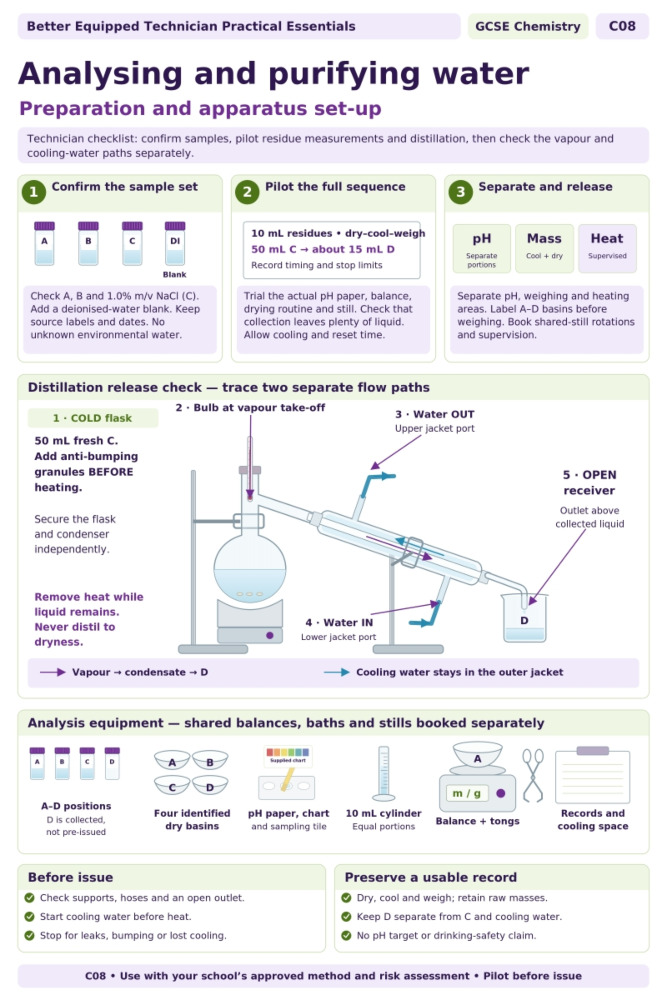
Use known, school-approved A, B and C stocks. Keep identities and dates. Trial C at 1.0% mass/volume; add a deionised-water blank. Natural or chemically unknown waters require a different assessment; do not heat them under this example.
Check pH-paper readability, 10 mL residues, balance suitability and dry–cool–weigh timing. Trial 50 mL C through the actual still; confirm about 15 mL collection with plenty left in the flask. Record all stop limits and allow cooling between runs.
Keep pH work, weighing, hot evaporation and distillation in identified areas. Mark A–D basins before initial masses. Book a rotation so pupils can participate safely; two shared stills do not automatically fit eleven runs into one lesson.
| Part | Required arrangement |
|---|---|
| Cold flask and boiling aid | 50 mL C in the checked flask; add approved anti-bumping granules before heating. Never add granules to hot liquid. |
| Thermometer and supports | Bulb in the vapour path at the take-off, not dipped in the boiling liquid. Secure flask and condenser without stressing the glass. |
| Cooling water | Secure hoses; water enters the lower jacket port and leaves the upper port. Start a gentle flow before heating. [4] |
| Condenser and receiver | Condenser slopes towards the receiver. The vapour/condensate route is unobstructed and open to air; outlet above collected liquid. |
| Stop and cooling | Collect only the piloted quantity. Remove heat while liquid remains; keep initial cooling in place. Stop for leaks, bumping, lost cooling or an obstructed outlet. |
Use equal 10 mL portions in individually identified basins. Dry and cool consistently; record actual masses and balance resolution. Small tap/bottled-water residues may be too small to quantify. A negative difference signals a measurement problem, not negative solids.
Keep D separate from cooling water and original C. Cool before testing. Use a fresh strip and record what it shows, not a forced pH 7. pH is not a sensitive stand-alone purity check for low-ion water. [7]
| Sample / source | pH / range | Dry basin m₀ / g | Basin + dry residue m₁ / g | Residue m₁ − m₀ / g |
|---|---|---|---|---|
| A · tap | ||||
| B · bottled | ||||
| C · prepared NaCl | ||||
| D · distilled from C |
Check contamination, measurement limits and heat control · keep raw evidence · no drinking-water claims
| Problem | What to check | Technician action |
|---|---|---|
| Residue mass is tiny or negative | Balance resolution, basin identity, dryness, cooling and any lost solid. | Retain the raw masses. Compare a blank and repeat if approved. Do not turn an unresolved or negative difference into a precise zero-solids claim. |
| Heavy or inconsistent residue | Incomplete drying, contamination, unequal volumes or droplets on the basin exterior. | Recheck by the agreed dry–cool–weigh routine. Never include wet mass as dry residue or subtract a guessed correction. |
| pH readings are unexpected | Fresh paper, its chart/read time, sample mix-up or cross-contamination. | Test a separate fresh portion and a known check. Do not adjust the sample to make the colour fit an expected result. |
| Steam escapes / little distillate | Joint fit, heat input, condenser flow and receiver position. | Stop heating and alert staff. Keep clear of steam; do not force hot joints together. Staff inspect and reset only when safe. |
| Bumping, blocked outlet or cooling failure | Boiling aid, fill, heater setting, hose security and an open flow path. | Stop heat safely and alert the teacher. Do not seal a leak, add granules to hot liquid, or open a possibly pressurised joint. |
| D leaves an unexpected residue | Splash carry-over, dirty receiver, mixed labels, contaminated measuring tools or wet basin. | Use a blank and review technique. Repeat the complete separation if approved; do not claim every collected colourless liquid is pure. |
Reference check: 12 October 2026. AQA curriculum/handbook [1] [2] [3] [6]; RSC distillation resources [4] [5]; manufacturer guidance on low-ion water pH [7]. Full references and access limits are online.
The sample set, water-bath drying routine, 50 mL saline still charge, 15 mL collection aim and supply calculator are editorial adaptations requiring a local pilot and approval. This is not a validated water-quality method. No examination-board, supplier, RSC or CLEAPSS approval is claimed.
Explore buying guides, practical resources and laboratory reference information.
This Technician Practical Essentials guide brings together water-sample selection, pH checks, residue measurements, distillation preparation, equipment issue, troubleshooting and clear-down. It complements our Curriculum Experiments resources.
Source basis and adaptation: AQA supplies the curriculum scope and example residue/distillation work. [1] [2] [3] RSC supplies the water-cooled-condenser arrangement and explanations of state changes. [4] [5] C08 combines these into an original technician preparation plan. The AQA handbook uses a small conical-flask/ice-cooled-receiver arrangement; RSC’s condenser demonstration uses copper sulfate. This guide instead uses a piloted 50 mL sodium chloride feed and a Liebig condenser. It is not a reproduction or endorsement of either published recipe.
The handbook frames the activity in a drinking-water context. C08 deliberately limits the conclusion to the evidence collected: pH and residue comparisons do not establish potability. The distinction between chemically pure and potable water remains part of the curriculum. [6] No practical water, including D, is for consumption.
A and B provide different real water sources; they need not have different pH readings or readily measurable residue masses. The prepared C sample is a salt-water model, not a claim to reproduce seawater composition. The 1.0% mass/volume example means 1.0 g sodium chloride in each 100 mL of final solution; select and prepare the working stock through the school’s approved procedure. Use clean, unflavoured, non-carbonated bottled water for B. Keep records of all sources and dates.
This example does not cover biological contamination, suspended matter or volatile chemicals. Do not assume that boiling an unidentified sample makes its vapour or residue safe. Any extension to river, pond, waste or other unknown water needs its own sampling, treatment and safety plan.
Every comparison round generates its own D from C. Keep its identity linked to the still run. Reserve a clean 10 mL portion for residue testing before using the remainder for pH. If collection stops early, record the shortfall; never top it up with tap or deionised water.
Residue mass is a small difference between two larger readings. Use the same identified basin and consistent cool, dry conditions. Readability alone is not accuracy. A 0.01 g display may not resolve the residue from 10 mL of a low-mineral water; pilot before choosing a balance or assigning a numerical comparison.
Report the mass left by the stated drying method. Drying conditions, contamination and any suspended matter affect the result. C08 is not a standardised total-dissolved-solids determination, a microbiological test or a drinking-water compliance assessment.
Use a deionised-water blank through the same residue routine to check contamination and the scale of background variation. Book it separately from A–D. Do not automatically subtract its mass unless the approved analytical plan defines a suitable blank correction. Do not use a conductivity meter’s estimated TDS reading as though it were the weighed residue: that is a separately planned measurement.
Paper gives an approximate comparison at the chosen chart resolution. A probe is an optional separately booked method: follow calibration, storage and rinsing instructions, and allow a representative sample volume for the electrode. Low-ion water can give unstable readings and absorb carbon dioxide; do not force D to read exactly 7. [7]
The thermometer should sample vapour at the take-off. A boiling-temperature observation is supporting evidence, not a complete purity or safety certificate; pressure and instrument performance matter. This guide does not require a second heating test of the small D sample. Retain the actual reading and thermometer position.
Suppose a dry basin is 42.36 g and the same cooled basin plus dry residue is 42.46 g. Residue mass = 42.46 − 42.36 = 0.10 g. For a 10 mL portion, volume = 0.010 dm³, so apparent residue concentration = 0.10 ÷ 0.010 = 10 g/dm³. This calculation assumes a valid dry-mass difference; it does not identify the solid.
If both readings show 42.36 g, the displayed difference is 0.00 g. Report the raw values and explain that no mass change was resolved under that method. Do not claim there are no ions or microbes. If more sample or a different balance is needed, revise and re-pilot the method rather than silently changing only one comparison.
Analysis sets = working stations + extra sets. Complete rounds = sets × selected rounds per set. Each round contains four pH/residue analyses (A–D) and one 50 mL distillation of C. Four reusable basins and four labelled sample positions belong to each analysis set; a repeat does not require a new still, balance or set of clamps.
Before allowances, budget 15 mL each of A and B and 65 mL of C per round. Multiply each by rounds per set and the stock allowance; round each liquid up to 10 mL per analysis set, then multiply by sets. pH paper is four strips per complete round, with the percentage spare allowance rounded up once for the class. The same percentage is a preparation convenience, not a chemical dose. Blanks, rinsings and cooling/bath water are additional.
10 stations + 1 extra = 11 analysis sets. One round each gives 11 distillations. With 20% allowance, A and B each need 15 × 1.20 = 18 mL, rounded to 20 mL/set = 220 mL each. C needs 65 × 1.20 = 78 mL, rounded to 80 mL/set = 880 mL. Paper: 44 × 1.20 = 52.8, rounded to 53 strips.
Two stills running in parallel require at least ceil(11 ÷ 2) = six sequential batches. This excludes any time saving assumption: charging, supervised heating, collection, cooling, cleaning and handover must all be piloted. Changing the number of stills changes hardware and minimum batches, not reagent use or pupils’ observation count.
Around 15 mL of D per distillation is a collection aim to provide a 10 mL residue portion and separate pH sampling. It is not a guaranteed yield. Stop limits and sufficient liquid left in the flask take priority. Add separately any pre-run demonstration or pilot not represented by an extra analysis set.
Checked 12 October 2026. Curriculum facts are distinguished above from the editorial sample, apparatus and calculator choices.
Access and review limits: AQA specification text and relevant handbook text were accessible; direct RSC article access returned errors, so only the publicly indexed text stated above was used. Member-only CLEAPSS guidance, individual equipment instructions and the exact local sample/indicator SDS were not consulted. The school’s current guidance, risk assessment and actual apparatus instructions remain necessary. No external endorsement is implied.
Have feedback or a useful technician tip? Please contact us.
Draft prepared: October 2026 · Version: 1.0 · Technical review: pending confirmation before publication.
Build the issue around separate pH and residue-analysis positions, plus the number of shared distillation stations you can safely staff and supply. Check basin capacity, balance suitability, compatible glassware joints and condenser connections against the apparatus checklist. This is not a pre-approved kit.
Select any heating unit to the actual flask and local method. Do not assume an ordinary water bath can boil the distillation feed; the residue bath and the still heater have different jobs. Source A and B locally under the school’s approval.
Links open in a new tab or window. These are catalogue-search links, not verified individual product recommendations. Check current results, specifications, packs and availability before ordering. No fixed purchasing quantity replaces the local equipment and risk review.



 Call us:
 Email us: