We use cookies to give you the best experience possible. By continuing to use the site, you indicate that you accept cookies. See our cookies policy here.
Better Equipped Technician Practical Essentials
A quick-reference, six-page guide for technicians preparing a GCSE acid–carbonate reaction: what to issue, how to test the gas, what to check and how to clear down. For more detailed curriculum practical resources, visit our Curriculum Experiments resources.
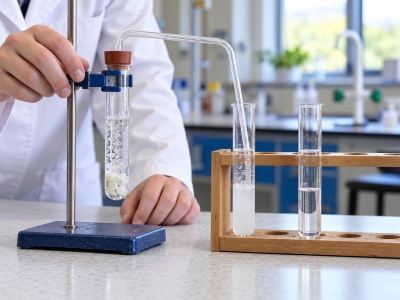
Observe the reaction · test the gas · distinguish evidence from inference
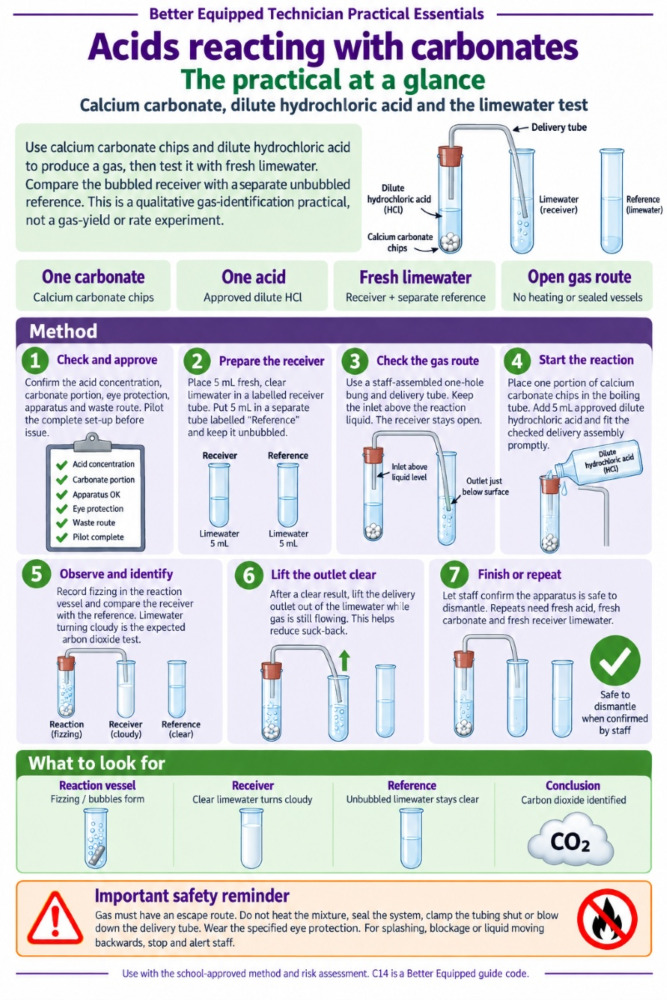
One reaction station · fresh reactants for every run · a separate limewater reference
One run uses 5 mL acid, 5 mL receiver limewater and one approved carbonate portion. Add one 5 mL unbubbled limewater reference per set, retained across sequential runs. The liquid allowance applies to each liquid separately; round up to whole mL per set, then multiply by sets. Reuse the apparatus between runs.
Spare carbonate portions are rounded up once across the class. “One portion” means the mass and chip size approved in the pilot, not one chip or one arbitrary spatula. The calculator does not determine concentration, carbonate mass, gas volume or safe limits. Add unbudgeted work separately. Settings and ticks are not saved.
Interactive calculator not active. Fixed example: 10 stations + 1 extra set, two runs per set, 25% liquid allowance and 20% spare carbonate portions. Prepare 143 mL acid, 209 mL limewater and 27 carbonate portions. Adjust locally when scripting is unavailable.
Planning issue: 10 working stations + 1 extra = 11 sets; 2 fresh reaction runs per set = 22 runs. Prepare 11 boiling tubes, 22 test tubes and 11 delivery assemblies. At 25% liquid allowance, issue 13 mL acid and 19 mL limewater per set: 143 mL acid and 209 mL limewater for the class. Prepare 22 carbonate portions + 5 spares = 27 portions. One separate 5 mL limewater reference per set is included.
| Item / issue specification | Per equipped set | Class provision |
|---|---|---|
| 1 | 11 | |
| 2 | 22 | |
| 1 assembly | 11 assemblies | |
| 1 station kit | 11 kits | |
| 2 | 22 | |
| 2 | 22 | |
| 1 kit | 11 kits | |
| 13 mL | 143 mL | |
| 19 mL | 209 mL | |
| 2 portions + class spares |
27 portions (22 + 5 spare) |
|
| Per person | Count separately |
Book a balance if portions are specified by mass, portion containers, wash bottles, spare clean tubing and the pilot record. Inspect preassembled glass connections; pupils must not force glass tubing through bungs.
Provide identified reaction-liquid, limewater and solid-residue arrangements, spill provision and handwashing. Safety limits, disposal quantities and additional pilot work are not calculated.
Confirm reagents → inspect the gas route → pilot → label and release
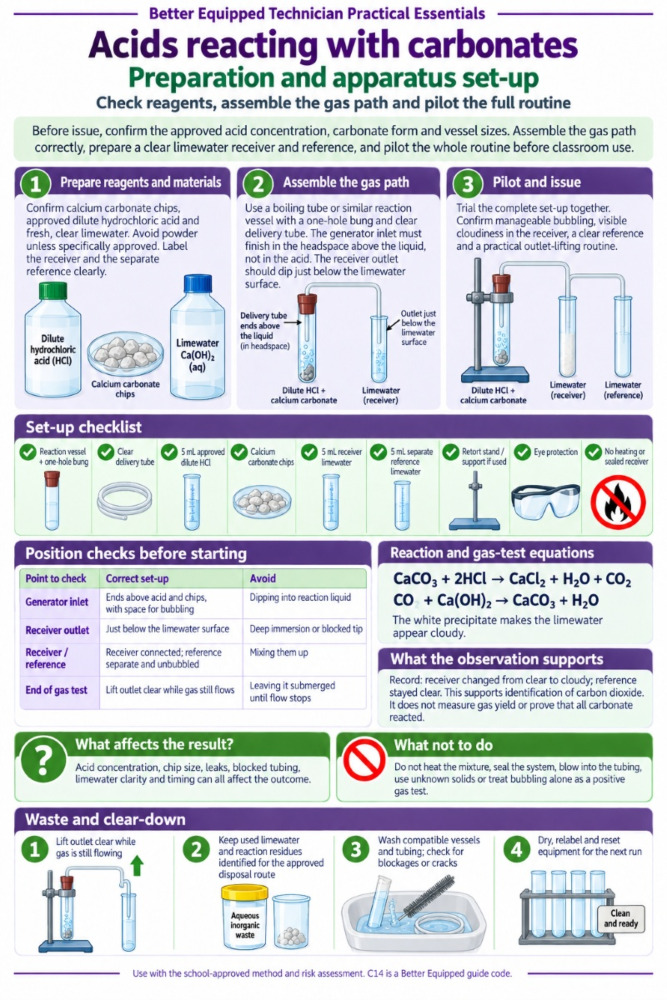
Check acid identity, concentration and SDS. Confirm calcium carbonate chip mass and size. Issue clear limewater with no suspended solids; keep stock bottles closed when not dispensing. Do not substitute milk of lime.
Check glass, bung fit and tubing before issue. The inlet must finish in the gas space, not the acid. Keep the delivery route short, unblocked and free of kinks; support each vessel independently.
Trial the stated charges and apparatus together. Confirm manageable bubbling, enough gas to show cloudiness, a clear reference and a practical outlet-lifting routine. Record the approved quantities and timing.
| Part | Correct arrangement | Avoid |
|---|---|---|
| Generator inlet | Ends above acid and chips, with space for bubbling. | An inlet dipping into reaction liquid. |
| Receiver outlet | Just below the limewater surface, clear of the glass bottom. | Deep immersion, a blocked tip or a closed receiver. |
| Tubing and supports | No kinks; vessels stable; all connections checked before reaction. | Pulling a tube over or forcing glass through a bung. |
| End of gas test | Lift the outlet clear while gas still flows; keep it open. | Leaving it submerged until flow has stopped. |
CaCO₃ + 2HCl → CaCl₂ + H₂O + CO₂CO₂ + Ca(OH)₂ → CaCO₃↓ + H₂OThe first reaction generates gas. The second forms the white precipitate seen in the receiver.
Record “receiver changed from clear to cloudy; reference stayed clear”. The gas-test result supports carbon dioxide identification. [2] It does not measure gas yield, prove all carbonate reacted or establish the final pH.
| Run / materials | Reaction vessel | Receiver / reference / inference |
|---|---|---|
| ____________ | ||
| ____________ |
Check the gas route and reagent clarity first · preserve observations · finish safely
| Problem | What to check | Technician action |
|---|---|---|
| Little or no reaction | Acid identity, concentration, carbonate identity and chip surface. | Compare the pilot and labels. Use approved replacements; do not add stronger acid, powder or heat to force a result. |
| Gas forms, but no receiver bubbles | Leaks, a kink, blocked tip, outlet above the limewater, or gas escaping before connection. | Stop and alert staff if blockage is suspected. Do not squeeze tubing or blow into it. Check a clean replacement assembly before a fresh run. |
| Bubbles pass through, but no cloudiness | Wrong or depleted reagent, excessive receiver volume, insufficient gas or contamination. | Use verified fresh limewater and the piloted amounts. Record an inconclusive result if appropriate; bubbling alone is not a positive gas test. |
| Limewater cloudy before use | Suspended solids, air exposure or cross-contamination. | Withhold the affected supply. Replace with verified clear limewater; retain a separate unbubbled reference. |
| Foam or acid enters the delivery tube | Too much solid or acid, dust, vigorous mixing or inadequate headspace. | Stop the test and alert staff. Treat the receiver as contaminated; do not count its appearance as valid evidence. |
| Liquid moves back towards the generator | Outlet left submerged as gas flow slows or stops. | Alert staff and lift the free outlet clear if safe to do so. Do not restart or dismantle under suspected pressure; follow the local response procedure. |
Reference check: 13 October 2026. AQA acid–carbonate chemistry [1] [3] and carbon dioxide identification [2]. The apparatus arrangement, 5 mL charges, reference sample and calculator are editorial choices, not a laboratory-validated protocol. Local technical and safety approval is required. Full references are below the printable area.
Explore buying guides, practical resources and laboratory reference information.
This Technician Practical Essentials guide brings together apparatus issue, acid–carbonate reaction preparation, gas-test checks and clear-down for school science technicians. It complements our Curriculum Experiments resources.
Better Equipped’s technical team draws on experience supplying practical science equipment to schools, colleges and laboratories, including experience as school laboratory technicians. This draft is prepared for technical review before publication; it does not claim that a review or classroom trial has already taken place.
Source basis: the previous guides supply the four-chart structure, styling and interactive-control approach. The AQA sources below establish the curriculum principles. The particular calcium carbonate example, delivery arrangement, 5 mL liquid charges and quantity budgets are editorial preparation choices, not a reproduced examination-board protocol.
AQA Chemistry 4.4.2.2 covers acid–carbonate products; 4.8.2.3 covers the carbon dioxide test, and 4.8.3.3 applies it to carbonate identification in separate Chemistry. [1] [2] Trilogy includes the related acid-reaction and gas-test content. [3] This guide does not by itself fulfil the full salt-preparation or ion-identification required practical.
A single identified carbonate and one approved dilute acid keep the preparation focused on reaction evidence and gas identification. Comparing different acids, carbonate powders or gas-production rates needs a separately planned method. Do not reuse C13’s metal quantities or hydrogen-test assumptions.
The school method must specify a numerical HCl concentration and a carbonate mass/size specification. “Dilute” is not a complete concentration label, and “one portion” does not mean any chip will do. Pilot these variables with the chosen vessel and delivery tube before preparing the class supply.
Use clear calcium hydroxide solution, not a suspension of calcium hydroxide solids. A second, unbubbled sample makes a change in appearance easier to judge, but it is not a complete procedural blank. It does not rule out contamination carried over from the generator. Add separately budgeted control runs where the local method requires them.
A bung fitted with an unblocked delivery tube channels gas; a solid bung traps it. The receiver must remain open. Staff check construction and stability before issue, and pupils do not force glass through rubber. Practise lifting the delivery outlet clear before the gas flow stops, without pulling vessels over.
No heater, gas syringe, collecting balloon, stoppered receiver, flame test or mouth-blowing is needed. This page is not an apparatus pressure test, carbonate reactivity ranking or mass-loss experiment. A change of acid, solid, concentration or gas route needs a fresh method review.
The calculator defaults to 10 stations + 1 extra set, two fresh reaction runs per set, 25% liquid allowance and 20% spare carbonate portions. One extra set includes the same number of runs as a working set. Reusable apparatus is counted once per set. Further trials, demonstrations or replacement references must be added.
Acid: 5 mL × 2 runs = 10 mL per set. With 25% allowance: 12.5 mL, rounded up to 13 mL. For 11 sets: 143 mL.
Limewater: (5 mL × 2 runs) + one 5 mL reference = 15 mL per set. With 25% allowance: 18.75 mL, rounded up to 19 mL. For 11 sets: 209 mL.
11 sets × 2 runs = 22 carbonate portions. Twenty per cent of 22 is 4.4; round up to 5 spare portions, making 27 portions in total.
Each set uses one generator and two test tubes: 11 boiling tubes + 22 test tubes, with 11 delivery assemblies. Clean and reset these between runs.
Rounding and limits: each liquid is rounded up separately for each set before class totals are calculated. Solid spares are rounded up once across the class. The calculator counts approved portions; it cannot infer chip mass, convert portions to grams, predict gas volume or establish a safe reaction charge. Allowances are working-supply margins, not extra reactants to put into one vessel.
Checked 13 October 2026. These sources support the stated curriculum chemistry, not every practical handling choice or quantity in this guide.
The AQA pages were consulted. No member-only CLEAPSS material or specific supplier SDS was reviewed for this draft. Before classroom issue, trained staff must check current school/CLEAPSS guidance where applicable, the actual SDS and equipment instructions, and approve the local pilot and waste arrangements. No examination-board or safety-body endorsement is claimed.
Have feedback or a useful technician tip? Please contact us.
Draft prepared: 13 October 2026 · Version: 1.0 · Technical review: pending confirmation before publication.
Build the issue around compatible reaction vessels and delivery tubing, secure supports, accurate dispensing and identified chemical stocks. Check the school method, actual product specifications and required concentrations before ordering.
Links open in a new tab or window. These are catalogue searches, not verified product matches or a pre-approved kit. Confirm current availability, vessel sizes, connections and chemical specifications. Stock-solution preparation is a separate staff procedure.



 Call us:
 Email us: