We use cookies to give you the best experience possible. By continuing to use the site, you indicate that you accept cookies. See our cookies policy here.
Better Equipped Technician Practical Essentials
A quick-reference, six-page guide for technicians preparing a GCSE ecology practical: what to issue, how to plan the sampling, what to check in the field and how to clear down. For more detailed curriculum practical resources, visit our Curriculum Experiments resources.
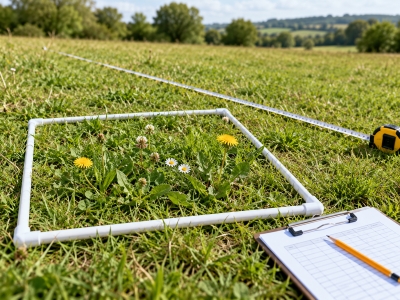
Known quadrat area · random population sample · transect distribution survey
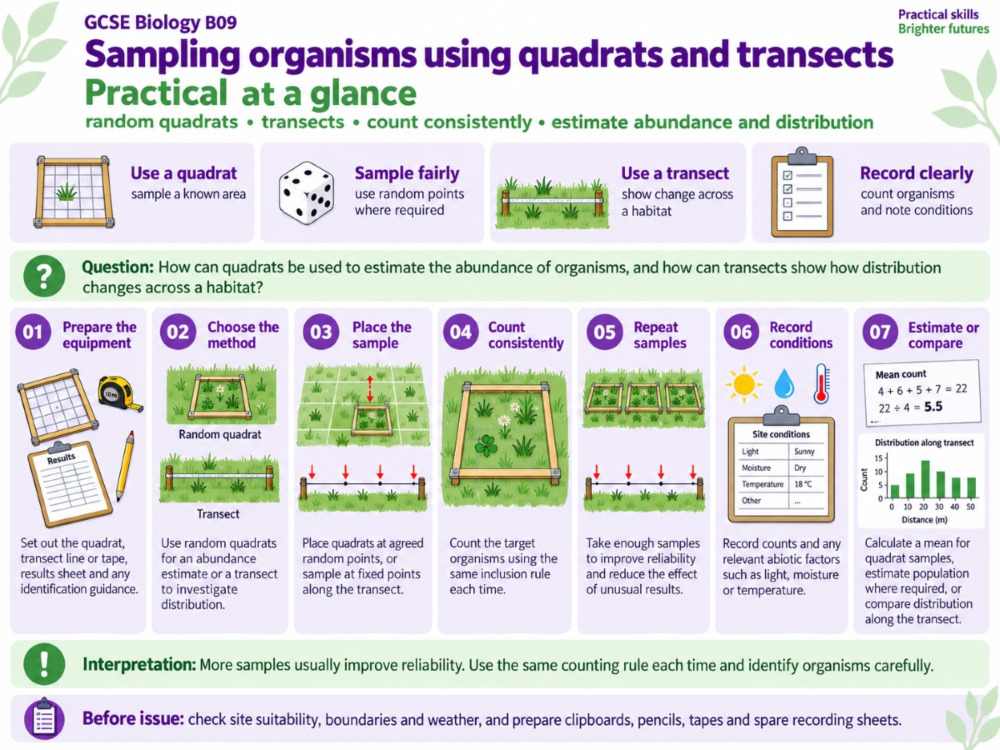
Tick-box issue checklist · plan equipment separately from the number of observations
Scale the working issue to your class. Adjust spare quadrats and planned sample records below; these defaults do not determine a sufficient sample size.
Interactive calculator not active. Static example: 10 groups; 1 quadrat, 10 random-sample records and 6 transect records per group, plus 2 spare quadrats for the class. With JavaScript enabled these quantities can be adjusted.
Planning issue for 10 groups: 10 working + 2 spare quadrats = 12 to prepare; 100 random-sample records and 60 transect records planned.
| Item / issue specification | Per group | 10 groups |
|---|---|---|
| 1 | 10 working | |
| Class reserve | 2 spare | |
| 1 | 10 | |
| Shared | 2 for one grid | |
| 1 set | 10 sets | |
| 1 | 10 | |
| 1 set | 10 sets | |
| 1 | 10 | |
| Shared / as plan | Book class capacity | |
| 1 set | 10 sets |
Confirm supervisor communications, first-aid access, suitable clothing/footwear, drinking water, handwashing and any assessment-selected PPE. Make agreed accessibility adjustments before the class goes out.
The same quadrat is reused at many locations. Ensure the grid contains enough eligible cells, repeat transects have space, and the sensor rota and recording load fit the available lesson time.
Check the site → allocate locations → agree counting → test the recording system
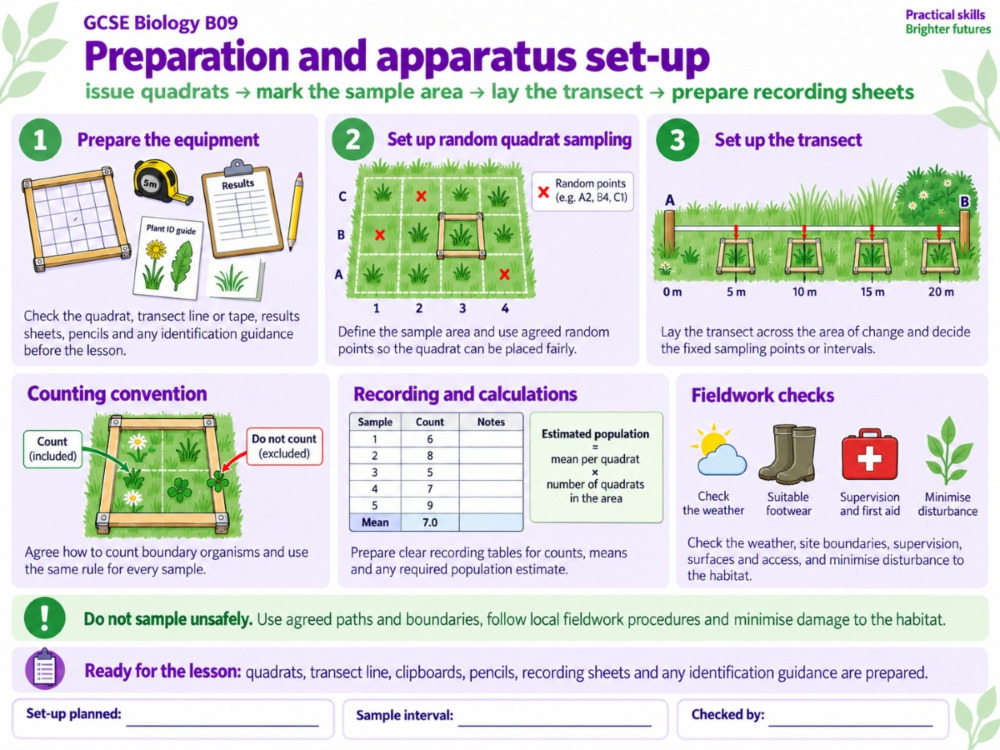
Choose a common plant with recognisable counting units. Check access, hazards, current vegetation and the proposed light gradient. Confirm boundaries and a weather fallback before issue.
Prepare one class location list, sample IDs and separately identified transect routes. Pilot the record count and interval; do not let groups choose the most convenient or plant-rich patches.
Verify quadrat sampling area, tape marks, meter units and batteries. Trial species identification, a boundary count and the results sheet. Make sure the full frame fits at every planned station.
Divide a measured rectangular study area into equal, non-overlapping cells matching the quadrat area. Select cell IDs randomly without replacement before observing the plants. Use two marked axes to locate them. Remove pre-agreed exclusions from both the sampling list and the study area. [3] [4]
Lay the tape across the gradient and use pre-agreed, regularly spaced stations: an interrupted belt transect. Keep the same quadrat reference corner and side of the tape. Give repeat lines distinct IDs. Recounting one station checks technique; it is not an independent site. [6]
For a rosette-forming target, count each agreed rooted rosette, not each flower head. Example edge rule: include centres on the top/left edges and exclude those on the bottom/right, with a consistent corner rule. Do not uproot plants to check identity.
For the worked light comparison, use the same sensor height and orientation at each station, record the actual displayed units and note time/cloud changes. Distance is a location, not a light measurement. Keep other site observations as possible explanations, not assumed constants. [8]
Illustrative example: internal frame dimensions 0.50 m × 0.50 m give 0.25 m². A total of 40 plants in 10 valid random samples gives 40 ÷ (10 × 0.25) = 16 plants/m². For a 200 m² study area, the estimate is 3,200 plants. This assumes a representative sample; it is not a census or a minimum sample-size recommendation.
Keep the raw data · investigate sampling issues · leave the site as found
| Problem | What to check | Technician action |
|---|---|---|
| Few or no target plants | Identification, season, recent mowing and the suitability of the chosen species. | Retain genuine zeros. Never move a selected frame to find plants. If the planned species is unsuitable, the teacher should revise and document the survey. |
| Very different counts | Natural clumping, quadrat area, edge rules and whether placements followed the plan. | Keep the raw values. Use the pilot to plan more representative coverage where needed; do not discard high or low counts just to reduce variation. |
| Duplicates / wrong locations | Grid origin, cell IDs, group allocations, transect zero and station reference corner. | Check the location log. Mark protocol deviations and apply the agreed replacement rule. Do not quietly pool random and transect records. |
| Observers disagree | Species features, rooted units versus flower heads, and treatment of boundary plants. | Compare counts together on a practice quadrat, then use the agreed convention. Record any later corrections transparently. |
| Unstable light readings | Cloud movement, body shadow, sensor orientation, range, units and battery condition. | Repeat under the agreed rule and note timing/conditions. A single reading is a snapshot, not a record of long-term light exposure. |
| Weather or site becomes unsafe | Slippery ground, sharp litter, animal fouling, public access, weather and supervision. | Stop and follow the school’s alternative plan. Mark unvisited samples as missing, not zero; keep pupils away from the hazard. |
Curriculum and public fieldwork sources checked 5 October 2026. [1] AQA Biology 8461: practical 9 · [2] AQA Trilogy 8464: practical 7 · [3] SAPS: questions about quadrats · [4] FSC: sampling basics · [5] FSC: using quadrats · [6] FSC: transects · [7] HSE: school trips and outdoor learning · [8] AQA: ecology and abiotic factors.
The grid arrangement, counting rule, light example and quantity defaults are guide choices. Follow the school’s current fieldwork assessment and relevant CLEAPSS guidance. No awarding-organisation or CLEAPSS approval is claimed.
Explore buying guides, practical resources and laboratory reference information.
This Technician Practical Essentials guide supports preparation for GCSE ecology fieldwork using quadrats and transects. It covers the equipment issue, a random-sampling population estimate, a separate distribution survey, environmental readings, recording conventions, troubleshooting and return of equipment. It is a quick-reference companion to the more detailed resources available through our Curriculum Experiments resources.
Better Equipped’s technical team draws on experience supplying practical science equipment to schools, colleges, laboratories and science departments throughout the UK. The team includes former school laboratory technicians and supports schools in selecting suitable equipment for practical work.
This preparation aid does not replace your school’s approved method, fieldwork risk assessment, access arrangements or equipment instructions. Confirm the survey area, species, counting unit, sample number, repeat locations and environmental measurements before the lesson. Indoor practice or photographs can support preparation, but do not replace the direct fieldwork specified in the AQA apparatus and techniques requirements. [1] [2]
Density uses counted individuals per unit area. Percentage cover estimates how much ground a species covers. Percentage frequency is 100 × the number of sampled quadrats containing the species ÷ the number sampled. These are different measures; select and label the one the investigation needs. A grass-cover estimate alone does not supply an individual-plant population estimate. [3] [5]
The calculator is a kit and recording planner, not a test of statistical adequacy. Set sample size after considering the habitat, variability, question and available time. If pupils share one line, retain it as one transect with several stations, not several independent transects. Repeated counts of the same patch are measurement checks. [4] [6]
For the worked grid, agree safe, eligible cells before random selection and give each an equal chance of selection. Keep a class register so a cell is not accidentally surveyed twice. If excluded ground, inaccessible edges or unsurveyed habitats differ, do not simply include them in the population extrapolation. Keep the reported study area consistent with the sampling frame.
Use an accessible sampling area and share locating, identifying, measuring and recording roles while preserving meaningful practical participation. Brief groups on boundaries, recall arrangements and tapes underfoot. Check clothing, weather, known allergies, handwashing and site hazards locally. Do not taste plants, uproot them or handle animal faeces or sharp litter.
Have feedback or a useful technician tip? Please contact us.
Source-based background is identified by the numbered links. The 0.50 m frame example, equal-cell grid without replacement, boundary-counting rule, worked arithmetic and calculator defaults are guide-specific choices, not mandatory methods quoted from these sources. Check current school guidance and equipment instructions; no member-only safety document or formal approval is claimed.
Draft prepared: October 2026 · Version: 1.0 · Technical review: pending confirmation before publication.
Browse equipment for quadrat and transect fieldwork, including quadrats, measuring tapes, light meters, hand lenses and recording equipment. Use the apparatus checklist to confirm the specifications, quantities and shared equipment needed for your sampling plan.
Equipment links open in a new tab or window. Check each selected product’s suitability; these are search links, not a pre-approved kit.



 Call us:
 Email us: