We use cookies to give you the best experience possible. By continuing to use the site, you indicate that you accept cookies. See our cookies policy here.
Better Equipped Technician Practical Essentials
A quick-reference, six-page guide for technicians preparing a GCSE Biology investigation using a bubble potometer: what to issue, how to set it up, what to check and how to clear down. For more detailed curriculum practical resources, visit our Curriculum Experiments resources.
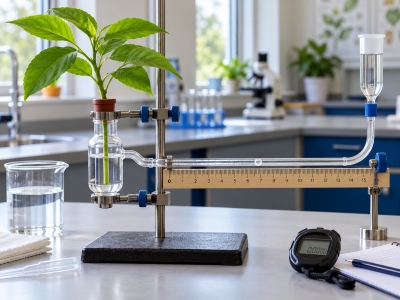
Water uptake · bubble movement · controlled conditions · repeat readings
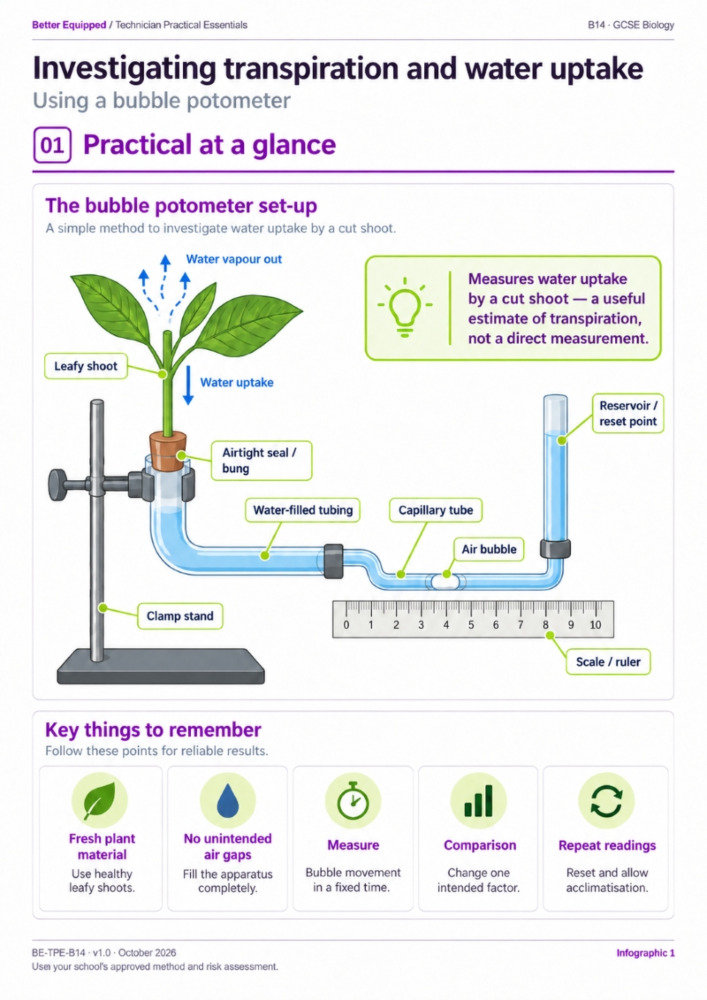
Tick-box issue checklist · per-group kit · adjustable class quantities
Example issue: one potometer set-up, one leafy shoot and one timer per working group. Counts are minimum group provision; add spares and any parallel set-ups separately.
Interactive calculator not active. Static example: 10 working groups, 10 potometer set-ups, 10 leafy shoots minimum and 10 timers. Edit quantities locally when JavaScript is unavailable.
Planning issue: 10 working groups; 10 potometer set-ups, 10 leafy shoots minimum and 10 timers. Add spare equipment and plant material separately.
| Item / issue specification | Per group | Class provision |
|---|---|---|
| 1 | 10 set-ups | |
| 1 minimum | 10 minimum | |
| As required | Plan to suit apparatus | |
| 1 | 10 | |
| 1 | 10 | |
| 1 if needed | 10 if needed | |
| As needed | Class provision | |
| As required | Check each set-up |
Approved cutting tool for shoot preparation.
Prepare spare shoots and, where possible, a spare potometer or replacement tubing/connectors for failed or leaking set-ups.
| Check | Why it matters |
|---|---|
| Capillary and reservoir/tubing are clean and unobstructed | Restrictions make bubble movement difficult to interpret. |
| Bungs, tubing and joints fit securely | Air leaks can prevent meaningful measurements. |
| Reset mechanism works smoothly | Students need repeat readings without dismantling the apparatus. |
| Shoots are fresh and stems fit the apparatus | Poorly matched or wilted material increases failure rates. |
Inspect and fill → prepare and fit → support, test and acclimatise
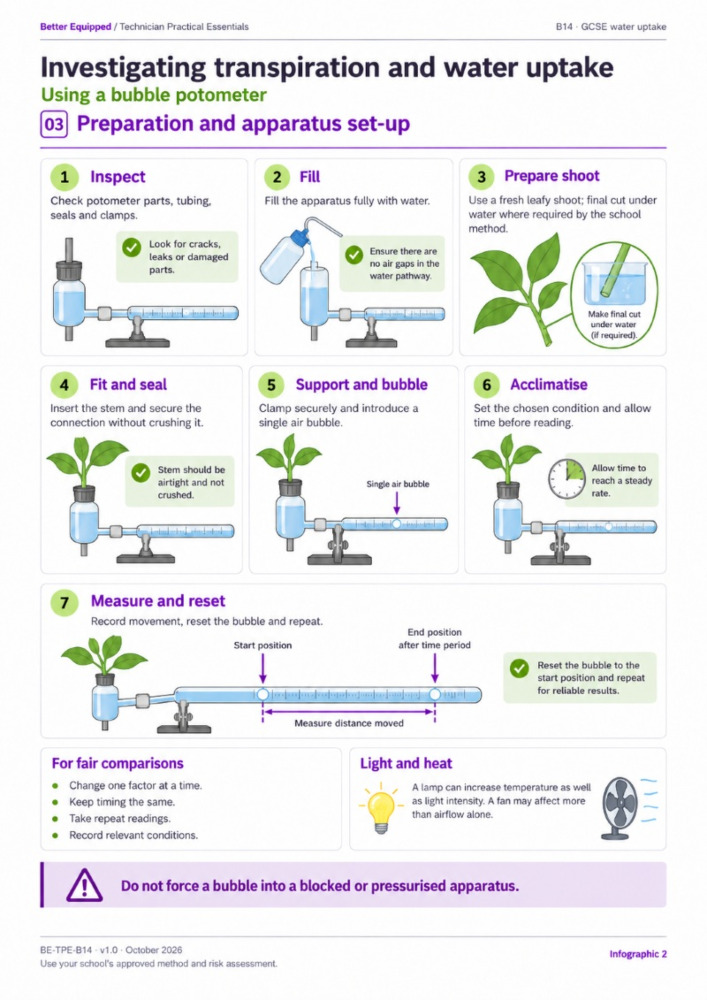
Check the potometers. Inspect components, tubing, seals and clamps. Remove damaged apparatus from use.
Fill with water. Fill the apparatus so the intended water pathway contains no unwanted air spaces.
Prepare fresh shoots. Select healthy shoots and use the approved cutting method. Make the final cut under water where this forms part of the school method.
Fit and seal. Insert the stem without crushing it and secure the connection using the method appropriate to the apparatus.
Clamp securely. Support the apparatus so the capillary can be read easily and cannot roll or fall.
Function-test. Confirm that a bubble can be introduced and reset, and that movement can be observed over a useful timescale.
Set the environment. Position fan/lamp only if required. Mark repeatable distances where useful.
Allow acclimatisation. Do not treat readings taken immediately after moving or handling the shoot as steady-state measurements.
A lamp can alter both light intensity and temperature. If light is the intended variable, the method should consider unwanted heating. Likewise, a fan may affect more than simple “wind speed”. Avoid presenting environmental factors as perfectly isolated unless the method actually controls them.
Check seals and conditions · protect fine tubing · reset for the next class
| Problem | What to check | Technician action |
|---|---|---|
| Bubble does not move | Shoot freshness, leaks, blockage, an unintended air gap and whether conditions produce measurable uptake. | Allow more acclimatisation; check the shoot is fresh; inspect the apparatus and conditions. |
| Bubble moves extremely quickly | Leaks, excessive airflow/heat and whether the bubble is in the intended capillary pathway. | Check these factors; shorten the measurement period if appropriate. |
| Bubble movement is erratic | Multiple bubbles, loose connections, movement of apparatus or rapidly changing conditions. | Check for these causes before taking further readings. |
| Bubble cannot be reset | Reservoir/reset mechanism and water level. | Check the reset mechanism and water level. Avoid dismantling a set-up mid-reading unless required. |
| Shoot wilts | Preparation, water continuity, sealing and environmental stress. | Replace with fresh material and review these factors. |
| Groups obtain very different results | Shoot size/leaf area, seals, acclimatisation, timing, conditions and measurement technique. | Compare these before assuming a biological effect. |
Explore buying guides, practical resources and laboratory reference information.
This quick-reference guide is designed to help school and college science technicians prepare and support the practical efficiently. It complements, rather than replaces, the school’s practical method, risk assessment, awarding-organisation materials, manufacturer instructions and local procedures.
Because potometer designs and teaching methods vary, check the apparatus-specific instructions before use and adapt quantities and preparation to the class method selected by the teacher.
Version: 1.1 · Layout updated: October 2026.
Better Equipped supplies practical science equipment and laboratory essentials for schools, colleges and science departments. Use the links below to browse relevant ranges and supporting resources.
Links open in a new tab or window.



 Call us:
 Email us: