We use cookies to give you the best experience possible. By continuing to use the site, you indicate that you accept cookies. See our cookies policy here.
Better Equipped Technician Practical Essentials
A quick-reference, six-page guide for technicians preparing a GCSE investigation of the body’s response to exercise: what to issue, how to organise observations, what to check and how to clear down. For more detailed curriculum practical resources, visit our Curriculum Experiments resources.
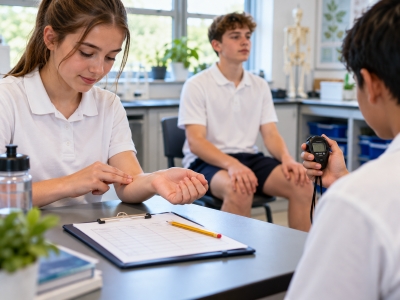
Wrist pulse · visible breathing cycles · timed observations · within-person comparison
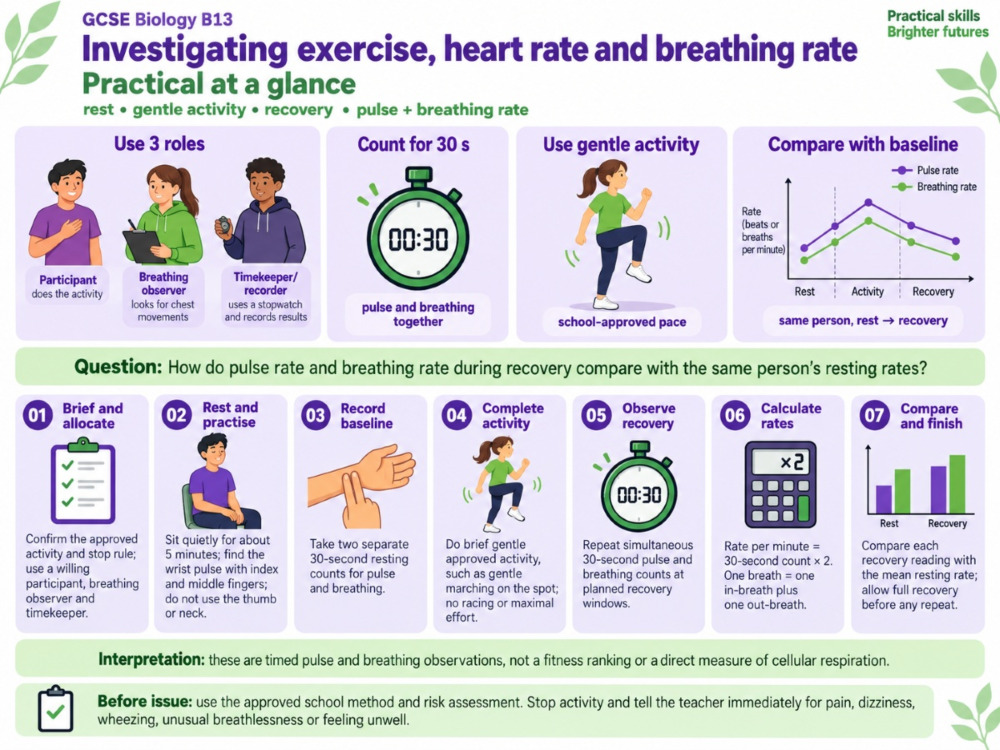
Tick-box issue checklist · three-person working groups · scale kit, not exercise intensity
Example organisation: trios with one participant at a time. Adjust the number of planned volunteer records and spares below; these are preparation quantities, not participation targets.
Interactive calculator not active. Static example: 10 groups, one planned volunteer record per group, 2 extra timers and 5 extra record sheets. Edit quantities locally when JavaScript is unavailable.
Planning issue: 10 working groups; 10 planned volunteer records; 12 timers and 15 record sheets including spares. The example schedule provides 60 paired observation windows.
| Item / issue specification | Per group | Class provision |
|---|---|---|
| 1 | 12 incl. spares | |
| 1 | 10 | |
| 3 | 30 | |
| 1 | 15 incl. spares | |
| 1 | 10 | |
| As assessed | Plan room capacity | |
| As needed | Class provision | |
| Optional | Book separately | |
| As needed | Prepare separate copies |
Provide the locally assessed first-aid arrangements, handwashing and equipment-cleaning materials. No chemical reagents, mouthpieces, breathing bags or blood-pressure apparatus are needed for this example.
It scales kit and paper only. More sheets do not require more volunteers or more exertion. Each recovery window is a time point within one participant’s record, not an independent participant or a repeat exercise trial.
Approve participation → rehearse counts → define the activity → plan observation windows

Teacher checks the activity, private health/PE arrangements, supervision and alternative roles. Pupils may decline or stop without penalty. Set a clear, non-competitive activity and a suitable measurement position; do not introduce stairs or improvised steps.
Check timers and any sensors. Practise simultaneous counts with the same start/stop cue. One visible in-and-out breathing cycle is one breath. No touch, clothing removal, forced breathing or breath-holding is needed.
Agree activity type, duration and pace before the lesson. Keep the recovery clock running from exercise end. Allow a safe transition back to the measurement position; note any delay rather than calling all first readings “immediate”.
Participant counts their own radial pulse at the wrist with two fingertips. [3] Observer counts breaths discreetly with agreement, not covertly. Stay quiet during counts. Use the same technique and posture for baseline and recovery; observation itself can affect breathing.
Rate per minute = count × 60 ÷ seconds36 pulses in 30 s = 72 beats/min.
8 breaths in 30 s = 16 breaths/min.
These are calculation examples, not target or “normal” values. One counting error in 30 s changes the calculated rate by 2 per minute.
| Stage / planned window | Actual start–end / s | Pulses counted | Pulse rate / beats min−1 | Breaths counted | Breathing rate / breaths min−1 |
|---|---|---|---|---|---|
| Rest 1 · 30 s | |||||
| Rest 2 · 30 s | |||||
| Recovery · 10–40 s | |||||
| Recovery · 60–90 s | |||||
| Recovery · 120–150 s | |||||
| Recovery · 180–210 s |
Use a separate rest clock or note baseline times before exercise. Recovery time zero = exercise end. Record participant code, actual activity/duration, posture, timing delays and observations alongside the table. Missing readings are “not measured”, never zero.
Check timing and technique · preserve personal dignity · finish safely
| Problem | What to check | Technician action |
|---|---|---|
| Wrist pulse is difficult to count | Finger position, pressure, practice time and whether an optional sensor has a stable signal. | Practise at rest with gentle pressure. Use an approved alternative or supplied data; do not press on the neck or repeat exercise to obtain a reading. |
| Breathing count is inconsistent | Counting both in and out as separate breaths, talking, laughter, poor view or conscious changes in breathing. | Agree one complete cycle per breath. Rehearse quietly with consent and without touching. Mark an unreliable window rather than inventing a count. |
| First recovery reading is unexpectedly low | Delay after exercise, different postures, brief activity, lost counts or sensor averaging/lag. | Keep actual start/end times. Do not relabel a late reading as “immediate” or increase exertion to force a rise. |
| Recovery values fluctuate or differ between people | Activity details, baseline, counting windows, individual variation, room conditions and known method issues. | Keep each person’s series separate. Average only comparable repeat windows. Do not rank fitness or remove points just to make a smooth curve. |
| Numbers or units do not make sense | Raw count versus per-minute rate; 30 s versus 60 s; pulse versus breath columns; an optional sensor already displaying rates. | Recalculate from the original count and duration. Do not double a device reading already in beats/min. A missing or failed reading is not zero. |
Sources checked 5 October 2026: AQA response-to-exercise content [1] [2]; BHF wrist-pulse technique and background [3] [5]; public CLEAPSS SSS007 teaching sheet [4]. Full references and method limitations appear in the online “About this guide” section.
The activity and timing schedule are preparation examples, not a validated exercise prescription. Use current school/employer guidance and local assessment. No awarding-organisation or CLEAPSS approval is claimed.
Explore buying guides, practical resources and laboratory reference information.
This Technician Practical Essentials guide supports preparation for a GCSE investigation of exercise, heart rate and breathing rate. It covers the class issue, participation planning, baseline and recovery observations, consistent counting, data handling, troubleshooting and clear-down. It is a quick-reference companion to the more detailed resources in our Curriculum Experiments resources.
Better Equipped’s technical team draws on experience supplying practical science equipment to schools, colleges, laboratories and science departments throughout the UK. The team includes former school laboratory technicians and supports schools in selecting suitable equipment for practical work.
This preparation aid does not replace your school’s approved method, risk assessment, individual care arrangements or equipment instructions. The three-person roles, 30-second counting windows and recovery schedule are editorial planning choices. The teacher must approve the activity, duration, pace, participation and observation arrangements for the actual class.
AQA Biology and Trilogy section 4.4.2.2 describe responses to exercise and signpost investigations into the effect of exercise on the body. [1] [2] B13 is not an AQA practical number. A short classroom comparison should not be used to diagnose a condition, prescribe exercise or rank pupils by fitness.
Offer timing, observation, analysis or supplied-data tasks without disadvantage. Handle relevant health and PE arrangements privately through the teacher and school procedures; do not collect diagnoses on results sheets. Do not ask pupils to change medication, consume stimulants or alter prescribed activity limits for this practical.
A 30-second rate is an average over that interval. Shorter windows magnify a one-count error; longer ones smooth a changing recovery response. Choose and document the method before taking readings. A late first sample cannot reconstruct the rate at exercise end.
Keep pulse and breathing results separate. For class summaries, compare the same recovery windows and changes from each person’s own baseline; identify different activities or adaptations. Multiple time points from one person are not independent people. A resting no-exercise comparison can help examine changes unrelated to the activity.
Checked 5 October 2026. These references support curriculum context, pulse technique and safety background. They do not validate the exact B13 activity or example observation schedule.
The public CLEAPSS sheet was consulted; no member-only guidance was read and no CLEAPSS approval is implied. Any optional sensor must be selected, fitted and cleaned according to its manufacturer’s instructions and school assessment.
Have feedback or a useful technician tip? Please contact us.
Draft prepared: October 2026 · Version: 1.0 · Technical review: pending confirmation before publication.
Browse timers, stopwatches, clipboards and recording supplies, plus optional pulse sensors and data-logging equipment. Use the checklist to plan a suitable class issue; manual pulse and breathing observations do not require specialist respiratory apparatus.
Equipment links open in a new tab or window. Check each selected product’s suitability; these are search links, not a pre-approved kit.



 Call us:
 Email us: