We use cookies to give you the best experience possible. By continuing to use the site, you indicate that you accept cookies. See our cookies policy here.
A practical guide to choosing, inspecting, handling, heating, cleaning and storing borosilicate laboratory glassware.
Borosilicate glassware is widely used in schools, colleges, universities and laboratories because its low thermal expansion and good chemical durability make it suitable for many routine laboratory applications. Common products include beakers, conical flasks, test tubes, boiling tubes, measuring cylinders, volumetric glassware and reagent bottles.
However, the word “borosilicate” identifies the glass material—not every permitted use of the finished product. An item’s shape, wall thickness, graduations, closures, coatings and manufacturer’s specification determine whether it is suitable for direct heating, hotplates, ovens, autoclaving, chemical storage, vacuum or pressure.
Borosilicate glass is more resistant to thermal shock than many ordinary glasses, but it remains brittle and breakable. Correct inspection, apparatus selection, heating and cooling, cleaning and storage are essential for reducing cuts, spills, contamination, breakages and avoidable replacement costs.
This guide was written and reviewed by Better Equipped's technical team, drawing on experience supplying borosilicate glassware, laboratory equipment, heating accessories, safety products and practical science resources to schools, colleges and laboratories throughout the UK.
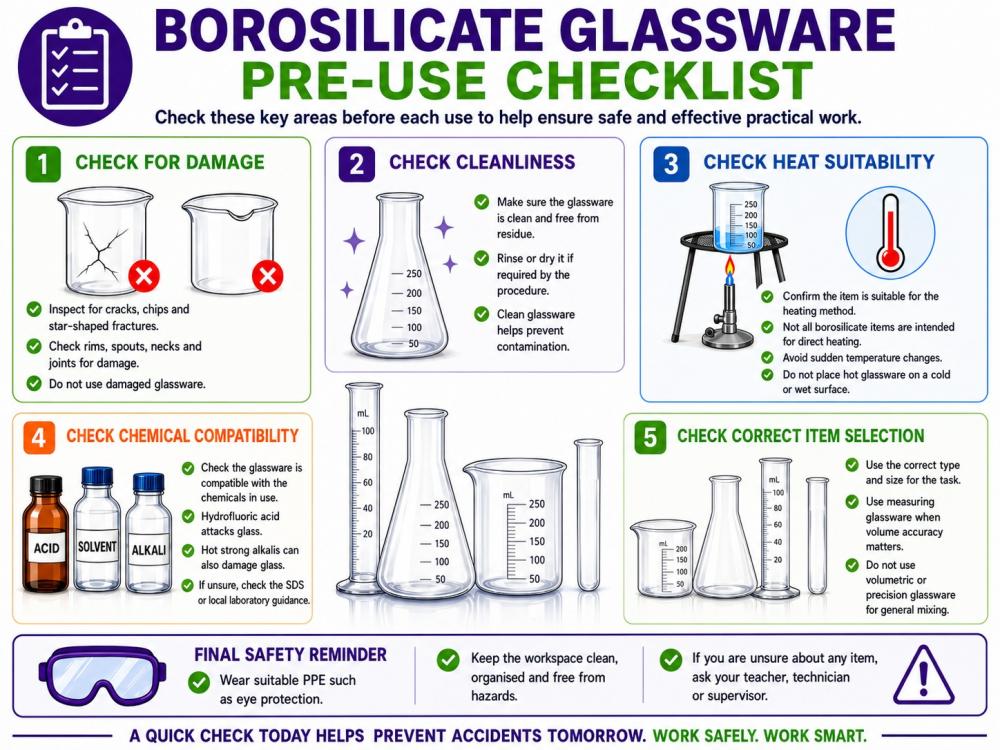
Borosilicate glass is a specialist glass made mainly from silica and boron oxide. It has a relatively low coefficient of thermal expansion, meaning that it expands and contracts less than many ordinary glasses when its temperature changes.
This low expansion gives borosilicate glass better resistance to thermal shock than many common soda-lime glasses. Its clarity and chemical durability also make it suitable for practical science, solution preparation, sample observation, storage and many controlled heating applications.
These properties do not make borosilicate glass universally heat-safe or chemically inert. The permitted use of a finished product depends on its shape, wall thickness, manufacturing quality, markings, closures, coatings and manufacturer’s instructions.

Many borosilicate products can tolerate laboratory heating when the item is approved for the method and is heated and cooled correctly.
It is less likely to crack under temperature change than many ordinary glasses, but sudden or uneven temperature changes can still cause failure.
It resists many common laboratory chemicals and solvents, but compatibility still depends on chemical identity, concentration, temperature and contact time.
Borosilicate glass is brittle. Chips, scratches, impact, poor support, uneven heating and incorrect use can all lead to breakage.
| Glassware Type | Common Uses | Key Safety or Accuracy Point |
|---|---|---|
| Beakers | Holding, mixing, transferring and, where approved, heating liquids. | Printed divisions are normally approximate. Use suitable support and do not assume every beaker is approved for every heating method. |
| Conical Flasks | Swirling, mixing, titrations, reactions and temporary sample holding. | Do not lift a large or heavily filled flask by the neck alone. Confirm suitability before heating. |
| Measuring Cylinders | Measuring routine liquid volumes more accurately than a beaker. | Usually not intended for direct heating. Read the liquid level correctly at eye level. |
| Volumetric Flasks | Preparing one accurate fixed volume of solution. | Calibrated measuring instruments. Do not directly heat and use at the specified calibration conditions. |
| Burettes and Pipettes | Delivering accurately measured volumes. | Do not directly heat. Use an approved pipette filler and never pipette by mouth. |
| Test Tubes and Boiling Tubes | Small-scale reactions, heating and observation. | Use a suitable holder, keep the tube moving during flame heating and point the opening away from yourself and everyone else. |
| Reagent Bottles | Storing compatible chemicals, solutions and prepared reagents. | Check the closure, label and chemical compatibility. Do not use as a heating or reaction vessel unless expressly specified. |
| Watch Glasses | Covering beakers, holding small samples and controlled evaporation. | Handle the edges carefully. Do not directly flame-heat unless the product and procedure expressly permit it. |
Choosing the correct glassware improves safety, measurement quality and practical reliability. No single type of borosilicate glassware is suitable for every laboratory task.

| Task | Typical Glassware Choice | Why |
|---|---|---|
| Holding or mixing a solution | Beaker or conical flask | Provides space for stirring or swirling. Any printed volume divisions are normally approximate. |
| Estimating a liquid volume | Graduated beaker or flask | Useful when only an approximate volume is required. |
| Measuring a routine liquid volume | Measuring cylinder | Normally more accurate than a beaker, but not intended for the highest-precision solution preparation. |
| Preparing one accurate fixed volume | Volumetric flask | Calibrated to contain a specified volume at the marked calibration temperature. |
| Delivering an accurate variable volume | Burette | Designed to deliver measured quantities during titrations and similar procedures. |
| Transferring an accurate fixed volume | Volumetric pipette with an approved filler | Designed to deliver a specified volume accurately. Never pipette by mouth. |
| Heating a small sample | Suitable borosilicate test tube or boiling tube | Useful for controlled small-scale heating when held and heated correctly. |
| Heating a larger liquid volume | Suitable beaker or flask approved for the heating method | Allows controlled heating when correctly supported and used within the product specification. |
| Storing a chemical or solution | Compatible reagent or storage bottle | Allows suitable labelling, sealing and storage when the bottle and closure are chemically compatible. |
Thermal shock occurs when different parts of a glass item expand or contract at different rates because of a rapid or uneven temperature change. The resulting internal stress can produce cracking, star-shaped fractures or sudden breakage.
Borosilicate glass resists thermal shock better than many ordinary glasses, but it can still fail if it is damaged, heated unevenly, cooled too quickly or used outside the permitted conditions for the finished product.

| Thermal Shock Risk | Why It Can Cause Failure | Safer Practice |
|---|---|---|
| Placing hot glassware on a cold, wet or unsuitable surface | The base may cool much faster than the rest of the vessel, creating stress. | Use a clean, dry, level and heat-resistant surface specified for laboratory use. |
| Adding substantially colder liquid to hot glassware | The inner surface may contract rapidly while the outer surface remains hot. | Allow the glassware to cool to an appropriate temperature unless a validated procedure expressly permits otherwise. |
| Heating one small area intensely | Local expansion creates stress between hot and cooler regions. | Heat gradually and as evenly as the apparatus and procedure allow. |
| Using damaged glassware during heating | Cracks, chips and deep scratches can act as stress concentrators. | Inspect before heating and remove damaged or questionable items from use. |
| Moving glassware directly from cold storage to strong heat | The rapid overall temperature change increases internal stress. | Allow the item to approach the appropriate starting temperature where practical and permitted. |
| Placing cold glassware on a fully preheated hotplate | The base can heat much faster than the walls. | Follow the product and hotplate instructions and increase heat gradually. |
Standard beakers, conical flasks, measuring cylinders and reagent bottles must not be assumed suitable for vacuum or positive-pressure work.
Glassware failure is often linked to previous damage, thermal stress, unsuitable use, chemical attack or poor storage. Understanding these causes helps reduce breakages and improve laboratory safety.
| Cause | What Can Happen | Prevention |
|---|---|---|
| Chips and Cracks | Damage weakens the glass and can spread during heating, handling, vacuum or pressure use. | Inspect before use and remove damaged items immediately. |
| Deep Scratches | Deep scratches can act as stress points and may retain contamination. | Avoid abrasive cleaning and assess or replace significantly scratched items. |
| Thermal Shock | Rapid or uneven temperature change creates internal stress and cracking. | Heat and cool gradually and avoid cold, wet or unsuitable surfaces. |
| Uneven Heating | One region expands more rapidly than the rest of the vessel. | Use suitable apparatus and avoid concentrating heat in one area. |
| Mechanical Impact | Knocks, drops and clashing items can create visible or hidden weaknesses. | Use trays, avoid overcrowding and inspect glassware after an impact. |
| Chemical Attack or Etching | Incompatible chemicals can cloud, etch or weaken the glass surface. | Check compatibility and consider chemical identity, concentration, temperature and contact time. |
| Incorrect Glassware Choice | Using measuring or storage glassware for unsuitable heating, vacuum or pressure work can cause failure. | Match the product specification to the task. |
| Poor Storage | Overcrowded shelves and unsupported items increase the risk of chips, impact and breakage. | Store by type and size, avoid unsafe stacking and keep heavy items on lower shelves. |
Correct cleaning helps prevent contamination, residue build-up, staining and hidden chemical risks. The method must match the substances used, the intended next use and the laboratory’s approved procedure.


| Check For | Why It Matters | What to Do |
|---|---|---|
| Cracks or star-shaped fractures | The item may fail suddenly, particularly during heating, vacuum, pressure or handling. | Remove from use immediately. |
| Chipped, rough or sharp rims and spouts | Can cause cuts and create a weakened region. | Remove and replace the item. |
| Deep scratches or impact marks | May act as stress points and harbour contamination. | Remove from use and assess according to the intended application. Replace where safety is uncertain. |
| Damage around side arms, hose connections or joints | These areas can be stressed during assembly, heating, vacuum or pressure use. | Remove from use and seek competent assessment. |
| Cloudiness, hazing or etching | May indicate deposits, permanent chemical attack or surface deterioration. | Remove from use until the cause is identified. Clean appropriately and replace if permanent damage affects visibility, cleanliness, accuracy or strength. |
| Faded, damaged or unclear graduations | Can affect measurement reliability. | Remove from quantitative use and replace, or have the item assessed or recalibrated where an appropriate system exists. |
| Uneven or unstable base | The item may tip or heat unevenly. | Remove from use. |
| Loose, damaged or incompatible stoppers and caps | Can cause leaks, contamination, evaporation or unsafe storage. | Replace the closure or the complete item as required. |
| Evidence of a drop or significant knock | Impact can create small or hidden weaknesses even when no large crack is visible. | Inspect carefully and remove from hazardous, heated, vacuum or pressure use if there is any doubt. |
Using the right supporting equipment helps protect glassware, improve heating control and make practical work safer.
Beakers, flasks, cylinders, test tubes and other laboratory glassware for school and laboratory use.
View GlasswareUseful for small-scale reactions, heating and classroom chemistry practical work.
View Test TubesProtect benches and provide a suitable heat-resistant surface for approved hot glassware and heating equipment.
View Heatproof MatsSupport suitable glassware above a flame and can help spread heat during approved heating procedures.
View Tripods and GauzesHelp clean inside narrow or awkward glassware without harsh scraping tools.
View BrushesEssential eye protection for practical work involving chemicals, glassware, heating or splashes.
View Goggles
| Mistake | Why It Matters | How to Avoid It |
|---|---|---|
| Using damaged glassware | Cracks, chips and deep scratches can lead to cuts or sudden failure. | Inspect before use and remove damaged items immediately. |
| Assuming all borosilicate products can be directly heated | Some products are designed for measuring or storage rather than direct heating. | Check the product specification and laboratory procedure. |
| Heating too quickly or in one small area | Rapid or localised temperature change can cause thermal stress. | Heat gradually and use the correct support and heating method. |
| Putting hot glassware on a cold, wet or unsuitable surface | One area may cool rapidly and crack. | Use a clean, dry, level and heat-resistant laboratory surface. |
| Adding cold liquid to hot glassware | The inside surface can cool and contract much faster than the outside. | Allow the item to cool unless a validated procedure and manufacturer’s instructions specifically permit otherwise. |
| Using approximate glassware for precise measurement | Beakers and conical flasks may only provide approximate volume indications. | Use a measuring cylinder, burette, volumetric pipette or volumetric flask as appropriate. |
| Using an incompatible chemical | Hydrofluoric acid, hot strong alkalis and other unsuitable conditions can attack glass. | Check the SDS, product specification, concentration, temperature and contact time. |
| Forcing glass into a bung or flexible tube | The glass may snap and cause a serious puncture or laceration. | Use correctly sized components and the approved assembly technique. |
| Poor cleaning | Residues can contaminate samples or react during later use. | Use an approved cleaning and decontamination method. |
| Unsafe storage | Overcrowded shelves increase chips, impact and breakages. | Store clean, dry, supported and separated by type and size. |
| Problem | Possible Cause | What to Do |
|---|---|---|
| Glassware cracks during heating | Thermal shock, existing damage, uneven heating, poor support or unsuitable glassware. | Stop heating if it is safe to do so, isolate the area and follow the breakage or spill procedure. Replace the item and review the heating method. |
| Cloudy or hazy appearance | Residue, mineral deposits, chemical etching or surface deterioration. | Remove from use until assessed. Clean using an approved method and replace if permanent damage affects safe or accurate use. |
| Residue will not come off | The sample has dried onto the glass or an unsuitable cleaning method has been used. | Identify the residue and use the approved cleaning or soaking solution. Do not use uncontrolled scraping or incompatible chemicals. |
| Glassware keeps chipping in storage | Overcrowded shelves, poor stacking, unsupported items or frequent contact between rims. | Reorganise the storage area and separate fragile or frequently used items. |
| Measurements seem unreliable | Approximate glassware, damaged graduations, temperature effects or incorrect reading technique. | Use suitable calibrated equipment, read the scale correctly and replace or assess worn items. |
| Ground-glass joint is stuck | Residue, overtightening, temperature change or long-term storage while assembled. | Do not force, strike or apply uncontrolled heat. Secure the apparatus, identify any chemical or pressure hazard and follow the laboratory’s approved joint-release procedure. |
| Glassware rocks on the bench | Deformed or damaged base, trapped residue or an unsuitable surface. | Remove the item from use, check the surface and replace the glassware if the base is unstable. |
| A stopper or cap leaks | Incorrect closure, damaged threads, degraded seal or chemical incompatibility. | Use a correctly specified compatible closure and replace damaged components. |

Keep people away from the area. Do not pick up fragments with bare hands. Use a brush and dustpan, forceps or another approved tool appropriate to the contamination. Place clean broken laboratory glass in the designated rigid glass or sharps container required by local procedure.
Move away from immediate danger, alert others and follow the laboratory spill procedure. Wear the PPE specified by the risk assessment and inform a teacher, technician or supervisor.
Cool the affected area under cool running water for at least 20 minutes. Remove nearby jewellery or clothing if it is not stuck. Do not use ice, creams or greasy substances. Obtain first aid and further medical advice appropriate to the severity.
Seek first aid. Apply firm pressure with a clean dressing if nothing is embedded. Do not remove embedded glass; apply pressure around it and obtain urgent medical assistance. Seek urgent help for severe bleeding, deep wounds, loss of sensation or suspected retained glass.
Turn off the heat source only if this can be done safely. Move away from the apparatus, warn others and alert a teacher, technician or supervisor. Do not approach until chemical, heat and broken-glass hazards have been assessed.
Treat glass contaminated with chemicals, biological material or radioactive substances according to the relevant hazardous-waste procedure. Do not place contaminated fragments in ordinary clean-glass waste.
Borosilicate glass is specialist glass made mainly from silica and boron oxide. Its relatively low thermal expansion makes it more resistant to thermal shock than many ordinary glasses.
No. Borosilicate glass is brittle and can break if dropped, chipped, scratched, heated incorrectly, poorly supported or exposed to rapid temperature changes.
No. Borosilicate describes the glass material, not every permitted use of the finished item. Some products are intended for measuring or storage rather than direct heating.
No. It resists many common laboratory chemicals, but hydrofluoric acid attacks glass and hot, concentrated or prolonged exposure to strong alkalis can damage the surface. Check compatibility before use.
Common causes include chips, cracks, deep scratches, impact, thermal shock, uneven heating, chemical attack, poor storage and using an unsuitable product for the task.
Heat and cool gradually, avoid highly localised heating, do not place hot glassware on cold or wet surfaces and avoid adding substantially colder liquid to hot glassware unless a validated procedure permits it.
Volumetric flasks, burettes and pipettes should not be directly heated. Excessive temperature exposure can affect calibration and measurement reliability.
Identify the previous contents, use the approved waste and cleaning procedure, avoid incompatible cleaning agents and abrasive tools, rinse appropriately and inspect before storage.
Remove glassware from use if it has cracks, star-shaped fractures, chipped or sharp rims, significant scratches, damaged joints, an unstable base or permanent surface damage that affects safe or accurate use.
Store it clean, dry, supported and grouped by type and size. Keep heavy items low, avoid overcrowding, protect rims and joints and remove damaged items immediately.
Choosing the correct laboratory glassware can improve safety, practical results and equipment lifespan. Better Equipped supplies borosilicate glassware, test tubes, boiling tubes, beakers, flasks, measuring cylinders, safety goggles and laboratory accessories for schools, colleges and laboratories throughout the UK.
This guide was written and reviewed by Better Equipped's technical team, drawing on experience supplying borosilicate glassware, heating equipment, safety products and practical science resources to schools, colleges, universities and laboratories throughout the UK.
Our aim is to help teachers, technicians, students and laboratory users choose, inspect, use, clean and store glassware safely while reducing avoidable breakages and improving practical science outcomes.
Last reviewed and updated: June 2026
More practical science resources: betterequipped.co.uk/better-resources



 Call us:
 Email us: